
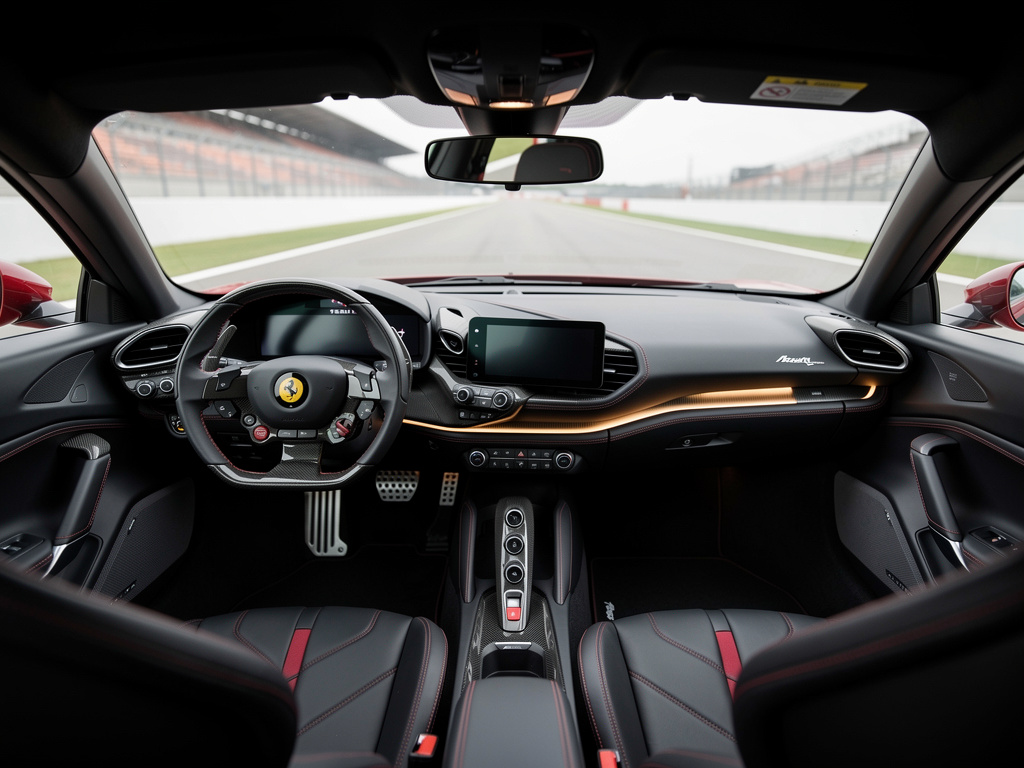
When Ferrari unveiled its first fully electric vehicle, the marque’s leadership made a decision that sent ripples through both the automotive and technology worlds: they handed the interior design reins to Jony Ive, the legendary former Apple chief design officer whose minimalist aesthetic defined a generation of consumer electronics. The result is a cabin that has sparked fierce debate among Ferrari purists, tech enthusiasts, and design critics alike — and it reveals a great deal about where luxury automaking is headed in the electric era.
The collaboration between Ferrari and Ive’s design firm, LoveFrom, represents one of the most high-profile crossovers between Silicon Valley design thinking and traditional European automotive craftsmanship. According to AppleInsider, the partnership has been in development for some time, with Ferrari CEO Benedetto Vigna cultivating a relationship with Ive that ultimately led to LoveFrom taking a significant role in shaping the interior experience of Ferrari’s electric future.
Why Ferrari Looked Beyond Its Own Walls for Design Inspiration
Ferrari’s decision to bring in an outside designer — particularly one from the consumer technology sector — is almost without precedent for the Italian automaker. For decades, Ferrari’s design language has been shaped by its in-house Centro Stile design team and legendary Italian coachbuilders like Pininfarina. The move to engage Ive signals a recognition that the transition to electric powertrains fundamentally changes what a car’s interior needs to be. Without the mechanical demands of an internal combustion engine — the gear lever, the engine-linked tachometer, the visceral connection between driver inputs and mechanical response — the cabin becomes a blank canvas that demands reimagination.
Benedetto Vigna, who joined Ferrari as CEO in 2021 after a career in the semiconductor industry at STMicroelectronics, has been the driving force behind this philosophical shift. His technology background made him uniquely receptive to the idea that Ferrari’s electric vehicles would need to deliver an entirely new kind of sensory experience. As AppleInsider reported, Vigna understood that the traditional Ferrari cockpit — a shrine to mechanical performance — would feel anachronistic in a vehicle powered by electric motors and batteries. The question was not whether to change, but how radically to do so.
The Controversial Interior: Minimalism Meets Maranello
The interior that has emerged from the Ive collaboration is unmistakably influenced by the same design principles that guided Apple’s most iconic products. Early reports and images suggest a cabin stripped of unnecessary ornamentation, with clean surfaces, carefully considered material choices, and a dramatic reduction in physical controls. This is the Apple playbook applied to automotive design: remove complexity from the user interface, hide the technology beneath elegant surfaces, and trust that fewer elements executed with extraordinary precision will create a more powerful emotional response than a dashboard cluttered with switches and gauges.
Yet this is precisely where the controversy lies. Ferrari enthusiasts have long cherished the brand’s cockpits as purpose-built environments for driving — places where every dial, every toggle, every surface communicates the car’s mechanical soul. The minimalist approach championed by Ive risks stripping away the tactile richness that makes a Ferrari feel like a Ferrari. Critics have drawn unfavorable comparisons to Tesla’s polarizing decision to consolidate nearly all vehicle controls into a central touchscreen, arguing that what works for a smartphone does not necessarily translate to a vehicle traveling at 200 miles per hour. The debate echoes a broader tension in automotive design between digital simplicity and analog engagement.
Ive’s Post-Apple Empire and the LoveFrom Vision
For Jony Ive, the Ferrari project represents one of the most visible commissions since his departure from Apple in 2019. LoveFrom, the design firm he co-founded with fellow Apple veteran Marc Newson, has deliberately pursued a small number of high-impact projects rather than building a large consultancy. The firm’s portfolio includes work with Airbnb, where Ive has advised CEO Brian Cheney on product and brand design, as well as a reported collaboration with OpenAI’s Sam Altman on a new hardware device. The Ferrari engagement fits neatly into LoveFrom’s strategy of partnering with brands that command extraordinary cultural cachet.
Ive’s design philosophy has always centered on the idea that the best design is the least design — that objects should feel inevitable rather than designed. At Apple, this manifested in the seamless aluminum unibody of the MacBook, the radical simplicity of the iPhone, and the almost jewelry-like refinement of the Apple Watch. Applied to a Ferrari interior, this philosophy translates into surfaces that flow without interruption, controls that appear only when needed, and materials selected not just for their visual appeal but for how they feel under the hand at speed. The challenge, of course, is that a car is not a phone. The stakes of interface design are literally life and death, and the sensory demands of high-performance driving require a level of haptic feedback and spatial awareness that a flat touchscreen cannot easily provide.
The Electric Transition Forces a Reckoning Across the Industry
Ferrari is far from the only legacy automaker grappling with how to redesign the cabin for the electric age. Porsche’s Taycan, BMW’s iX, and Mercedes-Benz’s EQS have all taken different approaches to reimagining the driver environment, with varying degrees of success and customer acceptance. The Mercedes-Benz Hyperscreen — a 56-inch curved display spanning the entire dashboard — represents one extreme of the digital-first approach, while Porsche has deliberately retained more physical controls in response to customer feedback about over-digitization. Ferrari’s decision to bring in Ive suggests the company believes the answer lies not in simply adding screens but in fundamentally rethinking the relationship between driver and machine.
The timing of this collaboration is also significant. Ferrari’s first electric vehicle is expected to arrive with a price tag reportedly exceeding $500,000, positioning it at the absolute summit of the EV market. At that price point, every design decision carries enormous weight. Buyers spending half a million dollars on a car expect not just performance but an experience that justifies the premium over competitors. By enlisting Ive — whose name alone carries a kind of design authority that few living practitioners can match — Ferrari is making a statement about the seriousness of its electric ambitions. It is also, perhaps, hedging against the risk that its own internal design team, steeped in decades of combustion-engine tradition, might not be able to make the conceptual leap that electrification demands.
The Deeper Strategic Logic Behind the Partnership
There is a commercial calculus at work as well. Ferrari has long been as much a luxury brand as an automaker, deriving significant revenue from merchandise, licensing, and brand partnerships. The association with Jony Ive — a figure who transcends the design world to occupy a place in popular culture — adds a layer of cultural relevance that resonates with a younger, tech-savvy clientele that Ferrari will need to cultivate as its customer base evolves. The collaboration positions Ferrari at the intersection of technology and luxury in a way that no other automaker can currently claim.
The partnership also raises questions about the future of automotive design talent. If one of the world’s most prestigious car manufacturers turns to a consumer electronics designer for its most important new vehicle, what does that say about the skills and perspectives that the industry values? It suggests that the era of the electric vehicle has blurred the boundaries between product categories — that designing a great car interior now requires the same understanding of software, interface design, and digital experience that was once the exclusive domain of Silicon Valley. For traditional automotive designers, this is both a challenge and an opportunity: the field is expanding, but so is the competition.
What the Ive-Ferrari Alliance Signals for Design’s Future
Ultimately, the success or failure of Ive’s Ferrari interior will be judged not by design critics or technology journalists but by the drivers who sit behind the wheel. If the minimalist cabin enhances the driving experience — if it creates a sense of focus, calm, and connection that amplifies the thrill of electric performance — then it will be hailed as a masterstroke. If it feels sterile, disconnected, or frustrating at speed, it will be remembered as a cautionary tale about the limits of cross-industry design thinking.
What is already clear is that the collaboration has succeeded in one crucial respect: it has made the world pay attention. In an era when every major automaker is launching electric vehicles, Ferrari’s partnership with Jony Ive has ensured that its entry into the EV market will be discussed, debated, and scrutinized with an intensity that no marketing campaign could buy. Whether that attention ultimately translates into the kind of reverence that Ferrari’s greatest cars have always commanded remains the most fascinating open question in automotive design today.


 WebProNews is an iEntry Publication