
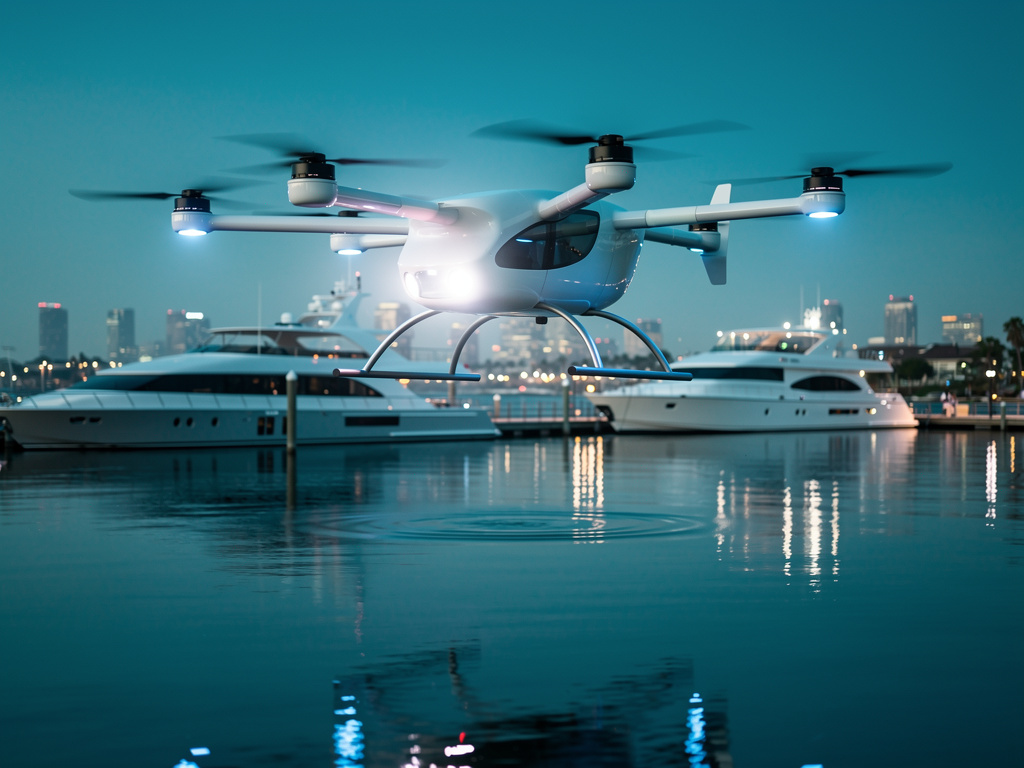
On a sun-drenched tarmac in Marina del Rey, California, Joby Aviation pulled back the curtain on something that until recently existed only in science fiction and investor pitch decks: a full-scale, piloted air taxi designed to carry paying passengers over some of America’s most congested cities. The event, held in late June 2025, wasn’t just a product demo. It was a declaration of intent — and a high-stakes bet that the age of urban air mobility has finally, tangibly arrived.
The aircraft Joby displayed is an electric vertical takeoff and landing vehicle, or eVTOL, capable of carrying a pilot and four passengers at speeds up to 200 miles per hour with a range of roughly 100 miles on a single charge. Six tilting propellers allow it to lift off like a helicopter and then transition to wing-borne flight like a conventional airplane. Quiet. Fast. Zero emissions in operation. That’s the pitch, anyway.
But Joby isn’t pitching into a vacuum. The Santa Cruz, California–based company is locked in a fierce competition with rivals including Archer Aviation, Lilium, and a handful of well-funded Chinese firms — all chasing the same prize: Federal Aviation Administration certification and the right to begin commercial passenger flights in U.S. airspace. The stakes are enormous. Morgan Stanley has projected that the global urban air mobility market could reach $1 trillion by 2040, a figure that has attracted billions in venture capital, SPAC money, and strategic investment from the likes of Toyota, Delta Air Lines, and the U.S. Department of Defense.
Joby’s Marina del Rey event, reported by Yahoo Finance, was designed to demonstrate tangible progress toward commercial readiness. The company flew its aircraft in front of invited guests, media, and local officials — a calculated move to build public confidence in a technology that still strikes many Americans as implausible. The demonstration site sits near Los Angeles International Airport, one of the initial markets Joby has targeted for service.
JoeBen Bevirt, Joby’s founder and CEO, has been working on this problem for over a decade. He founded the company in 2009, long before eVTOL became a buzzword on Wall Street. His background is in robotics and consumer products — he previously founded Joby Inc., which makes phone mounts and camera accessories. The pivot to aviation was audacious. And expensive.
Joby went public via a SPAC merger in 2021 at a valuation of roughly $6.6 billion. The stock has been volatile since, as is typical for pre-revenue companies in capital-intensive industries. As of late June 2025, Joby’s market capitalization hovers around $6 billion, reflecting both optimism about the technology and anxiety about the long road to profitability. The company reported having approximately $955 million in cash and short-term investments at the end of the first quarter of 2025, which it says is sufficient to fund operations through the certification process and initial commercial launch.
The Certification Bottleneck — and Why It Matters More Than the Aircraft Itself
The FAA’s type certification process is the single most important variable in Joby’s timeline. Without it, nothing else matters — not the aircraft’s performance, not the partnerships, not the infrastructure plans. The agency has never certified an eVTOL aircraft for commercial passenger service, and the process has proven slower and more complex than many in the industry initially anticipated.
Joby has been working with the FAA under a special certification basis since 2018, making it one of the furthest along among U.S.-based eVTOL developers. The company has completed more than 1,600 test flights, according to its public filings. In 2024, it became the first eVTOL company to receive a Part 135 air carrier certificate from the FAA, which authorizes it to operate as a commercial air taxi service once the aircraft itself is certified.
That’s a meaningful distinction. The Part 135 certificate covers the operational side — pilot training, maintenance protocols, safety management systems. The type certificate covers the aircraft. Joby needs both. It has one. The other is still in progress.
The company has said it expects to receive its type certificate and begin commercial operations in 2025, a timeline it has reiterated in recent earnings calls and public statements. But the industry has a history of slipping deadlines. Archer Aviation, Joby’s closest domestic competitor, has also targeted 2025 for initial commercial flights, though it too faces certification uncertainty. Lilium, the German eVTOL maker, filed for insolvency in late 2024 before being rescued by new investors — a cautionary tale about the capital demands of this industry.
The FAA, for its part, has been building out its regulatory framework for eVTOL aircraft in real time. The agency published updated airworthiness criteria and noise standards in recent years, and it has assigned dedicated teams to work with leading applicants. But the agency is also under political pressure. Congressional leaders have pushed for faster action, while safety advocates have urged caution. The result is a process that moves deliberately — some would say painfully slowly.
One complicating factor: the aircraft’s software. Modern eVTOL vehicles rely on fly-by-wire systems and complex flight control software to manage the transition between vertical and horizontal flight modes. Certifying that software to the highest safety standards — what the FAA calls Design Assurance Level A — is a painstaking process that involves exhaustive testing and documentation. It’s not the kind of thing you can rush.
Joby has also been working with the U.S. Department of Defense, which has provided both funding and operational experience. The company received a $131 million contract from the Air Force’s Agility Prime program, designed to accelerate the development of advanced air mobility platforms for military applications. That relationship has given Joby access to military airspace for testing and a customer that’s less price-sensitive than the average commuter.
Infrastructure, Economics, and the Question Nobody Wants to Answer
Even if Joby secures its type certificate on schedule, the question of infrastructure looms large. Air taxis need places to take off and land — called vertiports — and those facilities don’t yet exist at scale. Building them requires real estate, permitting, environmental review, and community buy-in, all of which take time and money.
Joby has been strategic about its initial market selection. Los Angeles, New York, and Dubai are among the cities where the company has announced plans or signed agreements. In Los Angeles, it has partnered with the city and with real estate developers to identify potential vertiport locations near high-traffic corridors. The Marina del Rey demonstration was partly about showing Angelenos what the aircraft looks and sounds like in person — an effort to preempt the kind of NIMBYism that could slow permitting.
The noise profile is a critical selling point. Joby claims its aircraft is 100 times quieter than a conventional helicopter during flyover, producing roughly 45 decibels at a distance of 500 meters — comparable to a normal conversation. If those numbers hold up in real-world operations, it could defuse one of the biggest sources of community opposition. Helicopters are loud and unpopular in residential areas. A quieter alternative changes the political calculus.
Then there’s the economics. Joby has said it aims to offer rides at prices competitive with ground-based ride-hailing services like Uber — roughly $3 to $5 per passenger mile in mature markets. That’s ambitious. The company’s partnership with Delta Air Lines, announced in 2022, is designed to provide an initial customer base: business travelers willing to pay a premium to skip traffic between airports and city centers. Delta invested $60 million in Joby and has committed to helping build out airport-adjacent infrastructure.
But getting to Uber-like pricing will require massive scale — hundreds or thousands of aircraft operating at high utilization rates across multiple cities. That’s years away at best. In the near term, Joby’s service will likely cater to a premium market: executives, high-net-worth individuals, and time-sensitive travelers willing to pay significantly more than a ground taxi for a 10-minute flight that would otherwise take an hour in traffic.
The manufacturing challenge is equally daunting. Joby is building a production facility in Marina del Rey and has plans for a larger factory. Scaling from prototype to serial production of a novel aircraft type is one of the hardest problems in aerospace. Boeing and Airbus, with decades of experience and tens of thousands of employees, still struggle with production ramp-ups. Joby, with a fraction of those resources, is attempting something that has never been done before in this category.
Toyota’s involvement provides some reassurance. The Japanese automaker has invested more than $890 million in Joby, making it the company’s largest outside investor. Toyota’s expertise in lean manufacturing, supply chain management, and quality control is directly applicable to aircraft production, and the two companies have been working together on manufacturing processes. Toyota engineers have been embedded at Joby’s facilities, helping design production lines that can eventually scale to high volumes.
The competitive picture is intensifying. Archer Aviation, backed by United Airlines and Stellantis, is building its own production facility in Covington, Georgia, and has also targeted 2025 for initial commercial flights. In China, companies like EHang and AutoFlight have made rapid progress, with EHang receiving a type certificate from Chinese aviation authorities in 2023 — the first for a passenger-carrying eVTOL anywhere in the world. That milestone, while not directly applicable to the U.S. market, underscored how quickly the technology is maturing globally.
Regulatory divergence is a real risk. If China or the UAE or Singapore certifies and deploys air taxis before the United States, it could create competitive pressure on the FAA to accelerate its own process — or it could lead to a fragmented global market where different countries adopt different standards. Joby has been working with international regulators, including those in the UAE and UK, to pursue concurrent certification in multiple jurisdictions.
Wall Street is watching all of this with a mix of excitement and skepticism. Joby’s stock tends to move sharply on certification milestones, partnership announcements, and demonstration events. The Marina del Rey showcase was no exception. But the fundamental question for investors remains: can Joby turn a spectacular piece of technology into a viable business before it runs out of cash?
The company’s burn rate is significant. Joby spent approximately $220 million in the first quarter of 2025 alone, according to its SEC filings. At that pace, its current cash reserves give it roughly four to five quarters of runway — enough to get through certification if the timeline holds, but thin enough to require additional capital raises if it doesn’t. Joby has an at-the-market equity offering program in place, giving it the ability to sell shares opportunistically to bolster its balance sheet.
What Happens Next
The next six to twelve months will be decisive. Joby needs to complete its FAA type certification, begin initial commercial operations, and demonstrate that its aircraft can perform reliably in real-world conditions with paying passengers. Any significant delay or safety incident could set the entire industry back years.
And yet. The technology works. The aircraft flies. The partnerships are real. The regulatory framework, while incomplete, is taking shape. After more than a decade of promises and prototypes, the air taxi industry is closer to commercial reality than it has ever been.
Whether that reality matches the trillion-dollar projections is another matter entirely. Markets have a way of getting ahead of themselves, particularly when the underlying technology is genuinely impressive. The internet was genuinely impressive in 1999, too. Some of the companies built around it became world-changers. Many more went to zero.
Joby Aviation is betting it will be in the first category. The Marina del Rey event was designed to make that bet feel less like speculation and more like inevitability. For now, the aircraft is in the air. The certificate is not yet in hand. And the clock is ticking.


 WebProNews is an iEntry Publication