
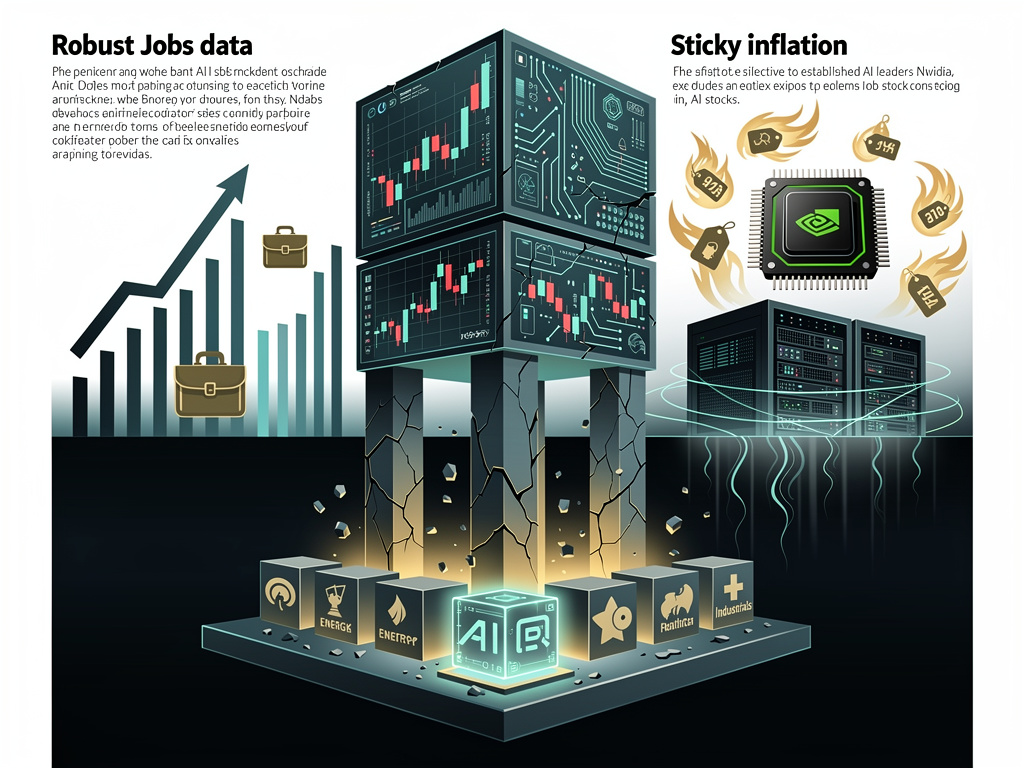
Jim Cramer sees trouble ahead. On a recent Mad Money broadcast the longtime CNBC host delivered a blunt assessment. “Things have changed. For the worse,” he said. Then came the line that grabbed attention across trading floors. “There’s a shroud over this market and you ignore it at your own peril.”
The message lands at a delicate moment. Strong jobs numbers have upended hopes for rate cuts. Inflation refuses to cooperate. And the once unstoppable momentum in artificial intelligence stocks shows cracks. Investors who built portfolios around the Magnificent Seven now face a tougher calculus. Cramer isn’t calling for an immediate crash. He is signaling that the easy assumptions of the past three years no longer hold.
The Data That Changed the Script
Start with the numbers that surprised even Cramer. May nonfarm payrolls rose by 172,000 according to the Bureau of Labor Statistics. Unemployment held steady at 4.3 percent. On the surface those figures look healthy. For stock bulls they carry an unwelcome implication. The Federal Reserve has less urgency to cut rates. Inflation for May registered 4.2 percent. That reading marks the highest level in three years and sits well above the central bank’s 2 percent target. (Yahoo Finance, June 20, 2026)
Cramer didn’t mince words on the policy outlook. “You could argue we might need a rate hike to cool the economy, not a rate cut to turn the temperature up.” CME Group’s FedWatch Tool now assigns more than 60 percent probability to a rate increase by October. The June 17 Federal Reserve meeting under new Chair Kevin Warsh left rates unchanged. The path forward looks narrower than bulls had hoped.
And. The employment strength isn’t the only headwind. Big Tech enthusiasm appears to be tiring. Apple offers the clearest recent example. After its 2026 Worldwide Developers Conference, shares fell roughly 7 percent in the following week. Promises of deeper Siri integration with Google Gemini failed to excite. The market wanted more. It received incremental updates instead.
But Cramer’s caution doesn’t mean he has abandoned technology entirely. Months earlier he reset his list of AI-related names worth owning. In November 2025 he highlighted four established players: Apple, Nvidia, Broadcom and Dell. These aren’t speculative startups chasing hype. They combine real earnings, proven products and credible leadership in the AI buildout. “Take risks with stocks tied to real products, solid earnings, and capable leadership,” Cramer advised at the time. He contrasted that approach with past flameouts at companies such as Embark Trucks, Babylon Health and Cruise. (Yahoo Finance, Nov. 6, 2025)
His stance on Nvidia in particular has remained largely consistent even through periods of weakness. He has repeatedly called the company central to the AI story. Still, the broader tone has shifted. By early June 2026 Cramer openly discussed signs of fatigue in software stocks. He pointed to the massive capital requirements ahead. Data center construction could demand $500 billion in fresh funding over a short period. If Alphabet and others issue equity to raise cash, the entire technology group could face pressure. Add in anticipated mega IPOs from SpaceX, Anthropic and OpenAI. The supply of new shares looms large. (CNBC, June 2, 2026)
“Things could get tough in tech,” Cramer said, “because there’s some $500 billion that might need to be raised in a very short period of time for the data center buildout, and if more companies sell stock like Alphabet, it’ll put pressure on the entire group.”
So. What should investors do? Cramer isn’t suggesting a wholesale exit from growth stocks. He recommends building exposure to sectors long ignored during the AI frenzy. On that same June broadcast he named several candidates trading at depressed valuations with limited Wall Street support. JPMorgan Chase caught his eye. The bank trades around 13 times forward earnings after falling from 15 times. The stock is down about 7 percent year to date. “You normally don’t get to buy this stock so cheap, and no one would regard it as a lousy franchise,” he observed.
In healthcare he pointed to Johnson & Johnson. “Buy this one slowly because, like the banks, there’s very little support for the stock here.” Consumer staples and restaurants also made the list. Kimberly-Clark with its portfolio of household brands and attractive dividend. McDonald’s and Yum! Brands, both beaten down by the love affair with tech. Kraft Heinz, where Cramer expressed confidence in the CEO’s turnaround plan and noted a nearly 7 percent yield. “These are the stocks that will start going higher if tech retreats,” he said. “You’ll wish you had some of these when the time comes and the momentum tech stocks run out of, well, momentum.”
The rotation talk isn’t theoretical. Market action in recent sessions has shown pockets of strength outside technology even as Nvidia and peers waver. Cramer has noted days where the Dow and S&P 500 lagged while certain non-AI names held firmer. He calls it the revenge of the plain vanilla companies left behind during the parabolic AI run.
His views have evolved with the evidence. Late in 2025 he declared the year of magical investing largely over. Speculative AI bets faced a reckoning. Only a few of the Magnificent Seven outperformed the S&P 500 that year. The lesson, according to Cramer, is to favor quality companies actually deploying AI rather than those solely building the infrastructure. He has praised Johnson & Johnson for using the technology in cancer treatment and Procter & Gamble for supply chain efficiencies powered by Nvidia tools.
Yet the core warning from his recent Mad Money episode carries extra weight. The pillars that supported the bull run, easy monetary policy, boundless enthusiasm for anything tagged AI, and limited competition for capital, are eroding. Strong growth ironically reduces the odds of rate relief. Tech valuations that once looked reasonable now appear stretched against a backdrop of coming equity supply. Investors concentrated in a handful of names sit exposed.
Cramer still believes in selective technology exposure. He continues to back Nvidia as one of the fastest-growing companies with one of the more reasonable valuations in the market. He has highlighted sovereign AI initiatives as a potential new growth driver that could lessen dependence on U.S. hyperscalers. But he pairs that optimism with a call for balance. A bifurcated portfolio, part index funds, part individual quality growth names, plus some insurance in the form of non-tech holdings, fits the moment.
The shroud he describes isn’t panic. It’s realism. Markets have climbed on assumptions that now require reexamination. Employment data surprised to the upside. Inflation remains sticky. Rate cuts look further away. The AI trade shows differentiation between winners with real products and those riding narrative alone. Apple’s post-conference selloff served as exhibit A.
Portfolio managers on trading desks this week echoed similar themes. Some trimmed technology weightings in favor of financials and staples. Others increased cash. Few dismissed Cramer’s remarks outright. His track record draws plenty of criticism, especially from proponents of the inverse Cramer trade. Yet his ability to crystallize shifts in sentiment keeps him relevant. When he says the ground has changed, many listen.
The coming months will test these observations. Second-quarter earnings from technology giants could reinforce or challenge the fatigue thesis. Federal Reserve moves, or lack thereof, will shape rate expectations. Capital raises and IPO activity will determine how much supply hits the market. Investors who heed the warning have time to adjust. Those who don’t. They proceed at their own peril.


 WebProNews is an iEntry Publication