
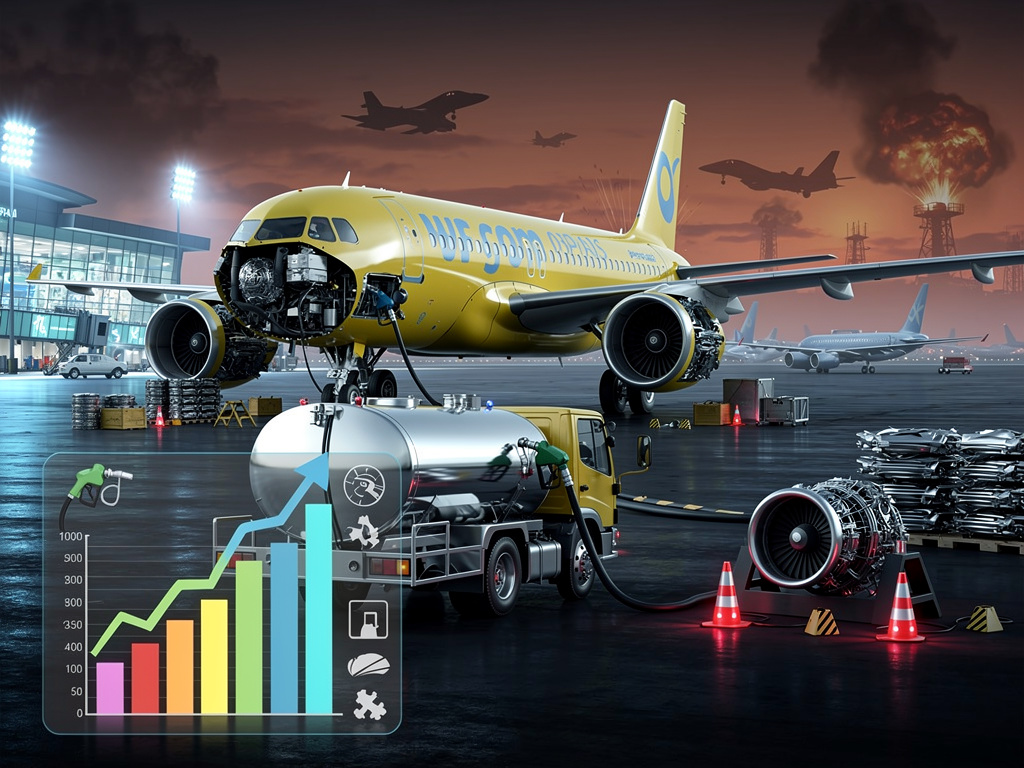
Spirit Airlines hangs by a thread. Jet fuel prices have doubled, smashing the budget carrier’s bankruptcy escape plan. Creditors circle. Liquidation looms.
The ultra-low-cost pioneer filed for Chapter 11 twice in under two years—first in November 2024, emerging in March 2025 after slashing $800 million in debt, then again in August 2025 with $7.4 billion in debt and a 214-aircraft fleet. Now, under “Project Soar,” it aims to shrink to 76-80 planes by Q3 2026, cut debt to $2 billion, and exit by early summer. But fuel costs assumed at $2.24 a gallon for 2026 now hit $4.24—and spiked to $4.88 in key hubs. That’s no hiccup. It’s a crisis.
Fuel is an airline’s second-biggest expense after labor. The surge stems from the U.S. war with Iran, disrupting supplies since late February. Spirit’s annual report warns of an “immediate and substantial negative impact.” J.P. Morgan crunches the numbers: sustained high fuel at current levels drags 2026 operating margins to negative 20% from a projected 0.5%, piling on $360 million in extra costs—more than the carrier’s $273 million unrestricted cash at year-end 2025.
Citibank, agent for revolving credit lenders, fired off a court objection. Projections ignore the “entirely new and unbudgeted strain,” they argue. Spirit’s already in default on parts of its credit agreement, owing over $35 million or more collateral. Confirm the plan? Lenders could seize engines and spare parts, sparking “almost immediate liquidation.” The U.S. Trustee piles on, questioning why not sell the airline instead.
Spirit fights back. It’s raised fares, cut capacity, and eyed premium seats like Big Front Seat expansions in strong markets: Fort Lauderdale, Orlando, Detroit, New York. Q1 2026 margins hit negative 5.6%, better than last year’s negative 27.1%. Cash projections dip to $87 million at nadir, then positive net flow from November—$97 million full-year. But creditors aren’t buying it. Talks include liquidation options, sources tell The Wall Street Journal. Bloomberg echoes: decision as soon as last week.
From Glory to Gutting: A Budget Model Unravels
Remember $49 fares? Deregulation in 1978 slashed prices 50%. Spirit thrived on no-frills: pay for seats, bags, water. But Pratt & Whitney engine recalls grounded Airbuses from 2023. Failed Frontier merger. Weak leisure demand. Elevated capacity. Then Iran.
Fleet halved already—from 214 to 125 by early 2026, now targeting one-third original size, all A320/A321ceo. Unions conceded. But rivals pounce: Frontier and JetBlue overlap 32% and 21% on Spirit routes, adding flights. Delta braces for $2 billion extra fuel; United eyes mergers. Southwest ditched free bags after 54 years.
Spirit’s email to pilots: operations normal. To reporters: “We don’t comment on market rumors and speculation,” per CNBC. Yet X buzzes with bailout pleas to Trump admin—hundreds of millions needed, meetings this week. Secretary Duffy convenes budget carriers.
Cash at end-2025: $273 million unrestricted, $591 million restricted. Must repay $150 million bankruptcy loans, keep minimums, pay $100 million exit fee, snag new financing. Monthly burn eases, but fuel volatility? Court filings bet on easing by spring. Fat chance if Iran’s blockade holds.
Liquidation’s Shadow: What Happens Next?
No shutdown this week, insiders say. But shake the trees for cash. Auction 20 planes, floor $530 million. Deutsche Bank’s Michael Linenberg notes rival capacity grabs. J.P. Morgan’s Jamie Baker: $360 million hole dwarfs reserves.
Buyers? Unlikely. Spirit’s model—high density, low yield—cracks under costs. Passengers: 9.1 million from FLL in 2025, down 18%. Orlando fears low-cost void. Industry watchers see premium shift accelerating.
And so the carrier shrinks. Or vanishes. Fuel’s fire tests if budget flying survives the blaze.


 WebProNews is an iEntry Publication