
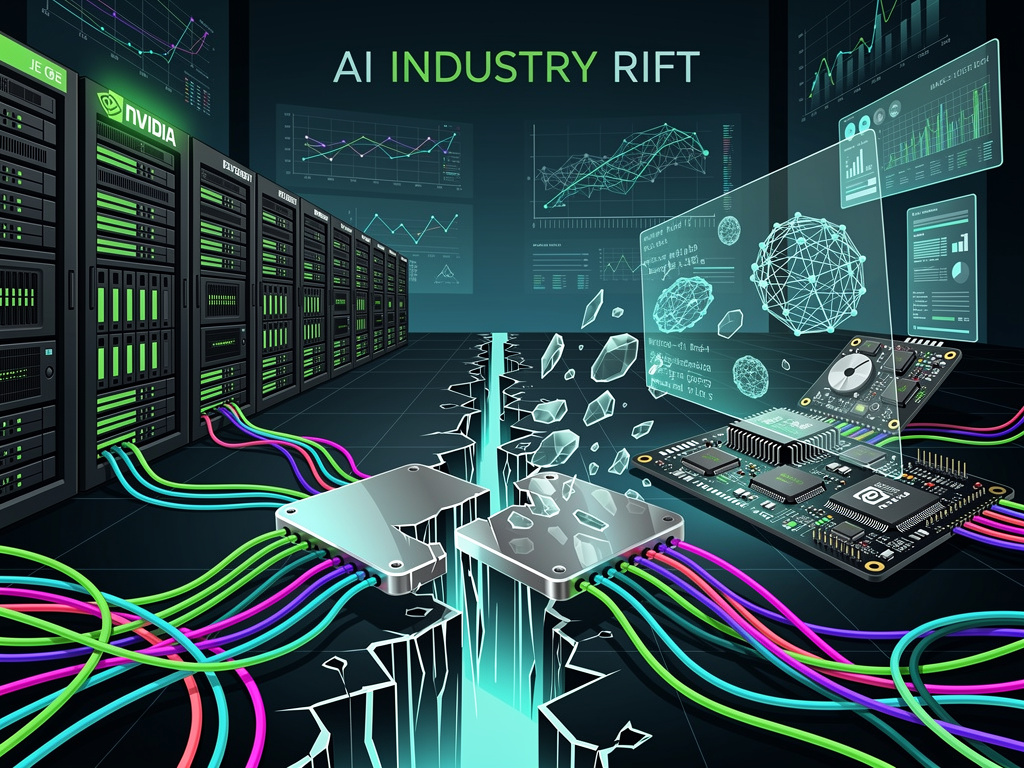
The artificial intelligence industry’s uneasy alliance between chipmakers and AI developers has reached a breaking point, as Nvidia CEO Jensen Huang’s recent expressions of dissatisfaction with OpenAI reveal fundamental tensions over market dynamics, competitive positioning, and the future direction of generative AI development. According to The Verge, Huang has voiced concerns about OpenAI’s strategic decisions and market approach, marking a rare public display of friction between two companies that have been instrumental in driving the current AI revolution.
The relationship between Nvidia and OpenAI has historically been symbiotic, with OpenAI relying heavily on Nvidia’s advanced GPU technology to train and deploy its large language models, while Nvidia benefited from OpenAI’s voracious appetite for computing power. However, this dynamic appears to be shifting as both companies navigate an increasingly complex competitive environment where former partners are becoming potential rivals, and the boundaries between hardware providers, model developers, and application builders continue to blur.
The Roots of Discord: OpenAI’s Expanding Ambitions
Huang’s discontent stems from multiple strategic moves by OpenAI that potentially threaten Nvidia’s dominant position in the AI hardware market. OpenAI has been exploring custom chip development initiatives, a move that would reduce its dependence on Nvidia’s H100 and upcoming B100 GPUs. This vertical integration strategy mirrors efforts by other major AI players, including Google, Amazon, and Meta, all of whom have invested billions in developing proprietary AI accelerators to reduce reliance on third-party hardware suppliers and control more of their technology stack.
The tension has been exacerbated by OpenAI’s recent partnerships and business model evolution. The company’s collaboration with Microsoft, which has invested over $13 billion in the AI startup, has created a complex web of relationships where Microsoft both competes with and depends on Nvidia. Furthermore, OpenAI’s transition from a research-focused nonprofit to a capped-profit entity has fundamentally altered its incentive structure, pushing it toward decisions that maximize commercial value rather than pure technological advancement or ecosystem collaboration.
Market Dynamics and Competitive Pressures
The AI chip market has become one of the most lucrative sectors in technology, with Nvidia’s data center revenue reaching $ 130.5 billion in 2025, driven primarily by AI workloads. This astronomical growth has made Nvidia the world’s most valuable semiconductor company, with a market capitalization exceeding $4.6 trillion. However, this dominance has also made the company a target for customers seeking to reduce dependence on a single supplier, creating natural incentives for vertical integration among Nvidia’s largest customers.
Industry analysts have noted that Huang’s concerns likely extend beyond just hardware competition. OpenAI’s development of increasingly efficient models, such as GPT-4 Turbo and the rumored GPT-5, could potentially reduce the computational requirements for AI inference and training, thereby limiting demand growth for Nvidia’s high-end chips. Additionally, OpenAI’s focus on model optimization and distillation techniques could democratize access to powerful AI capabilities, potentially commoditizing the infrastructure layer where Nvidia currently extracts premium margins.
The Broader Industry Context
Huang’s frustration with OpenAI must be understood within the broader context of the AI industry’s rapid evolution and consolidation. The past two years have witnessed unprecedented investment in AI infrastructure, with estimates suggesting that major technology companies will collectively spend over $200 billion on AI-related capital expenditures in 2024 and 2025. This spending boom has created both enormous opportunities and significant strategic challenges for all players in the ecosystem, as companies jockey for position in what many believe will be the defining technology platform of the next decade.
The relationship dynamics between AI model developers and hardware providers are further complicated by the emergence of open-source alternatives. Meta’s release of its Llama models, Mistral AI’s competitive offerings, and various other open-source initiatives have created competitive pressure on OpenAI’s closed-source approach. These alternatives often run efficiently on diverse hardware platforms, potentially reducing the premium that customers are willing to pay for both cutting-edge models and the specialized hardware required to run them. This democratization trend threatens to erode the market power of both OpenAI and Nvidia, albeit in different ways.
Strategic Implications for Nvidia
Nvidia has not remained passive in the face of these challenges. The company has been aggressively expanding its software ecosystem through initiatives like CUDA, NeMo, and various AI frameworks designed to create switching costs and lock-in effects. By building a comprehensive software stack around its hardware, Nvidia aims to make it prohibitively expensive and technically difficult for customers to migrate to alternative chip architectures. However, this strategy faces headwinds from industry standardization efforts and the growing maturity of competing platforms like AMD’s ROCm and various ASIC-based solutions.
The company has also been diversifying its customer base beyond the handful of large AI labs that currently dominate demand. Nvidia is actively courting enterprise customers, cloud service providers, and sovereign AI initiatives across various countries seeking to develop indigenous AI capabilities. This diversification strategy aims to reduce dependence on any single customer or market segment, thereby mitigating the risk posed by vertical integration efforts from companies like OpenAI. Additionally, Nvidia has been investing heavily in AI services and software offerings that move the company up the value chain beyond pure hardware sales.
OpenAI’s Perspective and Strategic Calculus
From OpenAI’s perspective, reducing dependence on Nvidia represents sound business strategy rather than any personal animosity. The company’s computing costs are enormous, with estimates suggesting that training GPT-4 alone cost over $100 million, and inference costs for serving millions of users run into hundreds of millions annually. Any reduction in these costs through custom silicon or more efficient architectures directly improves OpenAI’s unit economics and competitive position. Moreover, controlling more of the technology stack provides OpenAI with greater flexibility to optimize performance and potentially achieve capabilities that might be difficult or impossible with off-the-shelf hardware.
OpenAI’s chip development efforts, reportedly led by former Google TPU engineers, aim to create application-specific integrated circuits optimized specifically for transformer-based models and the company’s particular workloads. While such custom chips would require years of development and billions in investment, the potential long-term savings and strategic advantages could justify the expenditure. Furthermore, even the credible threat of custom chip development provides OpenAI with leverage in negotiations with Nvidia over pricing, allocation, and technical support, potentially improving terms regardless of whether custom chips ever reach production.
Industry-Wide Ramifications
The Huang-OpenAI tension reflects broader structural forces reshaping the technology industry. The concentration of AI capabilities in a small number of companies has created both unprecedented market power and significant vulnerabilities. Regulators worldwide are scrutinizing these relationships, with particular attention to whether Nvidia’s dominance in AI chips constitutes an anticompetitive bottleneck. Any regulatory intervention could fundamentally alter the dynamics between hardware providers and AI developers, potentially forcing greater interoperability or limiting exclusive arrangements.
The situation also highlights the inherent instability of the current AI ecosystem, where massive capital requirements create natural tendencies toward vertical integration and consolidation. As companies seek to capture more value from the AI stack, partnerships that once seemed natural and mutually beneficial are transforming into competitive relationships. This dynamic is likely to accelerate as the AI market matures and growth rates normalize, forcing companies to compete more directly for market share rather than simply riding the wave of overall market expansion.
Looking Ahead: An Uneasy Coexistence
Despite the tensions, Nvidia and OpenAI will likely remain interdependent for the foreseeable future. OpenAI’s custom chip efforts, even if successful, will take years to reach production scale, and the company will continue to rely heavily on Nvidia hardware for both training new models and serving inference workloads. Similarly, Nvidia cannot afford to alienate one of its largest and most influential customers, particularly one that has been instrumental in driving demand for its highest-end products and validating the importance of AI-specific hardware acceleration.
The resolution of this tension will likely involve a complex dance of cooperation and competition, with both companies seeking to maximize their strategic positions while maintaining necessary business relationships. Nvidia may offer more favorable terms or exclusive access to next-generation hardware in exchange for continued partnership, while OpenAI might slow or scale back custom chip efforts if it can secure adequate supply and pricing from Nvidia. Alternatively, the relationship could evolve into a more explicitly competitive dynamic, with OpenAI joining the ranks of companies developing their own AI accelerators and Nvidia increasingly competing with its customers through expanded software and services offerings.
What remains clear is that the AI industry’s power structure is far from settled. The public nature of Huang’s discontent with OpenAI signals that the era of easy collaboration among AI ecosystem participants is giving way to a more competitive and fragmented market. How this tension resolves will have profound implications not just for Nvidia and OpenAI, but for the entire technology industry as it navigates the transition to an AI-centric computing paradigm. The companies that successfully manage these complex relationships while maintaining technological leadership will likely emerge as the dominant players in the next phase of the AI revolution, while those that misjudge the strategic dynamics risk losing their current advantageous positions.


 WebProNews is an iEntry Publication