
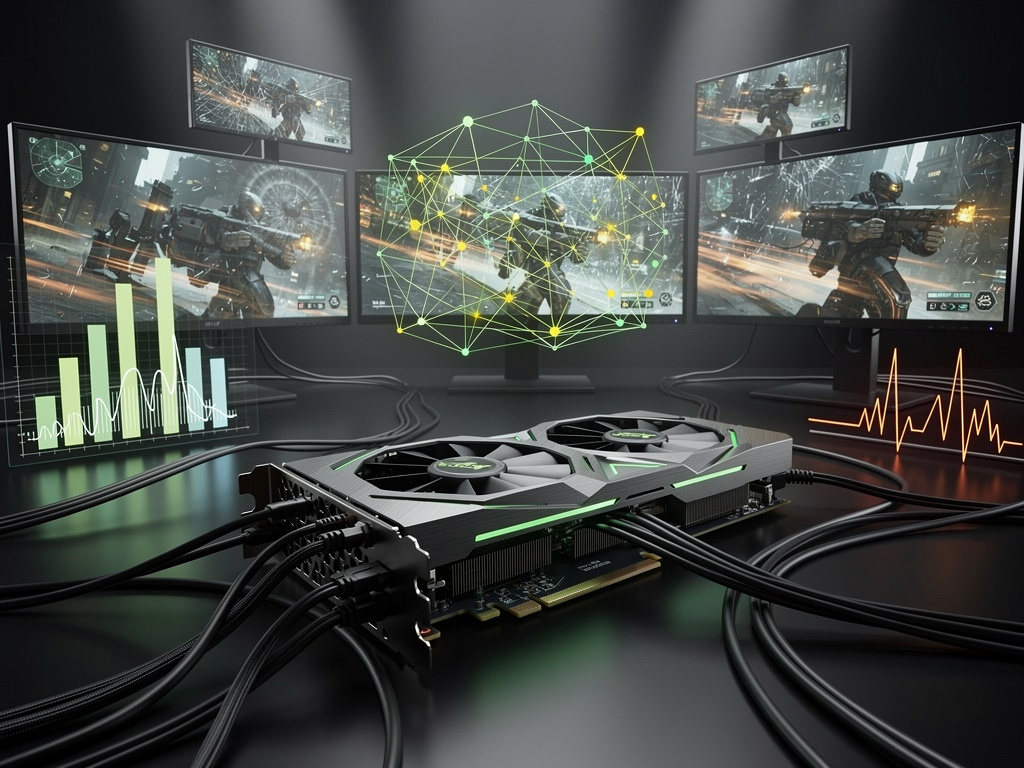
Jensen Huang has never been accused of excessive humility. But even by his standards, telling millions of PC gamers that their eyes are deceiving them represents a bold communications strategy.
The Nvidia CEO’s recent remarks defending the company’s DLSS 4 technology — specifically its Multi Frame Generation feature — have ignited a firestorm among the enthusiast PC gaming community. The controversy centers on a fundamental question that sits at the intersection of technology marketing and visual perception: When AI generates the majority of frames you see on screen, are you really gaming at the resolution and frame rate Nvidia claims?
Huang says yes. Emphatically.
A significant and vocal portion of Nvidia’s own customer base says absolutely not.
The Technical Dispute at the Heart of the Backlash
To understand why gamers are upset, you need to understand what DLSS 4’s Multi Frame Generation actually does. Traditional frame rates work like this: your GPU renders each frame from scratch, using the game’s 3D engine to calculate geometry, lighting, textures, and effects. If your monitor displays 120 frames per second, your GPU has produced 120 individually rendered frames.
DLSS 4 with Multi Frame Generation changes that equation dramatically. The GPU might render only 30 native frames per second. Nvidia’s AI model then generates three additional frames for every real one, interpolating motion and visual data to produce what appears on screen as 120 fps. The result, Nvidia argues, is visually indistinguishable from natively rendered frames — smoother motion, higher perceived quality, and frame rates that would otherwise require hardware costing thousands more.
Critics aren’t buying it. And their objections aren’t trivial.
As TechRadar reported, Huang’s response to this criticism has drawn comparisons to the infamous Principal Skinner meme from The Simpsons — the scene where Skinner, confronted with evidence that he’s out of touch, concludes that it’s the children who are wrong. In Huang’s case, the formulation is strikingly similar: confronted with widespread gamer dissatisfaction over AI-generated frames, the Nvidia CEO has essentially concluded that the gamers are wrong about what they’re seeing.
During a recent Q&A session, Huang argued that AI-generated frames are not fundamentally different from traditionally rendered ones, since modern GPUs already use extensive computational shortcuts, approximations, and AI-assisted techniques in their rendering pipelines. In his framing, there’s no bright line between a “real” frame and an AI-generated one. It’s all computation. It’s all math. The pixel output is what matters.
There’s a kernel of truth here. Modern game rendering is already stuffed with approximations — screen-space reflections instead of true ray tracing for every surface, temporal anti-aliasing that reuses data from previous frames, level-of-detail systems that simplify geometry you’re not looking directly at. The purist notion of a “natively rendered” frame hasn’t existed in any practical sense for years.
But gamers aren’t making a philosophical argument about the nature of rendering. They’re making a practical one: AI-interpolated frames introduce artifacts, add input latency, and don’t contain genuinely new visual information. When a frame is generated by predicting what should exist between two real frames, it can guess wrong. Fast camera movements, sudden explosions, objects appearing from off-screen — these are precisely the moments where interpolation fails, producing ghosting, smearing, or outright visual errors.
And in competitive gaming, the input latency question is particularly acute. A frame that didn’t come from the game engine doesn’t carry new input data. Your mouse movement, your keystroke — they aren’t reflected in an interpolated frame the way they would be in a natively rendered one. For casual players, this may be imperceptible. For competitive players operating at the margins of human reaction time, it matters.
The backlash has been widespread across social media platforms and gaming forums. On X (formerly Twitter) and Reddit, users have posted side-by-side comparisons highlighting artifacts in DLSS 4 Multi Frame Generation output. Digital Foundry, the respected technical analysis outlet, has published detailed breakdowns showing measurable differences between native rendering and DLSS-enhanced output, particularly in fast-motion scenarios. The consensus among technically literate gamers is not that DLSS 4 is bad — many acknowledge it’s an impressive technological achievement — but that Nvidia’s marketing overstates the quality equivalence.
Why Nvidia Can’t Afford to Back Down
Huang’s defiance isn’t just ego. It’s business strategy.
Nvidia’s entire product roadmap for consumer GPUs now depends on AI upscaling and frame generation being accepted as legitimate performance metrics. The company’s latest RTX 50-series cards, led by the RTX 5090 and RTX 5070 Ti, were marketed heavily on DLSS 4 performance numbers. Remove the AI-generated frames from the benchmarks, and the generational performance improvements look far less impressive — in some cases, barely justifying an upgrade from the previous RTX 40-series generation.
This is the real stakes of the argument. If the gaming community broadly rejects AI-generated frames as “fake” performance, Nvidia’s value proposition for its newest hardware weakens considerably. The company has invested billions in AI inference capabilities on its consumer GPUs. Those transistors need to justify their existence to buyers, and frame generation is the most visible consumer-facing application.
So when Huang pushes back on critics, he’s not just defending a software feature. He’s defending the architectural direction of Nvidia’s consumer GPU division for the next several product generations. AMD and Intel, both trailing Nvidia in AI-assisted rendering, would love nothing more than for the market to decide that traditional rasterization performance is the only metric that counts.
There’s also a broader context here. Nvidia’s stock price and market valuation are overwhelmingly driven by its data center AI business, not consumer gaming. But the gaming division remains symbolically important — it’s where the brand was built, where mindshare is won or lost among the technical enthusiast community that influences broader purchasing decisions. A perception that Nvidia is gaslighting its own customers could create brand damage that ripples beyond the gaming segment.
Recent coverage from outlets including TechRadar has highlighted the meme-worthy nature of Huang’s stance, but the underlying technical debate deserves more serious treatment than internet jokes provide. The question of what constitutes a “real” frame is genuinely complex, and Nvidia isn’t entirely wrong that the distinction between rendered and AI-generated will blur further as the technology matures.
But technology companies have a long history of getting ahead of their customers’ willingness to accept new paradigms. Remember when Apple removed the headphone jack and told users they were wrong to want it? The company was eventually proven right by market adoption — but only after years of customer frustration and a cottage industry of dongle manufacturers. Nvidia may be making a similar bet: that DLSS frame generation will become so good, so fast, that today’s complaints will look quaint in two or three GPU generations.
The risk is that competitors close the gap before that happens. AMD’s FSR (FidelityFX Super Resolution) technology, while currently behind DLSS in quality, is open-source and works across a wider range of hardware. Intel’s XeSS is improving with each iteration. If either competitor can offer comparable AI-assisted performance without the perception of overpromising, Nvidia’s aggressive marketing could backfire.
The Bigger Question: Who Defines Quality?
At its core, this controversy reflects a tension that runs through every technology transition: the gap between what engineers know is technically true and what users experience as functionally true.
Huang is correct that rendering has always involved approximation. He’s correct that AI-generated frames represent a logical extension of techniques the industry has used for decades. He’s correct that for many users, in many scenarios, DLSS 4 Multi Frame Generation produces results that are visually excellent.
But he’s wrong to dismiss the concerns of users who can see the artifacts, feel the latency, and object to marketing materials that present AI-generated frame counts as equivalent to natively rendered ones. These aren’t uninformed consumers complaining about something they don’t understand. Many of them are precisely the kind of technically sophisticated enthusiasts who built Nvidia’s brand in the first place.
The smarter play would be transparency. Acknowledge the limitations. Provide clear labeling that distinguishes native frames from generated ones in benchmarks. Let the technology speak for itself without overclaiming. Gamers who see genuine improvement will adopt it willingly. Those who prefer native rendering can make informed choices.
Instead, Nvidia’s CEO has chosen confrontation. It’s a familiar posture from Huang, who has built one of the world’s most valuable companies partly through sheer force of conviction. That conviction has served him extraordinarily well in the data center AI market, where customers are sophisticated enterprises making rational purchasing decisions based on throughput benchmarks.
Gamers are different. They’re passionate, opinionated, and deeply skeptical of corporate messaging. They’ve been burned before by misleading performance claims — from Nvidia and its competitors alike. Telling them their perceptions are wrong is, at minimum, a tone-deaf approach to community relations.
Whether DLSS 4’s Multi Frame Generation is genuinely as good as Nvidia claims may ultimately be beside the point. In consumer technology, perception is reality. And right now, Nvidia has a perception problem that no amount of AI-generated frames can interpolate away.
The company’s next move matters. A more measured acknowledgment of user feedback, combined with continued technical improvement, could turn skeptics into advocates. Doubling down on the “you’re wrong” messaging risks alienating a community that has other options — and increasingly good reasons to consider them.
Jensen Huang has been right about a lot of things. The future of AI computing. The value of parallel processing. The insatiable demand for accelerated compute. But on this particular issue, the market may have a different verdict than the one he’s rendering.


 WebProNews is an iEntry Publication