
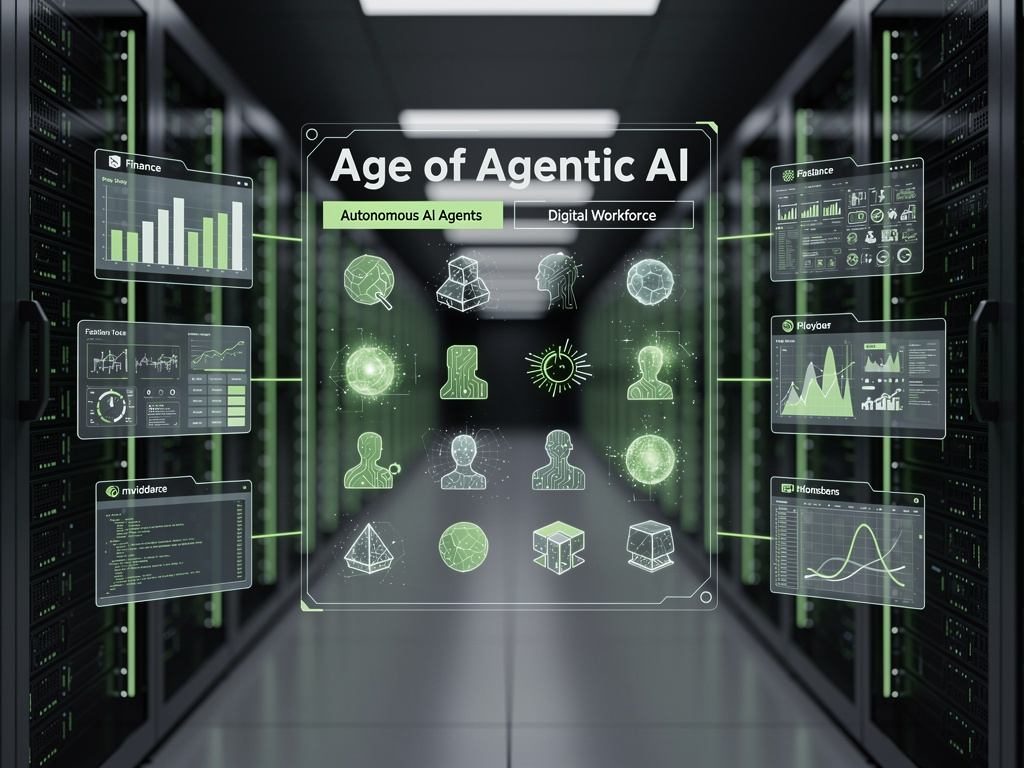
At Nvidia’s annual Computex keynote in Taipei, CEO Jensen Huang delivered a sweeping vision of the near future: one in which billions of AI agents operate alongside humans in every industry, every company, and eventually every household. The message was unmistakable — the era of agentic AI is not some distant forecast but an inflection point happening right now, and Nvidia intends to be the infrastructure backbone powering every bit of it.
Huang, who has become the most closely watched executive in the technology sector thanks to Nvidia’s meteoric rise as the dominant supplier of AI chips, used his keynote to lay out a roadmap that extends well beyond the data center GPUs that have already made his company one of the most valuable on Earth. As reported by CNET, Huang declared that “the age of agentic AI is here” and described a world in which AI systems don’t simply respond to prompts but take autonomous action — reasoning, planning, and executing multi-step tasks with minimal human oversight.
From Chatbots to Autonomous Agents: A Fundamental Shift in How AI Works
The concept of agentic AI represents a significant departure from the generative AI models that captured public imagination over the past two years. Tools like ChatGPT and Google’s Gemini respond to user queries in a conversational format. Agentic AI, by contrast, involves systems that can independently identify goals, break them into subtasks, use external tools, and iterate on their own outputs until a job is complete. Think of the difference between asking a chatbot to draft an email and deploying an AI agent that monitors your inbox, drafts responses, schedules meetings, and follows up — all without being told to do so each time.
Huang framed this transition as the next great computing platform shift, comparable in scale to the move from mainframes to PCs or from PCs to mobile devices. According to CNET, he predicted that within a few years, every company will deploy fleets of AI agents tailored to specific business functions — from customer service and supply chain management to drug discovery and financial analysis. “Every company is going to have AI employees,” Huang said, a line that drew both applause and nervous laughter from the audience of industry professionals and investors.
Nvidia’s Hardware and Software Stack Is Designed to Make Agents Inevitable
What makes Nvidia’s position so formidable is that the company is not merely selling chips. It has constructed an entire computing stack — from silicon to software frameworks — purpose-built for the agentic AI era. The company’s latest Blackwell Ultra GPUs and its forthcoming Rubin architecture are designed to handle the massive inference workloads that agentic AI demands. Unlike training, which involves teaching a model on vast datasets, inference is the process of running a trained model in real time. Agentic systems, which must reason continuously and often call multiple models in sequence, require enormous inference capacity.
Nvidia has also invested heavily in software platforms that make it easier for enterprises to build and deploy agents. Its NIM (Nvidia Inference Microservices) platform provides pre-built, optimized containers for running AI models, while its Omniverse platform enables the creation of digital twins — virtual replicas of physical environments where AI agents can be trained and tested before being deployed in the real world. Huang demonstrated several use cases during his keynote, including AI agents managing warehouse logistics and autonomous vehicles navigating complex urban environments, all trained initially in simulated Omniverse worlds.
The Economics of Agentic AI: Why Wall Street Is Paying Attention
For investors, the agentic AI thesis is compelling because it dramatically expands Nvidia’s total addressable market. If generative AI was primarily about training large language models — a market dominated by a handful of hyperscale cloud providers like Microsoft, Google, and Amazon — agentic AI democratizes demand. Every enterprise, from a regional bank to a global pharmaceutical company, becomes a potential buyer of Nvidia’s inference hardware and software tools. Morgan Stanley analysts have estimated that inference workloads could eventually account for more than 60% of all AI compute spending, a reversal from the current training-dominated market.
Nvidia’s financial results already reflect this momentum. The company reported record quarterly revenue of $26 billion in its most recent earnings, driven overwhelmingly by data center sales. But Huang has signaled that the next wave of growth will come from inference and edge computing — deploying AI agents not just in centralized cloud data centers but at the point of use, in factories, hospitals, retail stores, and autonomous vehicles. This is where Nvidia’s Jetson platform for edge AI and its DRIVE platform for autonomous vehicles fit into the broader strategy.
Competition Is Intensifying, But Nvidia Holds the High Ground
Nvidia is not operating in a vacuum. AMD has been aggressively positioning its MI300X accelerators as a viable alternative for AI workloads, and custom silicon from cloud providers — Google’s TPUs, Amazon’s Trainium and Inferentia chips, and Microsoft’s Maia — threatens to erode Nvidia’s dominance in their respective clouds. Startups like Cerebras, Groq, and SambaNova are also targeting inference workloads with specialized architectures that promise better performance per dollar for specific use cases.
Yet Nvidia’s moat remains wide for several reasons. First, its CUDA programming platform, which has been the standard for GPU computing for nearly two decades, creates enormous switching costs. Millions of developers and researchers have built their workflows around CUDA, and migrating to a competing platform involves significant time and expense. Second, Nvidia’s full-stack approach — combining hardware, software, networking (through its Mellanox acquisition), and now agentic AI frameworks — means customers can get an integrated solution rather than piecing together components from multiple vendors. As Huang put it during his keynote, “The more you buy, the more you save,” a quip that underscored Nvidia’s strategy of making its platform indispensable across the entire AI workflow.
The Workforce Question: AI Employees and Human Displacement
Huang’s vision of AI agents as “digital employees” inevitably raises questions about labor displacement. When the CEO of the world’s most valuable semiconductor company tells an audience that every company will soon have AI workers, the implications for white-collar employment are hard to ignore. Consulting firms like McKinsey have projected that generative AI could automate tasks equivalent to 60 to 70 percent of current work activities, and agentic AI — which can chain together complex workflows autonomously — could accelerate that timeline considerably.
Huang has addressed these concerns by arguing that AI agents will augment rather than replace human workers, handling routine and repetitive tasks while freeing people to focus on higher-value creative and strategic work. Whether that optimistic framing holds up in practice remains to be seen. History suggests that major technology transitions create new categories of employment even as they eliminate old ones, but the speed of AI adoption may compress the adjustment period in ways that previous transitions did not.
What the Agentic AI Inflection Point Means for the Broader Tech Industry
The implications of the agentic AI shift extend far beyond Nvidia. Enterprise software companies like Salesforce, ServiceNow, and SAP are already embedding agentic capabilities into their platforms, recognizing that customers will increasingly expect their software to act, not just inform. Salesforce CEO Marc Benioff has spoken extensively about “Agentforce,” the company’s platform for deploying autonomous AI agents within its CRM system. Microsoft, meanwhile, has integrated agentic features into its Copilot products, allowing AI to take actions across Office applications, Dynamics 365, and other enterprise tools.
Cloud infrastructure providers are also racing to build the plumbing for agentic AI. Amazon Web Services, Google Cloud, and Microsoft Azure are all expanding their offerings of managed AI agent services, recognizing that most enterprises lack the in-house expertise to build and maintain these systems from scratch. The result is a rapidly forming value chain in which Nvidia provides the foundational compute, cloud providers offer the hosting and orchestration layer, and software companies deliver the application-specific agents that interact directly with end users and business processes.
Nvidia’s Bet Is Big — And the Stakes Are Even Bigger
Jensen Huang has made enormous bets before. His decision to pivot Nvidia from a gaming GPU company to an AI computing platform was widely questioned at the time and has since been validated in spectacular fashion. The agentic AI bet is of a similar magnitude. If Huang is right that autonomous AI agents will become as ubiquitous as mobile apps, the demand for Nvidia’s hardware and software could dwarf even the current AI boom. If the technology proves slower to mature than expected — or if regulatory, safety, or reliability concerns slow adoption — the company’s aggressive capital expenditure and R&D spending could weigh on returns.
For now, the market is giving Huang the benefit of the doubt. Nvidia’s market capitalization has surpassed $3 trillion, placing it among the most valuable companies in history. But as any seasoned investor knows, the gap between a compelling vision and sustained execution is where fortunes are made and lost. The agentic AI era, as Huang describes it, is arriving. The question is whether it arrives on Nvidia’s terms — and on Nvidia’s timeline.


 WebProNews is an iEntry Publication