
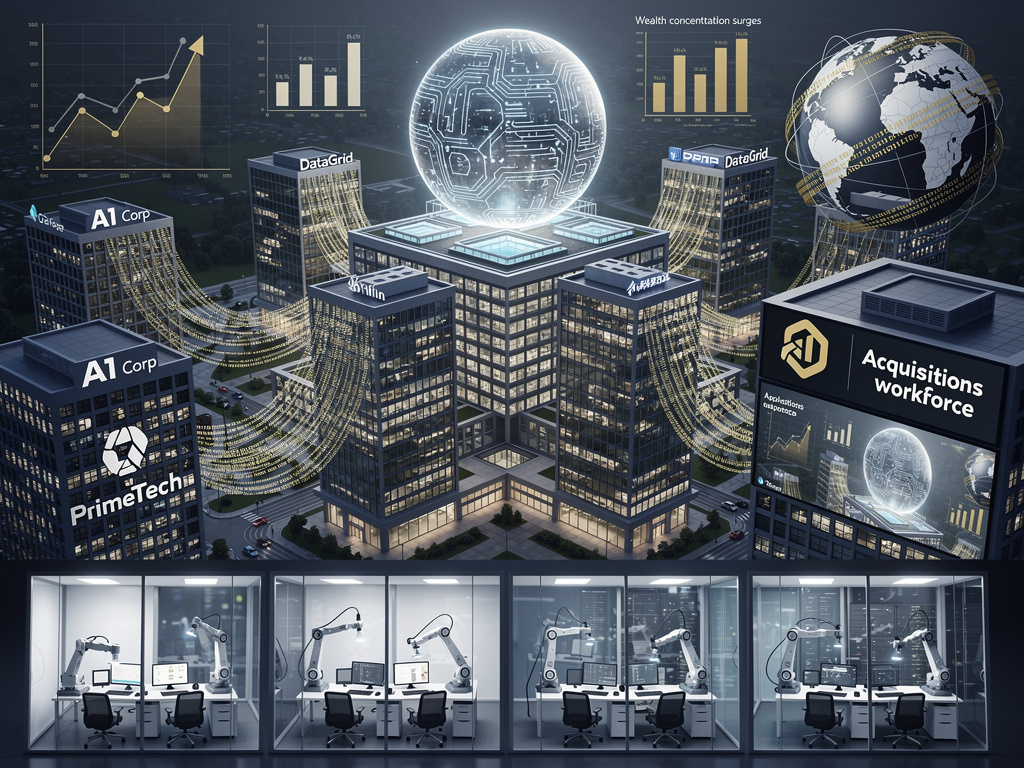
Jeff Bezos, the founder of Amazon and one of the wealthiest people on the planet, has made no secret of his fascination with artificial intelligence. But his latest ambitions go far beyond building smarter Alexa devices or improving warehouse logistics. According to recent reporting, Bezos is actively exploring the idea of acquiring companies where AI systems could effectively replace much of the human workforce — a strategy that, if executed at scale, could reshape the economics of corporate acquisitions and redefine what it means to own and operate a business in the age of machine intelligence.
The concept is deceptively simple but carries enormous implications: buy a company, strip out much of the labor cost by deploying AI agents and automation, and run the resulting entity at dramatically higher margins. It is a vision that treats human labor not as the backbone of enterprise but as a variable cost to be optimized away. And Bezos, who built Amazon into a $2 trillion juggernaut partly through relentless cost efficiency, may be uniquely positioned to execute it.
The Thesis: AI as the Ultimate Cost Restructuring Tool
As reported by Futurism, Bezos has been discussing the possibility of acquiring companies specifically because their operations could be automated with AI. The idea is not simply to integrate AI tools into existing workflows — the kind of incremental improvement that thousands of companies are already pursuing — but to fundamentally rebuild acquired businesses around AI from the ground up. The workforce reductions implied by such a strategy would be dramatic, potentially eliminating the majority of employees in target companies.
This approach represents a new twist on the classic private equity playbook, where firms acquire underperforming companies, cut costs aggressively, and flip them for a profit. But where traditional cost-cutting might involve consolidating offices, renegotiating supplier contracts, or trimming middle management, the Bezos model envisions something far more sweeping: replacing entire categories of workers with AI systems capable of performing their functions at a fraction of the cost and, in theory, with greater speed and consistency.
Bezos’s Track Record Suggests This Is More Than Idle Talk
Anyone tempted to dismiss this as speculative chatter should consider Bezos’s history. Amazon pioneered the use of robotics in its fulfillment centers, deploying hundreds of thousands of robots that work alongside — and increasingly instead of — human workers. The company’s cloud computing arm, Amazon Web Services, is one of the largest providers of AI infrastructure in the world. And Bezos personally has invested billions in AI ventures, including a reported $4 billion Amazon investment in Anthropic, the AI safety startup behind the Claude family of large language models.
Bezos has also demonstrated a willingness to make bold, long-horizon bets that others consider reckless. He funded Blue Origin for years before it became commercially viable. He bought The Washington Post when the newspaper industry appeared to be in terminal decline. His investment philosophy has consistently favored moves that look contrarian in the short term but position him to capture enormous value over time. Buying companies to rebuild them with AI fits squarely within that pattern.
The Economics of AI-First Acquisitions
The financial logic behind AI-driven acquisitions is compelling, at least on paper. Labor typically represents the single largest expense for most service-oriented businesses, often consuming 50% to 70% of revenue. If AI agents could handle customer service, data processing, financial analysis, content creation, software development, and other knowledge-work functions, the cost savings would be staggering. A company generating $100 million in revenue with $60 million in labor costs could theoretically see its margins explode if even half of those positions were automated.
Of course, the reality is far more complex. Current AI systems, while impressive, still require significant human oversight. They hallucinate, make errors, and struggle with tasks requiring nuanced judgment or deep contextual understanding. Deploying AI at the scale Bezos envisions would require not just powerful models but also sophisticated integration, monitoring systems, and a willingness to accept that some functions cannot yet be reliably automated. The gap between AI’s theoretical capabilities and its practical performance in messy, real-world business environments remains substantial.
A Growing Movement Among Tech Billionaires
Bezos is not alone in thinking along these lines. The broader tech industry has been moving rapidly toward what some executives have begun calling “AI-native” companies — organizations built from scratch to operate with minimal human involvement. Startups in fields ranging from legal services to accounting to software development are already marketing themselves as AI-first businesses that can deliver the same output as traditional firms with a fraction of the headcount.
Elon Musk has spoken extensively about his vision for AI and robotics replacing human labor, including through Tesla’s Optimus humanoid robot program. Sam Altman, the CEO of OpenAI, has predicted that AI will eventually be capable of performing most economically valuable work. And venture capital firms are pouring money into startups that promise to automate entire business functions. According to recent reporting from multiple outlets, AI startup funding reached record levels in early 2025, with investors betting heavily on companies that can demonstrate clear labor replacement capabilities.
The Workforce Implications Are Enormous — and Politically Charged
The social and political ramifications of a strategy like the one Bezos is reportedly pursuing cannot be overstated. If some of the world’s wealthiest individuals begin systematically acquiring companies and replacing their workers with AI, the backlash could be severe. Labor unions, which have already been raising alarms about AI-driven job displacement, would almost certainly mobilize. Politicians on both sides of the aisle have shown increasing willingness to scrutinize Big Tech, and a wave of AI-driven layoffs tied to billionaire-led acquisitions could accelerate regulatory action.
The debate over AI and employment is already one of the most contentious issues in technology policy. A March 2025 report from the International Monetary Fund estimated that AI could affect up to 40% of jobs globally, with advanced economies facing the highest exposure. In the United States, the Bureau of Labor Statistics has begun tracking AI-related workforce disruptions more closely, and several states have introduced legislation that would require companies to disclose when AI is being used to replace human workers.
What Target Companies Might Look Like
If Bezos does pursue this acquisition strategy, the most attractive targets would likely be companies with large, relatively standardized workforces performing tasks that current AI systems can handle well. Customer service operations, back-office processing centers, content moderation teams, basic legal and financial services firms, and data entry-heavy businesses all fit the profile. Companies in these sectors often trade at modest valuations relative to their revenue, making them affordable targets for someone with Bezos’s resources.
The strategy could also extend to companies that are struggling financially precisely because of high labor costs. A business that is barely profitable due to its wage bill could become highly profitable almost overnight if AI could absorb a significant portion of that work. For a buyer with deep pockets and access to world-class AI technology, these distressed assets could represent extraordinary opportunities — the corporate equivalent of buying a fixer-upper and renovating it with tools no one else possesses.
The Ethical and Structural Questions That Remain
Beyond the economics and the politics, there are deeper structural questions about what happens when AI enables a small number of individuals to control vast business empires with minimal human involvement. If one person can acquire and operate dozens of companies using AI agents instead of human employees, the concentration of economic power becomes even more extreme than it already is. The wealth generated by those businesses would flow overwhelmingly to the owner and the AI infrastructure providers, rather than being distributed across thousands of workers in the form of wages.
This is not a hypothetical concern. The trend toward greater wealth concentration has been accelerating for decades, and AI threatens to supercharge it. As Futurism noted in its reporting, the vision Bezos is pursuing raises fundamental questions about the future relationship between capital, labor, and technology. If the wealthiest people on Earth can use AI to run companies without workers, what role does the broader population play in the economy? Who benefits, and who is left behind?
Where This Goes From Here
For now, much of this remains in the realm of strategy and speculation rather than executed deals. Bezos has not publicly announced specific acquisition targets, and the technical barriers to fully automating most businesses remain significant. But the direction of travel is clear. AI capabilities are improving rapidly, costs are falling, and the economic incentives to replace human labor with machine intelligence are growing stronger by the quarter.
If Bezos moves forward with this approach — and given his track record, it would be unwise to bet against him — it could establish a template that other wealthy investors and private equity firms quickly adopt. The result would be a fundamental transformation in how companies are bought, restructured, and operated, with AI serving not just as a tool for incremental improvement but as the central organizing principle of entire businesses. The implications for workers, for markets, and for the structure of the economy itself are profound, and they are arriving faster than most policymakers or business leaders seem prepared to address.


 WebProNews is an iEntry Publication