
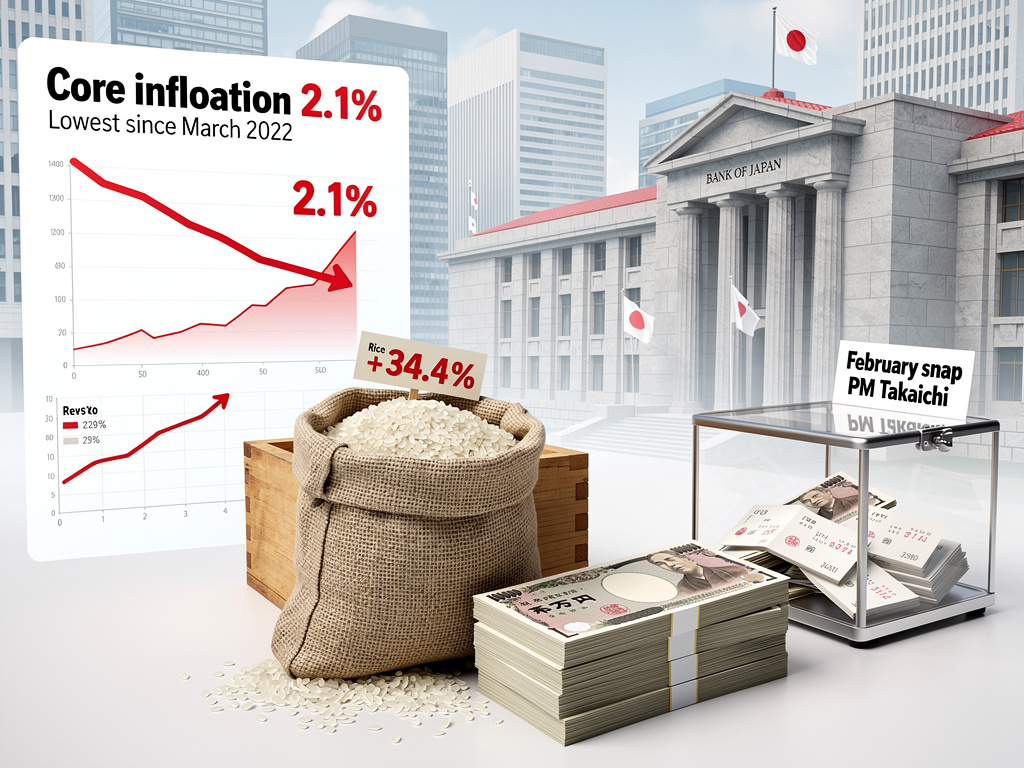
Japan’s core consumer inflation cooled to 2.1% in December, the lowest reading since March 2022, offering a brief respite for Prime Minister Sanae Takaichi’s government amid a looming snap election. The figure, which strips out volatile fresh food prices, matched economist forecasts but marked a sharp drop from November’s 2.9%, according to data released Friday by the internal affairs ministry. This slowdown comes as the Bank of Japan holds its benchmark rate at 0.75% following a December hike, with rice prices exploding 34.4% year-over-year casting a shadow over the nation’s economic narrative.
The deceleration reflects easing pressures in energy and services, though food costs remain a pain point. Rice, a staple in Japanese diets, has become a flashpoint, with prices up sharply due to poor harvests and supply constraints. Takaichi, Japan’s first female premier, faces a February 8 election after dissolving parliament this week, promising tax cuts and spending boosts to counter voter discontent over living costs. CNBC reports that core inflation touched its lowest since October 2024.
Posts on X highlighted the rice inflation spike, with users noting its potential to sway voters restless ahead of the poll. The Bank of Japan, in a Thursday decision, raised growth forecasts, projecting 0.9% GDP expansion for fiscal 2025 and 1% for 2026, signaling optimism despite holding rates steady. This sets the stage for monetary policy to intersect with political maneuvering.
Core Inflation’s Downward Turn
December’s 2.1% core CPI print underscores a broader disinflation trend, with Tokyo’s preliminary data earlier showing even softer numbers at 2.0% year-over-year. Services inflation eased to 1.6%, while overall headline inflation fell to levels not seen in nearly four years. Economists attribute this to base effects from last year’s energy surges and stabilizing import costs, though the weak yen—hovering near 155 to the dollar—keeps imported inflation risks alive.
The BOJ’s preferred core-core gauge, excluding fresh food and energy, dipped to 1.5%, per CNBC. Governor Kazuo Ueda has emphasized sustainable 2% inflation as the threshold for further hikes, but today’s data buys time. Market pricing now sees scant odds of a rate move before mid-year, with super-long bond yields spiking amid fiscal expansion fears.
Industry insiders watch how this plays into Takaichi’s platform. Her Liberal Democratic Party (LDP) coalition risks losing seats after scandals and economic gripes, with opposition parties hammering rising grocery bills.
Rice Prices Ignite Voter Fury
Rice inflation at 34.4%—the highest in decades—stems from a hot 2025 summer damaging crops and hoarding by wholesalers. Retail prices have doubled in some areas, prompting government subsidies that critics say fuel distortions. Reuters Breakingviews warns Takaichi’s subsidy machine, costing billions, could backfire with one bad harvest dooming her electoral bid.
Al Jazeera covered Takaichi’s parliament dissolution on January 23, paving the way for the February 8 vote where rice affordability tops voter concerns. Al Jazeera reports she seeks a mandate for defense build-up alongside fiscal largesse. X sentiment echoes this, with traders posting about yen weakness amplifying food import costs.
Agricultural economists note structural issues: Japan’s rice self-sufficiency masks inefficiencies, with aging farmers and shrinking paddies exacerbating shortages. Takaichi’s response—import quotas and price caps—hasn’t quelled markets, where futures signal further gains.
BOJ’s Tightrope Act
The central bank upgraded its outlook Thursday, citing wage gains and capex resilience, but inflation’s slide tempers hike urgency. Trading Economics confirms the 0.75% rate unchanged, the highest in 30 years after December’s lift from 0.5%. Trading Economics data shows this as the anchor amid volatility.
Ueda’s board faces pressure: too dovish risks yen depreciation fueling inflation; too hawkish could tip recession amid 1.2% GDP growth forecasts. Reuters notes a proposed record budget with curbed debt issuance, highlighting Takaichi’s growth push. Reuters details fiscal strains.
Bond markets revolt, with 40-year JGB yields hitting records above 4%, per Reuters Breakingviews. Investors flee debt auctions as election promises of tax cuts balloon deficits in the world’s most indebted major economy.
Takaichi’s High-Stakes Election Calculus
Takaichi called the snap vote to capitalize on honeymoon momentum, pledging ¥20 trillion in stimulus including child allowances and wage subsidies. Reuters says this targets rural rice belts and urban families squeezed by costs. Polls show LDP leading but vulnerable if inflation rebounds.
Opposition Constitutional Democratic Party pushes austerity and BOJ independence, contrasting Takaichi’s Abenomics revival. X posts from analysts like Shane Oliver note BOJ likely on hold post-hike, aiding her fiscal pitch. Vegetable price drops aided December’s cool-down, but rice’s persistence underscores uneven recovery.
Global context matters: U.S. rate cuts bolster yen carry trades, but Trump’s tariff threats loom. Japan’s export machine faces headwinds, with BOJ eyeing overseas risks in its upgraded GDP view.
Fiscal Pressures Mount
Government debt at 260% of GDP amplifies every spending vow. Buyers shunned recent JGB auctions, pushing yields up as Reuters reports politicians compete on tax relief. Takaichi’s ¥114 trillion budget proposal balances record outlays with issuance curbs, a delicate act.
The Japan Times earlier flagged Tokyo CPI at 2.3% in December, cooling from 2.8%, presaging national trends. The Japan Times ties this to yen woes. For insiders, the interplay of sticky rice inflation and cooling cores questions BOJ’s 2026 path.
Election outcome could pivot policy: LDP win fortifies easing bias; losses force austerity. Markets brace, with Nikkei futures dipping on fiscal fears.
Outlook Amid Uncertainty
Analysts project core CPI averaging 1.8% in 2026, per BOJ, but rice volatility clouds this. Takaichi’s win hinges on framing inflation relief via handouts over structural fixes. X chatter from Money Ape and others underscores market relief at softer prints, hedging via gold persists.
December’s data, while dovish, keeps Japan above BOJ’s target, with wage-price loops nascent. For industry players, opportunities lie in yen trades and JGB shorts, but election wildcards dominate positioning.


 WebProNews is an iEntry Publication