
Unlocking the Secrets of a Dying Star: Webb’s Intimate Portrait of the Helix Nebula
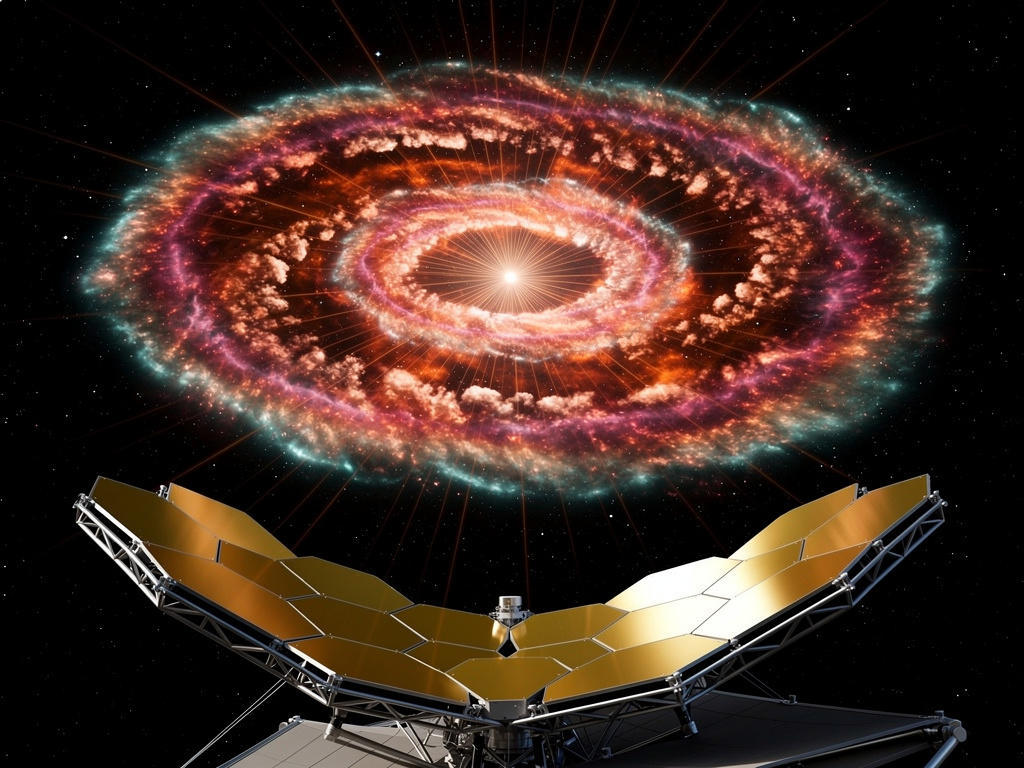
The James Webb Space Telescope has once again captivated the astronomical community with its latest release: a breathtaking infrared image of the Helix Nebula, offering unprecedented details of this iconic planetary nebula. Captured using Webb’s advanced instruments, the image reveals intricate structures within the gas and dust expelled by a dying star, structures that hint at the complex processes governing stellar evolution. This new view, released just hours ago, showcases comet-like knots and radial spokes that were previously glimpsed but never with such clarity, providing astronomers with fresh data to unravel the mysteries of how stars like our Sun meet their end.
Planetary nebulae, despite their name, have nothing to do with planets; they are the glowing remnants of stars that have shed their outer layers in the final stages of life. The Helix Nebula, located about 700 light-years away in the constellation Aquarius, is one of the closest and most studied examples, often called the “Eye of God” due to its striking appearance in visible light. Webb’s infrared capabilities penetrate the dust that obscures visible-light observations, exposing hidden features like the dense, knotty formations that resemble comets streaking through space.
This latest observation builds on decades of study, but Webb’s superior resolution and sensitivity mark a significant leap forward. According to details from a recent post on NASA’s science site, the image highlights the nebula’s central white dwarf star, surrounded by layers of ionized gas that glow in vibrant hues when processed for public viewing. The data not only enhances our visual appreciation but also offers quantitative insights into the nebula’s composition and dynamics.
Unveiling Hidden Structures in Infrared Light
Astronomers have long known that the Helix Nebula features radial structures emanating from its core, but Webb’s Near-Infrared Camera (NIRCam) and Mid-Infrared Instrument (MIRI) have resolved these into thousands of individual knots, each potentially harboring clues about mass loss in aging stars. These knots, appearing as bright heads with trailing tails, are thought to form from instabilities in the stellar wind, where denser regions clump together and are shaped by radiation pressure. The new image, as described in an article from Sci.News, shows these features in exquisite detail, allowing scientists to measure their sizes and distributions more accurately than ever before.
Comparisons with earlier observations from the Hubble Space Telescope reveal how Webb complements rather than replaces its predecessor. Hubble’s visible-light images captured the nebula’s outer glow, but Webb delves deeper, revealing mid-infrared emissions from cooler dust and molecular hydrogen. This multi-wavelength approach is crucial for understanding the full picture of planetary nebula formation, where ultraviolet radiation from the hot central star ionizes the surrounding gas, creating the luminous shell we observe.
The implications extend beyond aesthetics; these observations help model the fate of our own solar system. In about 5 billion years, the Sun will expand into a red giant and eventually form a planetary nebula similar to the Helix. By studying these knots, researchers can infer how material is recycled into the interstellar medium, seeding future star formation. Insights from a piece in Phys.org emphasize that Webb’s data could refine simulations of stellar winds and mass ejection rates.
The Technological Edge of Webb’s Observations
At the heart of this breakthrough is Webb’s ability to operate in the infrared spectrum, where heat signatures from dust and gas become visible. The telescope’s primary mirror, spanning 6.5 meters, collects far more light than Hubble’s, enabling it to resolve fine details even in distant objects. For the Helix Nebula, this means distinguishing individual molecular clouds within the knots, which are estimated to be about the size of our solar system—a scale that boggles the mind when considering the nebula’s overall diameter of several light-years.
Data processing plays a key role here, with astronomers using sophisticated algorithms to combine multiple exposures and filter out noise. The resulting composite image, shared via NASA’s multimedia galleries, displays a color palette that represents different wavelengths: blues for hotter regions near the core, transitioning to reds and oranges in the cooler outer expanses. This visualization not only aids public engagement but also serves as a tool for scientific analysis, highlighting temperature gradients and chemical compositions.
Experts in the field are buzzing about the potential for new discoveries. Posts on X from astronomy enthusiasts and professionals alike reflect a surge in excitement, with many noting how this image surpasses previous views in revealing the nebula’s three-dimensional structure. One such post highlighted the “comet-like pillars” as a first-time observation at this resolution, underscoring Webb’s role in pushing the boundaries of what’s observable.
Historical Context and Comparative Analysis
The Helix Nebula has been a subject of fascination since its discovery in 1824 by German astronomer Karl Ludwig Harding. Early telescopic views described it as a faint, circular glow, but advancements in imaging technology have progressively unveiled its complexity. Ground-based observatories like the Very Large Telescope in Chile provided initial infrared glimpses, but space-based instruments eliminated atmospheric interference, leading to Hubble’s iconic 2002 mosaic that popularized the nebula.
Webb’s contribution, as detailed in a NASA science update from NASA Science, focuses on the nebula’s inner regions, where previous telescopes struggled with overexposure from the bright central star. By employing coronagraphic techniques to block out the star’s glare, Webb captures the subtle interplay of gas layers, revealing concentric shells that indicate episodic mass loss events in the star’s history.
Comparing this to other planetary nebulae observed by Webb, such as the Red Spider Nebula featured in ESA’s Picture of the Month for October 2025, shows common themes in their morphology. The Red Spider’s bipolar outflows contrast with Helix’s more spherical shape, suggesting variations in progenitor star masses or magnetic fields. Such comparisons, drawn from ESA/Webb, enrich our understanding of stellar death diversity.
Scientific Implications for Stellar Evolution
Delving deeper, the knots in the Helix Nebula are not mere curiosities; they may represent sites of potential planet formation or survival. Some theories posit that these dense regions could shield planetary remnants from the star’s intense radiation, preserving them as rogue worlds drifting through space. Webb’s spectral data, which analyzes the light’s composition, detects molecules like carbon monoxide and hydrogen cyanide, indicators of organic chemistry that could inform astrobiology.
The central white dwarf, with a surface temperature exceeding 100,000 Kelvin, drives the nebula’s expansion at speeds up to 30 kilometers per second. Measurements from Webb refine these velocity estimates, helping model the nebula’s age—currently pegged at around 12,000 years. This precision aids in calibrating evolutionary timelines for similar stars, with broader applications to galactic chemical enrichment.
Collaboration between international agencies underscores the global effort behind these findings. NASA’s partnership with ESA and CSA ensures diverse expertise, from instrument calibration to data interpretation. A recent press release from ESA/Webb on related nebulae highlights how Webb’s observations are integrated into larger surveys, mapping hundreds of such objects to statistically analyze trends in their formation.
Future Prospects and Ongoing Research
Looking ahead, astronomers plan to use Webb’s time-resolved observations to monitor changes in the Helix Nebula over years, potentially capturing the evolution of its knots or the fading of its glow. This dynamic view could reveal how planetary nebulae dissipate, merging back into the interstellar medium. Proposals for follow-up studies, including spectroscopy to identify rare elements, are already in the pipeline, promising even more revelations.
The public’s reaction, as seen in trending discussions on X, amplifies the educational impact. Images like this inspire the next generation of scientists, while also fueling citizen science projects where amateurs contribute to data analysis. Engadget’s coverage in Engadget captures this sentiment, noting the image’s role as a momentary escape amid earthly concerns.
Beyond Helix, Webb’s queue includes targets like the Circinus Galaxy, as reported in a NASA update from NASA Science, demonstrating the telescope’s versatility in probing both nearby phenomena and distant cosmic structures. This holistic approach ensures that each observation contributes to a grander narrative of universal evolution.
Broader Impacts on Astronomy and Beyond
The Helix Nebula’s new portrait also informs models of galactic ecology, where dying stars replenish the cosmos with heavy elements essential for life. By quantifying the mass of ejected material—estimated at several solar masses for Helix—scientists can better predict the chemical makeup of future stellar generations. This ties into exoplanet research, as similar processes might influence habitability in other systems.
Challenges remain, such as interpreting the data’s complexities; not all knots are uniform, suggesting varied formation mechanisms. Ongoing debates in the community, echoed in posts on X, question whether magnetic fields or binary companions shape these structures, areas where Webb’s high-resolution imaging provides critical evidence.
Ultimately, this observation exemplifies Webb’s transformative power, bridging aesthetic wonder with rigorous science. As the telescope continues its mission, each new image like this one reinforces its status as a cornerstone of modern astronomy, illuminating the intricate dance of creation and destruction in the stars.


 WebProNews is an iEntry Publication