
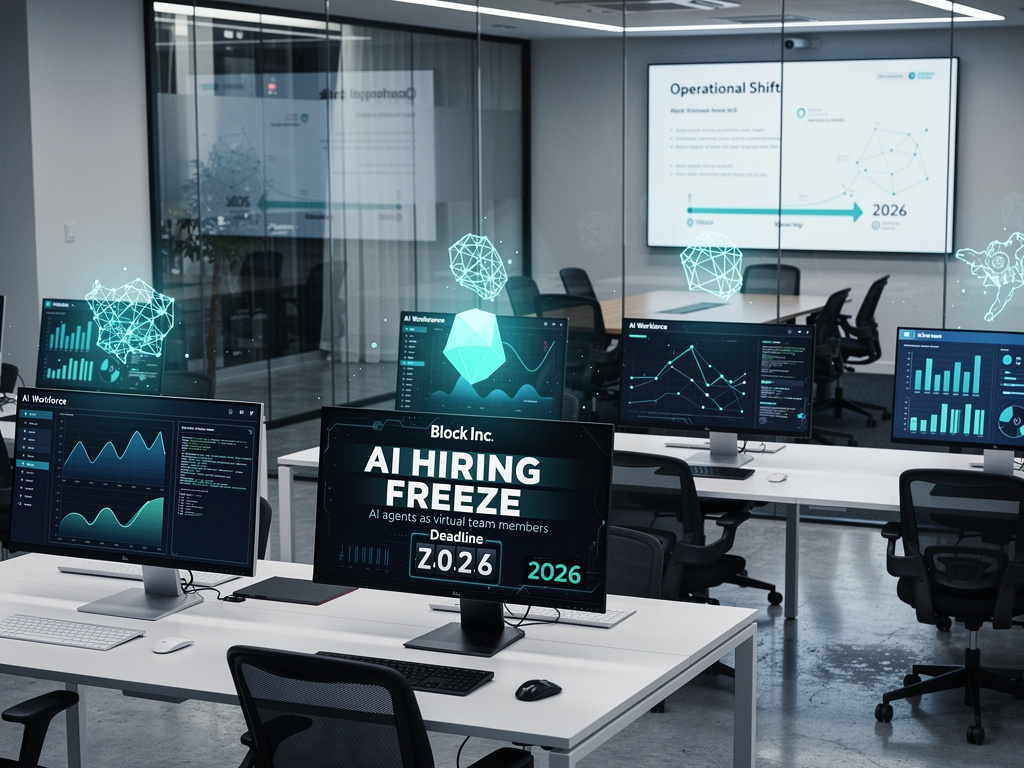
Jack Dorsey, the co-founder of Twitter and chief executive of financial technology company Block Inc., has issued one of the most aggressive mandates in corporate America regarding artificial intelligence adoption: the company will not hire new human employees for roles that AI can fill, and existing teams should plan for a future where software agents do much of the work currently performed by people.
The directive, communicated internally and reported by Business Insider, represents a stark escalation in how Silicon Valley leaders are thinking about the relationship between AI and their workforces. While many tech executives have spoken in broad terms about AI augmenting human productivity, Dorsey’s message goes further — explicitly tying hiring freezes and staffing decisions to the capabilities of AI tools, with a target of making significant changes by 2026.
A Memo That Sent Shockwaves Through Block’s Workforce
According to Business Insider, Dorsey told Block employees that the company would default to not hiring for a role if AI could reasonably be expected to handle the work. The implication is clear: teams across Block — which operates Cash App, Square, Tidal, and the Bitcoin-focused TBD — should begin restructuring their operations around AI agents rather than assuming headcount growth will continue.
The memo reportedly instructed managers to consider what their teams would look like if AI agents were treated as virtual team members. Dorsey asked leaders to think about how workflows, project planning, and resource allocation would change if software could handle tasks that currently require human judgment, coordination, or execution. This is not a theoretical exercise for some distant future; the 2026 timeline suggests Block’s leadership expects material changes within roughly a year.
Block’s Broader Restructuring and the AI Pivot
Dorsey’s AI mandate does not exist in a vacuum. Block has been undergoing significant organizational changes over the past two years. In 2024, the company laid off hundreds of employees as part of a broader effort to streamline operations and refocus on its core products. The company has faced pressure from activist investors, including Hindenburg Research, which published a scathing report in 2023 alleging compliance failures and inflated user metrics at Cash App. Block disputed those claims, but the scrutiny intensified focus on operational efficiency.
The push toward AI-driven operations fits neatly into this efficiency narrative. By reducing reliance on human headcount for routine or semi-routine tasks, Block can potentially lower operating costs while maintaining or even increasing output. For Wall Street analysts tracking Block’s margins and profitability trajectory, the AI strategy could be a significant factor in future earnings projections. Block reported $22.1 billion in gross profit for fiscal year 2024, and any meaningful reduction in personnel costs could flow directly to the bottom line.
What ‘AI Agents as Team Members’ Actually Means
The concept of AI agents functioning as virtual employees is gaining traction across the technology industry, but the specifics of implementation vary widely. In Block’s case, the company has been investing in AI tools for customer support, fraud detection, and internal software development. AI-powered coding assistants, for instance, can generate and review code, potentially reducing the number of software engineers needed for certain projects.
Customer service is another area ripe for transformation. Cash App handles tens of millions of customer interactions annually, and AI chatbots and automated resolution systems could handle a growing share of those queries without human intervention. Fraud detection algorithms, already a mainstay of fintech operations, could become more sophisticated with newer large language models capable of analyzing complex transaction patterns. The question is not whether AI can assist in these areas — it already does — but whether it can replace the humans currently doing the work at a level of quality that customers and regulators will accept.
The Industry Context: Dorsey Is Not Alone, But He Is Among the Most Blunt
Dorsey’s directive places him in a growing cohort of tech CEOs who are publicly tying AI adoption to workforce reductions. Shopify CEO Tobi Lütke issued a similar internal memo in early 2025, telling employees that teams must demonstrate that a job cannot be done by AI before requesting new hires. Klarna, the Swedish buy-now-pay-later company, has been vocal about reducing its workforce through AI, with CEO Sebastian Siemiatkowski claiming that AI was already doing the work of 700 customer service agents.
Meta’s Mark Zuckerberg has spoken about AI engineers being a priority investment, and the company has suggested that AI-generated code could replace some mid-level engineering work. Google, Amazon, and Microsoft have all made enormous investments in AI infrastructure while simultaneously conducting layoffs in other parts of their businesses. The pattern across the industry is unmistakable: companies are reallocating capital from human labor to AI systems at an accelerating pace.
The Human Cost and the Question of Morale
For Block’s roughly 12,000 employees, Dorsey’s memo raises uncomfortable questions about job security. When a CEO explicitly states that the company will default to AI over new hires, existing employees may reasonably wonder whether their roles are next. The psychological effect of such announcements can be corrosive to morale, even among workers whose positions are not immediately threatened.
Employee retention could become a challenge if top talent perceives that Block views human workers as a cost to be minimized rather than an asset to be developed. The technology industry remains competitive for skilled engineers, product managers, and designers, and companies that signal aggressive workforce reduction through AI may find it harder to attract the very people they need to build and maintain those AI systems. There is an inherent tension in telling your workforce that machines will replace many of them while simultaneously depending on that workforce to build the machines.
Regulatory and Ethical Considerations Loom Large
Block operates in a heavily regulated financial services environment. The Consumer Financial Protection Bureau, state financial regulators, and banking partners all impose requirements on how customer data is handled, how disputes are resolved, and how compliance is maintained. Replacing human workers with AI agents in areas that touch regulatory compliance is not straightforward. Regulators have historically expected human accountability in financial decision-making, and the legal frameworks governing AI in financial services are still being developed.
The European Union’s AI Act, which began phased implementation in 2024, imposes specific requirements on AI systems used in financial services, including transparency obligations and human oversight mandates. If Block’s AI ambitions extend to areas covered by such regulations, the company will need to ensure that its automated systems meet evolving legal standards — a task that itself requires significant human expertise.
What Investors and Analysts Are Watching
Wall Street’s reaction to Block’s AI strategy will likely depend on execution. Promises of AI-driven efficiency are easy to make; delivering measurable cost savings without degrading product quality or triggering regulatory problems is far more difficult. Investors will be watching Block’s quarterly earnings reports for evidence that AI adoption is translating into lower operating expenses, higher margins, or faster product development cycles.
Block’s stock has been volatile over the past two years, reflecting broader uncertainty about the company’s strategic direction and competitive position. If Dorsey can demonstrate that AI integration is producing tangible financial results — not just aspirational memos — it could provide a catalyst for the stock. Conversely, if the AI push leads to service quality issues, regulatory scrutiny, or talent flight, the strategy could backfire.
The Bigger Picture for Corporate America
Dorsey’s mandate at Block is a bellwether for a broader shift in how American companies think about labor and technology. The question is no longer whether AI will affect employment — it clearly will — but how quickly and how dramatically. The 2026 timeline that Dorsey has set is aggressive by any standard, and whether Block can meet it will be closely watched by executives across industries who are contemplating similar moves.
What makes Dorsey’s approach notable is its directness. Many CEOs talk about AI in euphemistic terms — “augmenting” workers, “enhancing” productivity, “empowering” teams. Dorsey is saying, plainly, that Block will hire AI instead of people when it can. That candor may be refreshing to some and alarming to others, but it removes any ambiguity about the company’s direction. For Block’s employees, partners, and investors, the message is unmistakable: the age of AI-first hiring has arrived, and the clock is ticking toward 2026.


 WebProNews is an iEntry Publication