
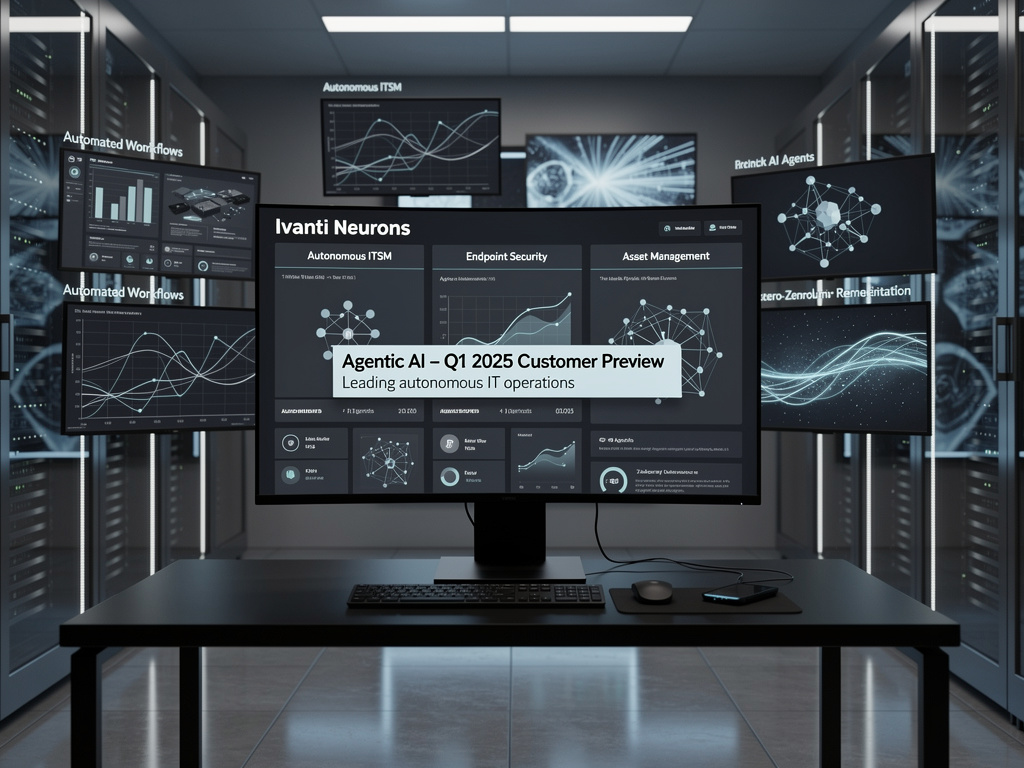
Enterprise software provider Ivanti is positioning itself at the forefront of a transformative shift in IT management by integrating agentic artificial intelligence into its Neurons platform, marking what industry analysts consider a significant departure from traditional reactive IT service models toward fully autonomous operations. The enhancement, scheduled for customer preview in the first quarter of 2025, represents a fundamental reimagining of how organizations manage endpoints, security protocols, and asset inventories across increasingly complex digital infrastructures.
According to Techzine, Ivanti’s implementation of agentic AI within Neurons will enable the platform to independently execute IT service tasks, manage endpoint security threats, and optimize asset management without requiring constant human oversight. This autonomous capability distinguishes agentic AI from conventional AI assistants and chatbots, which typically require explicit human commands before taking action. Instead, the technology operates with predetermined goals and parameters, making contextual decisions and executing complex workflows independently.
The timing of Ivanti’s announcement aligns with broader industry momentum toward agentic AI systems. Major technology vendors including Salesforce, Microsoft, and Google have recently unveiled their own agentic AI initiatives, signaling widespread recognition that autonomous AI agents represent the next evolutionary stage beyond generative AI tools like ChatGPT. Where generative AI excels at content creation and answering queries, agentic AI takes the additional step of independently performing tasks and making operational decisions within defined guardrails.
Addressing Critical Vulnerabilities in Enterprise IT Infrastructure
Ivanti’s move toward autonomous IT management comes against a backdrop of heightened security concerns affecting the company itself. The cybersecurity community has closely scrutinized Ivanti following multiple critical vulnerabilities discovered in its products throughout 2024. These security incidents have underscored the urgent need for more proactive, automated security responses that can identify and remediate threats faster than human teams operating manually.
The Neurons platform’s agentic AI capabilities are designed to address precisely these challenges by continuously monitoring endpoints for anomalous behavior, automatically deploying patches, and isolating compromised systems before threats can propagate across networks. This autonomous approach could significantly reduce the window of vulnerability that cybercriminals exploit between the discovery of a security flaw and the deployment of protective measures across an organization’s entire IT estate.
Technical Architecture Enabling Autonomous Decision-Making
The technical foundation supporting Ivanti’s agentic AI implementation relies on machine learning models trained on vast datasets of IT operations, security incidents, and asset management scenarios. These models enable Neurons to recognize patterns, predict potential issues before they manifest, and take corrective action based on established best practices and organizational policies. The system’s decision-making framework incorporates contextual awareness, understanding not just individual data points but the relationships between users, devices, applications, and network resources.
Unlike traditional rule-based automation, which follows predetermined if-then logic, agentic AI within Neurons can adapt its responses based on evolving circumstances. For instance, when detecting unusual network activity from a specific endpoint, the system might consider the user’s typical behavior patterns, the sensitivity of data they access, current threat intelligence, and organizational security policies before determining whether to simply alert IT staff, restrict network access, or completely isolate the device.
Implications for IT Operations and Workforce Transformation
The introduction of autonomous AI agents into IT service management raises important questions about the future role of human IT professionals. Rather than replacing IT staff, Ivanti positions its agentic AI as augmentation technology that handles routine, repetitive tasks while freeing human experts to focus on strategic initiatives, complex problem-solving, and activities requiring creativity and interpersonal skills. This division of labor could address the persistent shortage of qualified IT and cybersecurity professionals by enabling smaller teams to manage larger, more complex infrastructures.
However, the shift toward autonomous IT management also necessitates new skills among IT professionals. Teams will need expertise in training, monitoring, and refining AI agents rather than manually executing every task. This transition requires organizations to invest in upskilling programs and potentially restructure IT departments around AI oversight and governance rather than traditional operational roles. The most successful implementations will likely involve IT professionals who understand both technical infrastructure and AI system behavior.
Competitive Positioning in the Enterprise AI Market
Ivanti’s agentic AI announcement positions the company within an increasingly competitive enterprise AI market. Salesforce recently introduced Agentforce, its autonomous AI agent platform for customer relationship management, while Microsoft has embedded autonomous agents throughout its Copilot ecosystem. Google’s approach through Vertex AI Agent Builder provides tools for organizations to construct custom AI agents tailored to specific business processes. Each vendor emphasizes different aspects of agentic AI, from customer service automation to development assistance to IT operations.
What distinguishes Ivanti’s approach is its specific focus on the IT service management, endpoint security, and asset management domains where the company has established expertise. This vertical specialization potentially offers advantages over more generalized AI agent platforms, as the underlying models can be trained on domain-specific data and scenarios that IT professionals encounter daily. The effectiveness of this strategy will depend on how well Ivanti’s agentic AI performs compared to competitors’ more horizontal approaches adapted for IT use cases.
Customer Preview and Gradual Deployment Strategy
Ivanti’s decision to launch with a customer preview in the first quarter of 2025 rather than immediate general availability reflects a cautious approach appropriate for technology that will make autonomous decisions affecting critical IT infrastructure. This preview phase allows select customers to test agentic AI capabilities in controlled environments, provide feedback on performance and reliability, and help Ivanti identify edge cases where the system might require additional training or guardrails before broader deployment.
The preview program also serves as an opportunity for Ivanti to demonstrate the technology’s value proposition to potential customers who may be skeptical about entrusting autonomous AI with critical IT operations. Early adopters who successfully implement agentic AI within Neurons can serve as case studies illustrating tangible benefits such as reduced mean time to resolution for IT incidents, improved security posture through faster threat response, and more efficient asset utilization through intelligent optimization.
Governance and Risk Management Considerations
As organizations contemplate deploying autonomous AI agents for IT management, governance frameworks become paramount. IT leaders must establish clear policies defining the scope of decisions AI agents can make independently versus scenarios requiring human approval. These policies need to balance the efficiency gains from automation against the risks of autonomous systems making incorrect decisions that could disrupt operations or create security vulnerabilities.
Ivanti’s implementation will need to provide robust audit trails documenting every action taken by agentic AI, the reasoning behind those decisions, and the outcomes. This transparency enables IT teams to review autonomous decisions, identify areas where the AI requires additional training, and demonstrate compliance with regulatory requirements. Organizations in highly regulated industries such as healthcare, finance, and government will particularly scrutinize these governance capabilities before trusting autonomous AI with critical IT operations.
Integration with Existing IT Ecosystems
The practical success of Ivanti’s agentic AI depends significantly on how seamlessly it integrates with the diverse technology stacks most enterprises maintain. Modern organizations typically operate heterogeneous IT environments combining on-premises infrastructure, multiple cloud platforms, legacy applications, and contemporary SaaS solutions. Neurons’ agentic AI must effectively monitor, manage, and secure endpoints across this complexity without requiring organizations to standardize on Ivanti’s entire product portfolio.
This integration challenge extends beyond technical compatibility to include workflow integration with existing IT service management processes, ticketing systems, and communication platforms. The most valuable autonomous AI implementations will fit naturally into how IT teams already work rather than forcing process changes to accommodate the technology. Ivanti’s preview program will likely surface integration requirements and workflow adjustments needed to maximize the value of agentic AI across diverse customer environments.
The Path Forward for Autonomous IT Management
Ivanti’s introduction of agentic AI to IT management through the Neurons platform represents more than an incremental product enhancement; it signals a fundamental shift in how organizations can approach IT operations, security, and asset management. As the technology matures through the customer preview phase and eventual general availability, the IT industry will gain crucial insights into the practical benefits and limitations of autonomous AI agents in production environments managing real business operations.
The success of this initiative will influence not only Ivanti’s competitive position but also the broader trajectory of AI adoption in enterprise IT. If agentic AI delivers on its promise of autonomous, effective IT management, it could accelerate the transformation of IT departments from reactive problem-solvers to strategic enablers of business innovation. Conversely, if early implementations encounter significant challenges with accuracy, reliability, or integration complexity, the industry may adopt a more measured pace of autonomous AI deployment. The customer preview beginning in the first quarter of 2025 will provide the first substantial evidence of which scenario is more likely to unfold.


 WebProNews is an iEntry Publication