
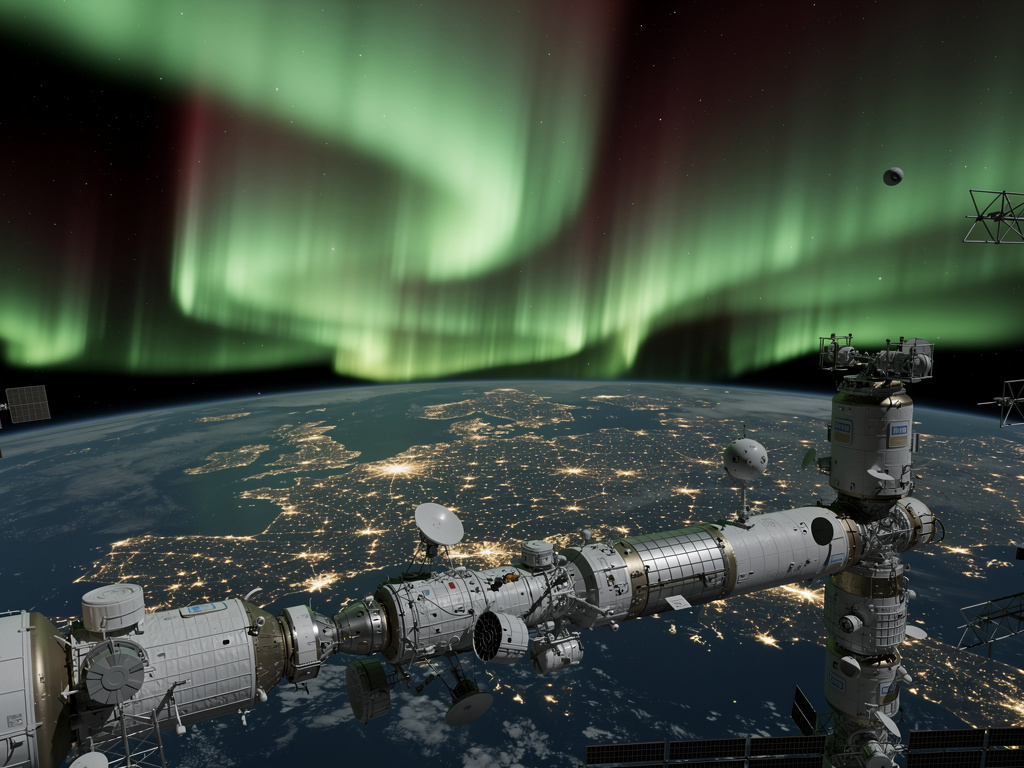
Orbital Spectacle: How Solar Storms Paint Earth’s Skies from the International Space Station
In the vast expanse of low Earth orbit, where the International Space Station (ISS) hurtles at 17,500 miles per hour, astronauts and cosmonauts have long been privy to views that ground-based observers can only dream of. Recent footage captured by Roscosmos cosmonaut Sergey Kud-Sverchkov has once again brought the mesmerizing dance of auroras into sharp focus, showcasing the ethereal glow of northern lights as seen from space. This video, shared amid a powerful geomagnetic storm in January 2026, depicts the ISS seemingly drifting through curtains of green and red light, a phenomenon triggered by solar activity that has captivated scientists and the public alike.
The footage, released just hours ago, illustrates the aurora borealis rippling across Earth’s atmosphere, with the planet’s curvature providing a dramatic backdrop. According to reports from Yahoo News, Kud-Sverchkov described the sight as “incredible,” highlighting how the solar wind interacts with Earth’s magnetic field to produce these vibrant displays. This isn’t the first time such visuals have emerged from the ISS, but the intensity of this event—stemming from a severe solar storm—has elevated it to new heights, drawing comparisons to past observations while underscoring advancements in space-based monitoring.
What makes these space-based perspectives unique is the unobstructed vantage point, free from atmospheric distortion or light pollution that plagues terrestrial viewers. From the ISS, auroras appear as dynamic, flowing rivers of color, often enveloping the station itself in a surreal glow. NASA astronauts like Zena Cardman have previously shared similar clips, such as one over the South Pacific Ocean that garnered over 1.2 million views, as detailed in a USA Today article from August 2025. These recordings not only serve as stunning visual records but also contribute valuable data to space weather research.
The Science Behind the Glow: Unpacking Solar Storms and Auroral Mechanics
At the heart of these displays lies the sun’s restless behavior. Solar flares and coronal mass ejections hurl charged particles toward Earth, where they collide with atmospheric gases like oxygen and nitrogen, exciting them to emit light in various colors—green from oxygen at higher altitudes, red from lower ones, and occasional purples from nitrogen. The January 2026 event, monitored by the European Space Agency (ESA), began with detections on January 18, as noted in an ESA update last updated on January 20. This storm, classified as severe, has led to auroras visible unusually far south, even over parts of the Middle East.
Space agencies leverage tools like the NOAA Space Weather Prediction Center’s Aurora Dashboard for real-time forecasting. This experimental platform, accessible via NOAA’s site, provides 30-minute predictions and models of geomagnetic activity, helping predict when such spectacles might occur. From the ISS, crew members use high-definition cameras to capture these events, offering insights into how auroras evolve in real time. A recent post on X from space weather expert Dr. Tamitha Skov described the color shifts at dawn as “the best I’ve ever seen,” emphasizing how sunlight illuminates nitrogen tips in blue hues.
Historical footage from the ISS, compiled by NASA’s Earth Observatory, reveals patterns over years. For instance, a 2018 video from Expedition 57, available on NASA’s Crew Earth Observations page, shows auroras stretching from the Pacific to Quebec, highlighting urban lights below. These archives demonstrate that while auroras are perennial, intense storms like the current one amplify their visibility and scientific value, aiding in the study of Earth’s magnetosphere.
The implications extend beyond aesthetics. Strong geomagnetic storms can disrupt satellite communications, power grids, and navigation systems. The ongoing event has prompted alerts from agencies worldwide, with SpaceWeatherLive.com tracking recent observations to inform stakeholders. For industry insiders in aerospace and telecommunications, understanding these phenomena is crucial for mitigating risks, such as induced currents in infrastructure.
From Orbit to Earth: Technological Advances in Capturing Auroras
Advancements in imaging technology aboard the ISS have transformed how we document these atmospheric events. High-resolution cameras and time-lapse capabilities allow for detailed footage that reveals subtle movements and color variations invisible from the ground. A striking example is the recent video from Kud-Sverchkov, featured in a Guardian video, where the aurora shimmers over Earth like a living entity.
NASA’s contributions include the GOES satellite series, which monitors solar activity feeding into auroral predictions. The GOES Solar Ultraviolet Imager captures X-ray fluxes that correlate with storm intensity, as integrated into NOAA’s models. Meanwhile, the ISS serves as a floating laboratory, with crew members like Matthew Dominick sharing images on X of auroras against the Milky Way, blending celestial wonders.
International collaboration amplifies these efforts. Roscosmos and NASA jointly operate the ISS, enabling shared data from events like this. A Scientific American piece from 2024 discussed a coronal mass ejection sparking dazzling auroras visible from space, underscoring the station’s role in real-time observation.
For researchers, this footage provides empirical data on particle precipitation. Vincent Ledvina’s X post from 2023 detailed real-time video of nitrogen fringes creating pink auroras at 80-100 km altitudes, a phenomenon echoed in the current storm’s red displays.
Global Impacts: Auroras Lighting Up Unexpected Regions
The January 2026 storm has extended auroral visibility to lower latitudes, with reports of southern lights, or aurora australis, illuminating skies as far north as Victoria and New South Wales in Australia. An Guardian article from two days ago predicted this, noting the storm’s potential for widespread displays.
In the Northern Hemisphere, forecasts from NBC News suggest visibility across Canada and northern U.S. states, possibly extending south. This broad reach has sparked public interest, with viewing guides proliferating online.
Australian media, such as ABC News, reported colorful cosmic displays painting the skies, a direct result of the geomagnetic disturbance. Similarly, Marie Claire Australia provided tips on when and where to spot the aurora australis, emphasizing the event’s rarity.
On X, users like John Cremeans shared “incredible visuals from orbit,” describing the ISS flying through rare red auroras during the strongest magnetic storm in decades. Such posts reflect growing public engagement with space weather.
Beyond Beauty: Risks and Research Opportunities in Space Weather
While captivating, these storms pose real threats. The ESA’s monitoring, updated on January 20, collects data from expert centers to assess impacts on satellites and ground systems. Disruptions to GPS and radio communications are common, as seen in past events.
Research opportunities abound. The ISS footage aids models like NOAA’s CTIPe Total Electron Content Forecast, enhancing predictions. A Worldnews.com article from today described the ISS drifting through the lights following an X-class solar flare, one of the largest in decades.
Collaborative efforts, including ESA and NOAA, integrate space-based observations with ground data for comprehensive analysis. This synergy is vital for industries reliant on stable orbits, from telecommunications to aviation.
Personal accounts from astronauts add a human element. CNN’s 2021 coverage of aurora australis footage, via X posts, explained the science behind the colors, caused by solar wind interactions.
Future Horizons: Evolving Tools for Auroral Study
Looking ahead, emerging technologies promise even deeper insights. Upcoming missions, like NASA’s planned aurora-focused satellites, could provide higher-resolution data. The ISS continues as a key platform, with crews trained to document these events.
Social media amplifies reach. Posts on X, such as those from Weather Monitor, highlight intense northern lights with rare reds, captured by Kud-Sverchkov. This democratizes access to space phenomena.
Industry insiders note the economic stakes. Power grid operators use forecasts from NOAA to prepare for induced currents, as in the current storm detailed by BBC Sky at Night Magazine.
The fusion of art and science in these videos inspires. Mia Stålnacke’s X post on light pillars and dancing auroras illustrates ground-level parallels, enriching our understanding.
Echoes from Space: Cultural and Scientific Resonance
Culturally, auroras have inspired myths and art for centuries. From space, they remind us of Earth’s fragility amid cosmic forces. The recent footage, as per Futurism, shows the station drifting through dazzling lights, a testament to human ingenuity in exploration.
Scientific resonance lies in data-driven advancements. Models like WSA-Enlil Solar Wind Prediction simulate particle paths, validated by ISS observations.
As solar activity peaks in the current cycle, more events are anticipated. Hindustan Times’ X coverage of Kud-Sverchkov’s video underscores global fascination.
In essence, these orbital views bridge heavens and Earth, fostering deeper appreciation and preparedness for solar whims. The January 2026 storm, with its vivid displays, exemplifies this ongoing dialogue between our planet and the sun.


 WebProNews is an iEntry Publication