
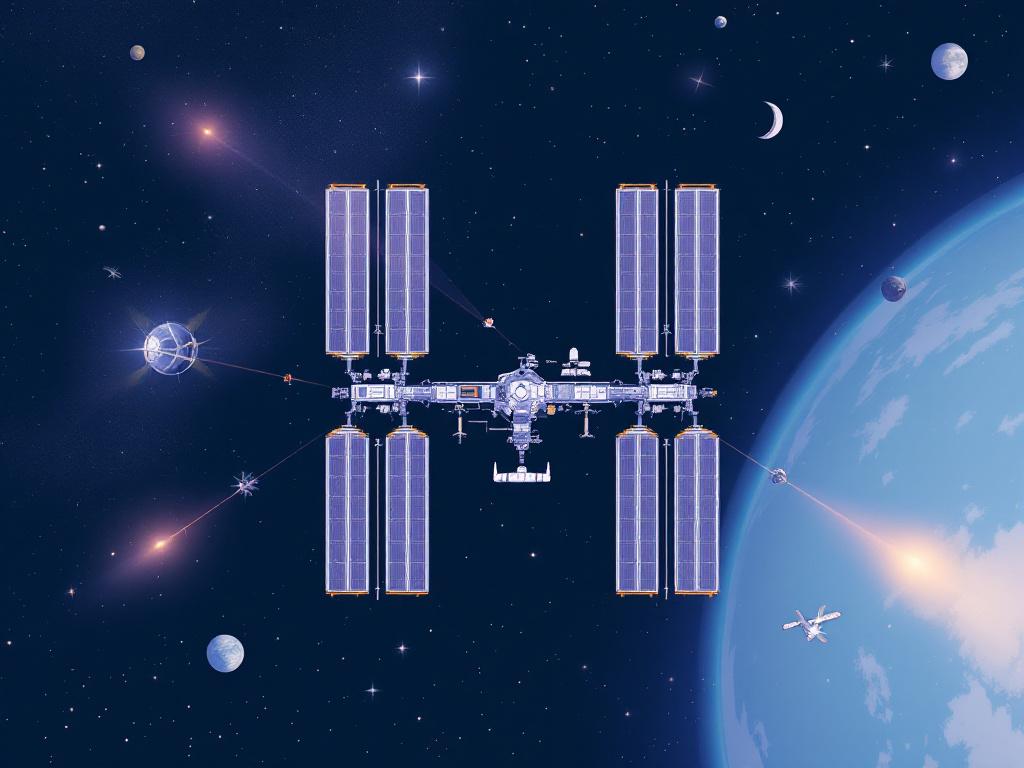
Orbital Milestone: When the ISS Became a Bustling Cosmic Harbor
In the vast expanse of low Earth orbit, the International Space Station (ISS) has long served as humanity’s outpost in space, a symbol of international cooperation and technological prowess. But this week, it achieved a remarkable feat that underscores the accelerating pace of space exploration: all eight of its docking ports are occupied simultaneously for the first time in its 25-year history. This congestion of spacecraft, including crewed capsules and cargo vessels from multiple nations and private companies, highlights the growing complexity and ambition of orbital operations. As of early December 2025, the station hosts a diverse fleet comprising two SpaceX Dragon capsules, a Northrop Grumman Cygnus XL, Japan’s HTV-X1, two Russian Soyuz crew ships, and two Progress resupply vehicles, according to reports from Space.com.
This milestone didn’t happen by accident; it resulted from meticulous planning and a surge in launch activities. The reinstallation of the Cygnus XL to the Earth-facing port of the Unity module was the final piece that filled every available slot, as detailed in a NASA blog post. With ten astronauts currently aboard, the ISS is not just a laboratory but a thriving hub of activity, where scientific experiments, maintenance tasks, and international diplomacy unfold in microgravity. The event comes amid a backdrop of evolving space dynamics, including recent setbacks for Russia’s space program, such as the incident at the Baikonur Cosmodrome that has left future Soyuz launches in uncertainty, as reported by The New York Times.
The implications of this full occupancy extend beyond mere novelty. It demonstrates the robustness of the ISS’s design, originally conceived in the 1990s, to handle an increasing volume of traffic. Engineers and mission controllers have had to adapt protocols for power management, thermal control, and orbital maneuvering to accommodate the added mass and complexity. This scenario tests the limits of the station’s infrastructure, providing valuable data for future habitats like those planned for lunar or Martian missions.
The Engineering Feats Behind the Full House
At the heart of this achievement is the ISS’s modular architecture, which has evolved over decades through contributions from NASA, Roscosmos, the European Space Agency, JAXA, and others. The station’s eight docking ports—four on the Russian segment and four on the U.S.-led side—were not all operational from the start. Upgrades, such as the addition of international docking adapters, have enabled compatibility with newer vehicles like SpaceX’s Dragon and Boeing’s Starliner, though the latter isn’t part of this current lineup. A recent NASA overview notes that the station now supports a mix of crew and cargo ships from various providers, reflecting the diversification of space access.
The Cygnus XL’s role in this record is particularly noteworthy. After delivering supplies, it was robotically relocated using the station’s Canadarm2, a maneuver that freed up space temporarily before being reattached to complete the octet. This flexibility showcases advancements in robotic operations, crucial for long-duration missions where human intervention might be limited. Meanwhile, the presence of two Dragon capsules underscores SpaceX’s dominance in crewed flights, with one serving as a lifeboat and the other facilitating crew rotations.
On the Russian side, the Soyuz and Progress vehicles maintain their longstanding reliability, despite recent challenges. The Baikonur mishap, which damaged launch facilities, could delay future missions, potentially straining the ISS partnership. Industry insiders speculate this might accelerate the transition to alternative launch sites or vehicles, as Russia grapples with geopolitical tensions and aging infrastructure.
Operational Challenges in a Crowded Orbit
Managing eight docked spacecraft requires unprecedented coordination among international teams. Ground controllers in Houston, Moscow, and other centers must synchronize undocking sequences, waste disposal, and experiment schedules to avoid conflicts. The added vehicles increase the station’s drag and alter its center of mass, necessitating more frequent boosts from thrusters to maintain altitude. Fuel efficiency becomes paramount, as each adjustment consumes precious resources.
Moreover, the human element adds layers of complexity. With ten crew members—representing NASA, Roscosmos, and other agencies—the station’s life support systems are pushed to capacity. Air recycling, water purification, and food supplies must scale accordingly, testing the limits of closed-loop technologies. Astronauts report a vibrant but hectic atmosphere, with overlapping shifts and multilingual communications enhancing the collaborative spirit.
This full docking also spotlights safety protocols. Emergency evacuation procedures now account for multiple escape vehicles, ensuring all crew can depart swiftly if needed. Simulations conducted prior to this event, as mentioned in NASA’s archives, prepared teams for scenarios like solar array obstructions or communication blackouts caused by the clustered spacecraft.
Broader Implications for Space Commerce
The record docking aligns with a surge in commercial space activities. SpaceX’s reusable Dragons have lowered costs and increased flight cadence, enabling more frequent visits. Northrop Grumman’s Cygnus, with its enhanced XL variant, exemplifies how private firms are innovating cargo delivery, including capabilities for satellite deployment post-mission. JAXA’s HTV-X1 represents Japan’s commitment to advanced resupply, incorporating technologies for automated docking and waste removal.
Looking ahead, this milestone foreshadows the ISS’s eventual deorbiting, planned for around 2030, and the rise of commercial stations like Axiom Space or Starlab. Lessons from handling eight vehicles will inform designs for these successors, emphasizing scalable docking systems and autonomous operations. Industry analysts note that such congestion could become routine as more players enter the field, from Blue Origin to emerging startups.
Posts on X (formerly Twitter) from space enthusiasts and experts reflect excitement about this event, with users highlighting it as a preview of busier orbital environments. For instance, accounts like those from NASA affiliates have shared visuals and updates, amplifying public interest and underscoring the educational value of these achievements.
Historical Context and Future Trajectories
Historically, the ISS has seen peaks of six or seven docked vehicles, but never eight until now. A 2018 observation noted six as a “fleet,” but today’s count dwarfs that, driven by post-shuttle era advancements. The transition from government monopolies to public-private partnerships has fueled this growth, with companies like SpaceX launching over 100 missions annually.
Challenges loom, however. The Russian launch site’s limbo could disrupt crew rotations, potentially leaving the ISS understaffed. NASA is exploring contingencies, including extended stays for current crews or accelerated development of alternative transport. This uncertainty highlights the fragility of international dependencies in space.
Innovation continues apace. Upcoming missions, such as those involving Boeing’s Starliner or Sierra Space’s Dream Chaser, promise even more diversity in spacecraft types. The data from this full-occupancy period will refine models for traffic management in orbit, akin to air traffic control but in space.
Scientific and Diplomatic Dividends
Scientifically, the crowded station enables a flurry of research. With more cargo arriving, experiments in biology, physics, and materials science can proceed without interruption. The presence of multiple vehicles also allows for unique studies on orbital mechanics and radiation exposure across different modules.
Diplomatically, this event reinforces the ISS as a beacon of cooperation amid terrestrial conflicts. Partners from the U.S., Russia, Japan, and others collaborate seamlessly, a testament to shared goals in exploration. Yet, as the station ages, discussions on its legacy intensify, with calls for sustained funding and knowledge transfer to new ventures.
Public engagement has spiked, with live streams of docking events drawing millions. Educational outreach, including virtual tours, inspires the next generation of engineers and scientists, ensuring the momentum carries forward.
Economic Ripples and Industry Shifts
Economically, the space sector benefits from this visibility. Investments in launch providers and habitat technologies are surging, with market valuations reflecting optimism. SpaceX’s Starship program, aiming for Mars, draws parallels, as its rapid iterations could enable even larger orbital complexes.
Risks persist, from space debris to geopolitical strains. Mitigation strategies, like improved tracking systems, are essential to prevent collisions in increasingly busy orbits.
Ultimately, this record docking at the ISS marks a pivotal moment, bridging current capabilities with future aspirations. As humanity pushes boundaries, such milestones remind us of the ingenuity required to thrive beyond Earth.


 WebProNews is an iEntry Publication