
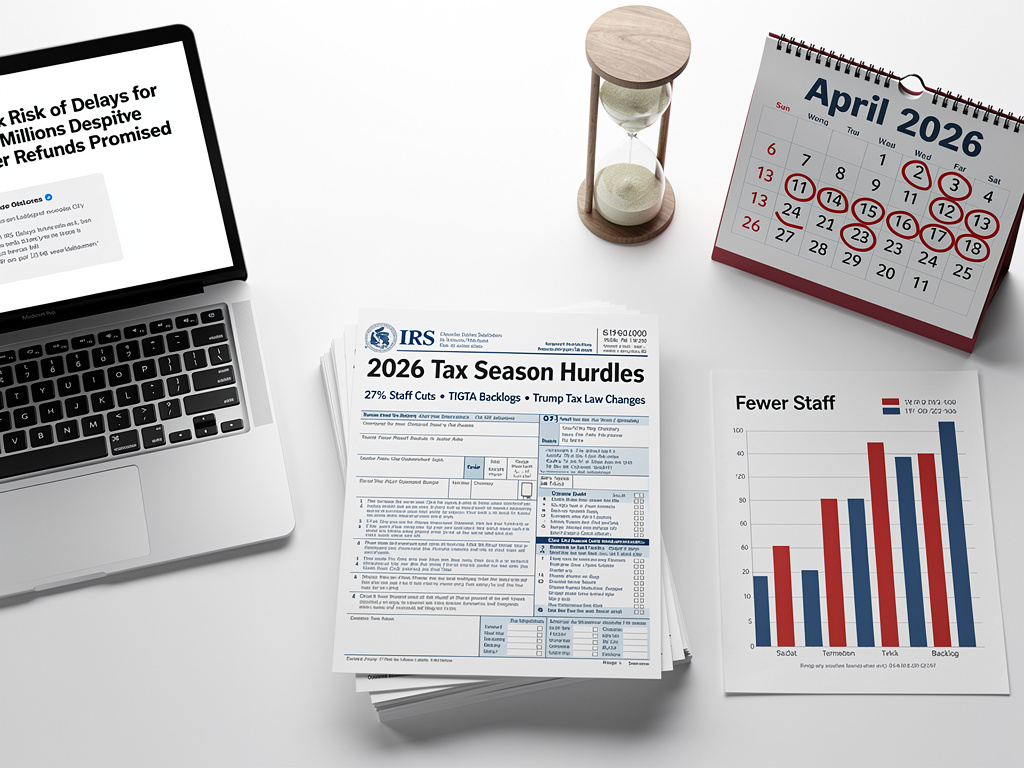
As the 2026 tax filing season kicked off on January 26, the Internal Revenue Service confronts unprecedented strains from a 27% workforce reduction, leadership upheaval, and over 100 retroactive tax code alterations under President Donald Trump’s One Big Beautiful Bill Act. National Taxpayer Advocate Erin M. Collins, in her 2025 Annual Report to Congress, cautioned that while simple electronic filings will process smoothly, millions facing issues could encounter substantial hurdles.
The IRS processed over 165 million individual returns in 2025 with timely refunds for most, bolstered by its largest staff in years and no major law changes. Collins noted, “Among the reasons the 2025 filing season went well was that the IRS had its largest workforce in many years and faced no major tax law changes that required implementation during the filing season.” Yet, entering 2026 marks a sharp shift, with customer service representatives down 22% and new hires lacking the experience of departed veterans, as detailed in a CNBC report.
Workforce Reductions Hit Core Operations
The Treasury Inspector General for Tax Administration (TIGTA) amplified these concerns in a recent memorandum, highlighting significant inventory backlogs 129% above pre-pandemic levels, delayed hiring, and incomplete IT modernization. TIGTA Deputy Inspector General Debra Tengesdal warned, “Inventory that is not worked during the current processing year will be carried into the 2026 Filing Season and may affect the IRS’s ability to timely process tax returns during the filing season, especially with reduced staff.” This could trigger refund delays and interest payments by the IRS, per a Forbes analysis.
Customer service faces acute pressure, with the IRS receiving over 100 million calls and millions of correspondence pieces annually. To cope, the agency slashed its phone service level goal to 70% from 85%, relying on overtime amid training lags of 60-80 days for new staff. Collins emphasized, “The success of the filing season will be defined by how well the IRS is able to assist the millions of taxpayers who experience problems.”
Senate Democrats echoed these worries in a letter to Treasury Secretary Scott Bessent and IRS executives, deeming 2026 a “huge test for the IRS,” as reported by Federal News Network.
Tax Law Overhaul Adds Processing Strain
The One Big Beautiful Bill Act, enacted mid-2025, introduced retroactive changes for 2025 returns filed in 2026, including no tax on overtime, a $6,000 senior deduction, tip income exemptions, and auto loan interest breaks. Without updated withholding tables, Treasury anticipates $100-150 billion in larger refunds—averaging $1,000-$2,000 per household—fueling an affordability push ahead of midterms, according to ABC News.
These shifts demand extensive IRS reprogramming, form updates, and taxpayer guidance. Collins wrote, “The IRS is simultaneously confronting a reduction of 27% of its workforce, leadership turnover, and the implementation of extensive and complex tax law changes… many of which apply retroactively.” TIGTA flagged risks in legislative implementation, per a FedScoop article.
Paper filers—about 11 million or 6% of returns—face extra risks from the Zero Paper Initiative, which has digitized only 4% of 10.7 million Form 1040s as of December 2025, potentially spilling manual work into peak season.
Tech Modernization Falters Amid Cuts
IT staffing plunged 27%, jeopardizing projects like Taxpayer 360 (AI-driven issue resolution), amended return automation, and the Centralized Authorization File for practitioners. A prior TIGTA report noted, “Initiatives to offset staffing losses may not yield expected benefits during the 2026 Filing Season.” IRS CEO Frank Bisignano countered, “The Internal Revenue Service is ready to help taxpayers meet their tax filing and payment obligations during the 2026 filing season,” urging self-service via online accounts.
Budget pressures exacerbate issues: Fiscal 2026 funding dips to $11.2 billion, 9% below 2025’s $12.3 billion. The House advanced deeper cuts, rejecting $850 million for 11,000 call center hires. Experts like Janet Holtzblatt of the Urban-Brookings Tax Policy Center advised, “Buckle your seatbelts. This is going to be a bumpy filing season,” in a CNBC piece.
Direct deposit emerges critical: Without it, refunds hold up to six weeks, per Collins. Electronic, error-free e-filings promise 21-day refunds, but paper checks phase out.
Taxpayer Strategies in a Constrained Era
For seamless processing, filers should e-file accurately with direct deposit, leveraging IRS online tools amid phone bottlenecks. Collins recommended aligning hiring with operational needs: “Workforce planning should be guided by the work necessary to provide timely, accurate service to taxpayers.” Her 2026 Purple Book proposes 71 legislative fixes for rights and administration.
Amid promises of “gigantic” refunds from Secretary Bessent, low-income households reliant on credits face heightened vulnerability to delays, which could mean skipped bills, as noted in The New York Times. X discussions highlight refund hype, with posts from users like @StandUpForFact amplifying $1,000-$2,000 boosts.
The IRS projects 164 million returns by April 15. While most may navigate unscathed, problem cases—exacerbated by staffing voids and law complexities—test the agency’s resilience, setting the stage for potential operational overhauls.


 WebProNews is an iEntry Publication