
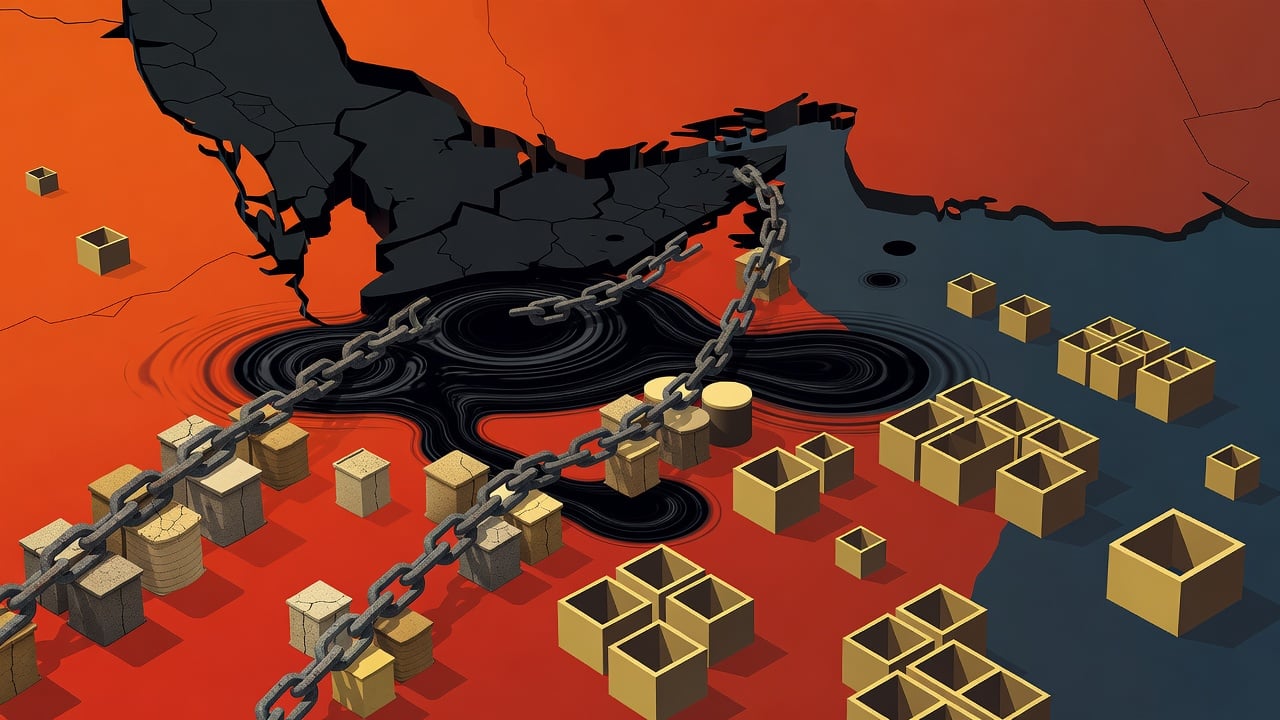
Oil prices spiked again this week. Tankers turned back from the Persian Gulf. And a new United Nations assessment paints a grim picture for the world’s poorest families.
The Fortune report on the UN’s latest findings lays it out plainly. In the worst case, nearly 19 million more people could face chronic undernourishment by 2030 because of disruptions tied to the Iran conflict and threats to close the Strait of Hormuz. The numbers come from the State of Food Security and Nutrition in the World 2026 report, released this week by five UN agencies.
But the story runs deeper than one document. Recent escalations have markets on edge once more. Oil jumped as Iran issued fresh warnings about shipping through the narrow waterway that carries one-fifth of global petroleum. Strikes on energy infrastructure added to the pressure. The Guardian detailed how attacks on tankers near the strait sent Brent crude climbing sharply, its steepest move in weeks.
So what exactly happens when energy flows seize up? Fertilizer production stalls. Natural gas prices soar. Farmers cut back on inputs or switch crops. Global food supplies tighten. Prices rise everywhere. The effect hits hardest where families already spend most of their income on meals.
The UN projections show global hunger falling for three straight years before this shock. From 8.6 percent of the world population in 2022 to 7.8 percent in 2025. About 645 million people. Progress that now risks reversal. In the pessimistic scenario, undernourishment climbs to 522 million by 2030 instead of 503 million. The gap lands mostly in Asia and Africa.
Ten million more in Asia. Eight million more in Africa. The rest scattered elsewhere. Máximo Torero Cullen, chief economist at the Food and Agriculture Organization, described the outcome as eroding gains that had seemed within reach. He spoke to Fortune via email.
Peter Alexander, senior lecturer in global food security at the University of Edinburgh, traced the mechanism in the same article. Fertilizer comes from natural gas. A supply shock anywhere ripples through the world market. Farmers respond to higher prices by using less or planting differently. Less food follows. Prices transmit globally regardless of where the original shortfall occurred.
“Supply and demand would tell you that if there is less supply entering the market for food commodities, then we’re going to see higher food prices,” Alexander said. “It sort of doesn’t really matter where the shortfall occurs. The price gets transmitted everywhere.”
Africa and Asia feel it more. People there allocate larger shares of income to food. Demand stays inelastic. When costs climb, nutrition suffers. North America, by contrast, absorbs the blow without widespread nutritional harm because of higher wealth.
This isn’t abstract modeling. Earlier this year the World Food Programme warned that up to 45 million more people could slip into acute food insecurity by mid-2026 if oil held above $100 a barrel. That figure addressed shorter-term acute crisis rather than the decade-long undernourishment tracked in the new report. Still, the overlap alarms policymakers.
Comparisons to historic famines feel uncomfortable. The UN’s 18.8 million additional chronically hungry exceeds four times low-end estimates of deaths in the Holodomor. It dwarfs the toll of Ireland’s potato famine. The SOFI numbers measure people pushed into hunger, not deaths. The scale still commands attention.
Recent events keep the risks alive. X posts from the past day show traders watching WTI near $85. Iranian strikes on tankers. Houthi threats expanding beyond Hormuz. One user noted Saudi oil tankers bound for China and India making U-turns after warnings in the Red Sea. Another highlighted US strikes on Iranian gas facilities adding upward pressure on prices.
The Council on Foreign Relations examined the recovery challenge. Even after an interim US-Iran ceasefire, restoring normal traffic through the strait won’t prove simple. The disruption shut in more than 10 million barrels per day of oil and substantial LNG volumes for over 100 days. No precedent exists for unwinding a shock this size. CFR noted the fragility and the lasting hunger effects.
Save the Children linked the crisis directly to children. Disruptions since late February have driven a 95 percent drop in strait traffic at peaks. The resulting commodity price surges push millions of children toward hunger. Their analysis from April remains relevant as tensions reignite.
Wikipedia’s entry on the 2026 Iran war fuel crisis captures the breadth. The conflict caused the largest supply disruption in oil market history according to the International Energy Agency. Brent prices swung wildly. Fertilizer shortages compounded food security worries. Panic buying hit multiple continents.
Yet baseline trends before the latest flare-up offered some hope. Hunger had declined. Conflict, climate shocks and economic slowdowns had eased in many places. The Hormuz factor changes the equation. Energy and fertilizer costs become the transmission belt from geopolitics to dinner tables in distant capitals.
Experts warn against viewing the numbers in isolation. The UN report models competing assumptions about how long repairs to damaged Persian Gulf infrastructure might take. Short disruptions produce smaller hunger increases. Prolonged ones multiply the pain. All scenarios show at least 8 million additional undernourished by 2030.
Alexander’s research on energy-fertilizer-food linkages explains why the impact persists. Global markets mean no one escapes the price signal entirely. Poor households lack buffers. They cut calories or sacrifice dietary quality first. Micronutrient deficiencies follow. Child stunting rates could rise in vulnerable zones.
Oil market watchers on X today pointed to the dual chokepoints. Hormuz under Iranian influence. Bab el-Mandeb under Houthi pressure. One post declared the world should prepare for an oil and gas crisis because nearly all supplies pass those two places. Another suggested Iran now effectively controls global oil flows. Hyperbole perhaps. The leverage remains real.
Humanitarian groups have called for protected corridors. The World Food Programme stressed that even resolved conflicts leave hunger scars for months. Supply chains for aid don’t snap back instantly. Donor fatigue adds another layer. Back-to-back years of reduced funding left many programs thin before this crisis hit.
Markets reflect the uncertainty. Prices that had eased from earlier peaks climbed anew after recent tanker attacks and renewed threats. Shipping data shows vessels diverting or canceling passages. Insurance costs surge. The longer the disruption, the deeper the fertilizer shock works through crop cycles in the Southern Hemisphere and beyond.
The UN agencies behind the SOFI report include the Food and Agriculture Organization, International Fund for Agricultural Development, UNICEF, World Food Programme and World Health Organization. Their joint analysis carries weight because it integrates economic modeling with on-the-ground nutrition data.
Torero Cullen’s assessment strikes a measured tone. Progress eroded. Not eliminated. Yet 19 million more people chronically short of food represents a serious step backward on Sustainable Development Goal targets already off track.
Policy responses could soften the blow. Targeted subsidies for fertilizer in at-risk countries. Accelerated humanitarian access agreements. Diplomatic efforts to keep the strait open for food and fuel shipments even amid tensions. History shows such measures work when political will aligns.
But the fundamental link remains. Control over energy arteries translates into control over food access for billions. A single waterway. A handful of actors. Outcomes measured in millions of lives altered years from now.
Observers on social media captured the moment’s tension. Reports of fresh US strikes. Iranian claims of successful actions in the strait. Oil at $85 a barrel serving as a wake-up call for inflation, central banks and equities. The connections move fast from tanker attacks to grocery prices to empty plates.
Longer term, the episode may accelerate diversification away from Middle East energy dependence. Renewables. Alternative shipping routes. Strategic reserves. Those shifts take time and capital that many developing nations lack.
For now the focus stays immediate. Monitoring crop yields in fertilizer-dependent regions. Tracking household food expenditure surveys in Asia and Africa. Updating hunger projections as the conflict evolves. The UN report offers a baseline. Real-world developments will test its assumptions.
One thing appears clear. The price of geopolitical miscalculation in the Gulf will be paid, in part, at kitchen tables far removed from the conflict zone. Millions of them. For years to come.


 WebProNews is an iEntry Publication