
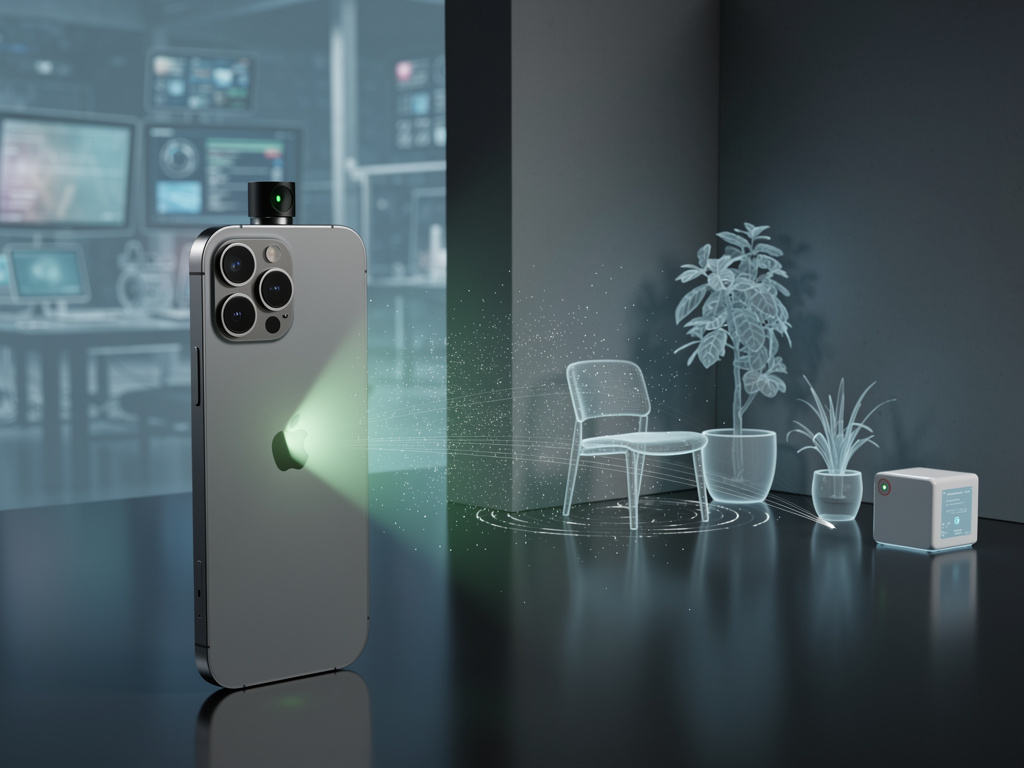
The iPhone’s lidar sensor, originally added to assist with augmented reality features and improved low-light autofocus, may soon expand its capabilities in surprising directions. Researchers have demonstrated how similar time-of-flight systems can detect objects hidden from direct view, effectively allowing a device to see around corners. This development, covered by Digital Trends, points to potential applications that stretch far beyond the current uses in portrait mode or room scanning.
Time-of-flight sensors like lidar work by emitting rapid pulses of laser light and measuring how long the light takes to bounce back from surfaces. The iPhone 12 Pro and later models contain a compact version of this technology that creates detailed depth maps of the immediate environment. While the current hardware primarily serves photography and ARKit experiences, scientists at various institutions have shown that the underlying principle can reveal information about objects not in the camera’s line of sight. The technique relies on capturing faint scattered photons that bounce off multiple surfaces before returning to the sensor.
In laboratory settings, researchers direct a laser toward a visible wall and record the tiny amounts of light that reflect off that wall, then bounce off a hidden object, and finally return after another reflection. By analyzing the precise timing and intensity patterns of these returned photons, sophisticated algorithms reconstruct the shape and position of the obscured item. Early experiments achieved impressive results using high-end scientific equipment, but recent advances suggest that consumer-grade components similar to those in recent iPhones could eventually perform comparable tasks under the right conditions.
The concept builds on a field known as non-line-of-sight imaging. Traditional cameras capture direct light paths, but non-line-of-sight methods interpret indirect paths to infer what lies beyond obstacles. One common demonstration involves a person standing behind a corner while a laser illuminates the floor nearby. The sensor detects light that has bounced from the floor to the person and back again. Mathematical models then process these signals to generate an approximate image of the hidden individual. Although the resulting reconstructions often appear blurry compared to conventional photographs, they contain enough detail to identify basic shapes, movements, or even recognize faces in some controlled tests.
Engineers face several technical hurdles before this technology reaches consumer devices. The lidar sensor in current iPhones operates with relatively low power and a limited field of view compared to specialized research setups. Ambient light from the sun or indoor fixtures can overwhelm the faint signals needed for non-line-of-sight detection. Additionally, the computational demands of reconstructing hidden scenes require substantial processing power, although recent improvements in neural networks have dramatically reduced the time needed for these calculations.
Despite these challenges, progress continues at a steady pace. Teams at institutions such as Stanford University and the Massachusetts Institute of Technology have published papers demonstrating non-line-of-sight imaging with hardware approaching consumer specifications. Some approaches use the same type of single-photon avalanche diodes found in smartphone lidar systems. These detectors can register individual photons with extreme timing precision, which proves essential for distinguishing the complex paths of scattered light.
Practical applications could transform several industries if the technology matures. Emergency responders might use smartphones to locate people trapped in collapsed buildings without entering unstable areas. The device could scan through doorways or around rubble to detect movement or body heat signatures indirectly. Law enforcement agencies have already expressed interest in tools that could reveal threats hidden behind walls during high-risk operations. While current implementations remain too slow for real-time tactical use, incremental improvements in both hardware and software suggest this limitation may not persist indefinitely.
The automotive sector stands to benefit significantly as well. Self-driving cars equipped with enhanced lidar could detect pedestrians or other vehicles around blind corners by analyzing reflections from nearby buildings or road surfaces. This capability would complement existing radar and camera systems, providing an additional layer of situational awareness in complex urban environments. Manufacturers already integrate multiple sensor types in autonomous vehicles, and adding non-line-of-sight functionality represents a logical extension of that approach.
Medical professionals have begun exploring related concepts for minimally invasive procedures. Certain imaging techniques use scattered light to create three-dimensional maps of internal organs without requiring large incisions. While these methods differ from the corner-seeing demonstrations, they rely on similar principles of interpreting diffuse reflections. The success of lidar in consumer devices has accelerated research funding across these seemingly disparate fields, creating unexpected connections between smartphone technology and advanced diagnostic tools.
Consumer applications might emerge in everyday scenarios that feel more ordinary yet still valuable. Imagine pointing your phone around a corner to check if a child is safely playing in another room without disturbing them. Or using the device to locate lost items that have rolled under furniture by analyzing the way light scatters in the space beneath. Interior designers could capture complete room measurements without needing physical access to every nook and cranny. These uses may seem modest compared to lifesaving applications, but they illustrate how the technology could gradually integrate into normal routines.
Privacy considerations naturally arise when discussing the ability to see around corners. The same capability that helps find a missing pet could potentially be misused to spy on neighbors or capture images without consent. Manufacturers would need to implement strict controls and transparent policies governing when and how such features operate. Regulatory bodies may eventually create guidelines similar to those governing wiretapping or other forms of electronic surveillance. The conversation around digital privacy continues to evolve, and non-line-of-sight imaging will likely become part of that ongoing dialogue.
Current iPhone lidar sensors operate at an infrared wavelength that remains invisible to the human eye, which offers both advantages and limitations. The invisible beam prevents distraction during normal photography, yet it also means users cannot easily verify when the system is actively scanning for hidden objects. Future iterations might incorporate visible light components or audible feedback to indicate active non-line-of-sight mode. Software interfaces would need careful design to communicate the probabilistic nature of reconstructions, since the resulting images often contain artifacts or ambiguities that require human interpretation.
The algorithms powering these reconstructions have improved dramatically through machine learning approaches. Rather than solving complex light transport equations analytically, modern systems train neural networks on vast datasets of simulated and real-world scattering patterns. The networks learn to associate particular timing signatures with specific object shapes and positions. This data-driven method has proven more resilient to real-world variables like surface texture and ambient illumination than earlier physics-based models.
Hardware manufacturers continue refining the components that make this possible. The latest iPhone models feature lidar systems with increased resolution and faster readout speeds compared to the first generation. These improvements, while primarily intended for better AR experiences and Night mode portraits, directly benefit non-line-of-sight research by providing higher quality raw data. The smartphone industry’s massive investment in these sensors creates economies of scale that research laboratories could never achieve independently.
Looking forward, the convergence of better hardware, more sophisticated algorithms, and creative applications suggests that seeing around corners may transition from laboratory curiosity to practical tool within the next decade. The technology will likely appear first in specialized professional devices before filtering down to consumer smartphones. Each generation of iPhone brings incremental improvements to the lidar system, and researchers eagerly test their algorithms against the latest available hardware.
The underlying physics has remained constant, but our ability to interpret the subtle information carried by scattered photons continues to advance. What once required room-sized equipment and hours of computation can now be approximated with laptop computers in minutes. As these trends continue, the distinction between visible and hidden may become less absolute, at least from the perspective of our electronic devices.
Engineers emphasize that practical implementations will require balancing multiple competing factors including power consumption, processing speed, accuracy, and size constraints. The version that eventually reaches consumers will likely represent a carefully tuned compromise rather than the most powerful laboratory demonstration. Nevertheless, the mere possibility that everyday phones could gain this extraordinary sense represents a notable expansion of their capabilities.
Various research groups have published open-source code and datasets to accelerate progress in the field. This collaborative approach stands in contrast to the more proprietary development cycles typical of consumer electronics. The cross-pollination between academic research and industry hardware development creates a productive tension that drives innovation in both directions. Smartphone makers gain access to novel use cases that can differentiate their products, while researchers receive detailed specifications and sample hardware to test new theories.
The path from laboratory demonstration to consumer product often spans many years, but the foundational elements already exist in millions of pockets worldwide. The lidar sensor that currently helps you take better pictures in dim restaurants contains the basic physical mechanism needed to detect what lies beyond direct view. Refining the supporting software and addressing the remaining technical obstacles will determine how quickly this capability moves from concept to reality.
As these systems mature, they may fundamentally alter how we interact with spaces both familiar and unknown. The ability to peer around obstacles without moving could change everything from architectural surveys to search and rescue operations. While the images produced may never match the clarity of direct photography, the information they provide could prove invaluable in situations where traditional sight fails completely. The technology builds upon the same foundation that powers current smartphone features, suggesting a natural evolution rather than an entirely foreign addition.
Future updates to iOS may eventually include experimental non-line-of-sight modes, initially limited to specific conditions or requiring additional accessories. Developers might create specialized applications for particular professions while the core capability remains available through the standard camera framework. The gradual introduction would allow both users and regulators to adjust to the new possibilities while the technology continues improving behind the scenes.
The story of the iPhone’s lidar sensor demonstrates how components designed for one purpose can enable entirely different functions as supporting technologies catch up. What began as an AR accessory may eventually help emergency workers locate survivors or allow drivers to avoid hidden hazards. The research highlighted by Digital Trends captures an intriguing moment when science fiction edges closer to practical implementation through components already present in consumer devices. The coming years will reveal exactly how these capabilities develop and what new ways of seeing they ultimately provide.


 WebProNews is an iEntry Publication