
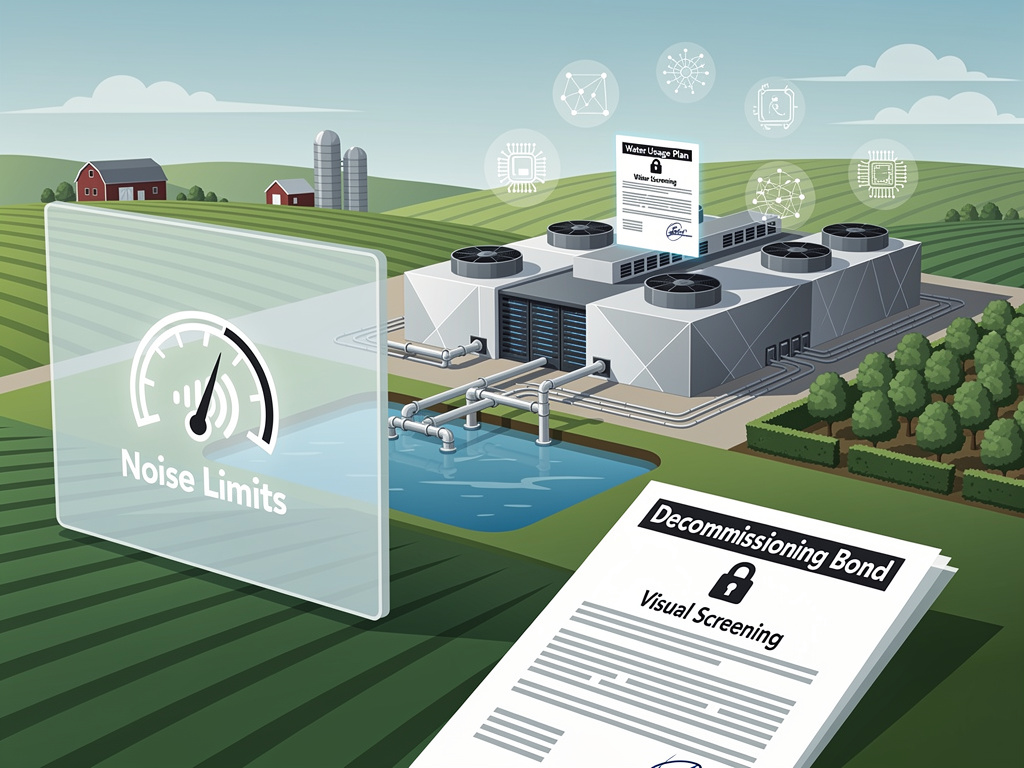
In the rolling farmland of eastern Iowa, a battle over the future of American infrastructure is playing out in county board meetings and public hearings. Linn County, home to Cedar Rapids and a growing target for data center developers hungry for cheap land and abundant power, has enacted what may be one of the most comprehensive local zoning frameworks in the nation specifically designed to govern the construction and operation of massive data centers.
The new regulations, approved by the Linn County Board of Supervisors, represent a growing pushback from rural communities across the United States that find themselves caught between the economic promise of the artificial intelligence boom and the very real costs imposed on local infrastructure, water supplies, and agricultural land. As reported by Slashdot, the Linn County ordinance introduces extensive requirements that go far beyond typical commercial zoning, touching on everything from noise limits and water consumption to visual screening and decommissioning bonds.
A County That Decided Not to Wait for the State
Linn County’s move comes amid a nationwide surge in data center construction driven by the explosive demand for AI computing power. Technology giants including Microsoft, Meta, Google, and Amazon have announced billions of dollars in planned data center investments across the Midwest, drawn by relatively inexpensive electricity, available land, and cooler climates that reduce cooling costs. Iowa has been a particular magnet: Meta already operates a massive facility in Altoona, and Microsoft has invested heavily in West Des Moines.
But as these facilities have proliferated, so have community concerns. Data centers are enormous consumers of electricity and water. A single large-scale facility can draw as much power as a small city and consume millions of gallons of water daily for cooling. They generate constant low-frequency noise from backup generators and cooling systems. And despite their enormous footprints—often spanning hundreds of acres—they create relatively few permanent jobs compared to other industrial developments of similar scale.
What the New Linn County Rules Actually Require
The Linn County ordinance is notable for its specificity. According to reporting on the regulations, the zoning rules establish data centers as a conditional use in agricultural and industrial zones, meaning developers must apply for special permission rather than building as a matter of right. The conditional use process requires public hearings and gives the county board discretion to impose additional conditions on each project.
Among the key provisions: data centers must meet strict noise limits measured at property lines, with different thresholds for daytime and nighttime operations. Developers are required to submit detailed water usage plans and demonstrate that their operations will not adversely affect local water tables or municipal water supplies. The ordinance mandates visual screening—berms, fencing, or vegetation buffers—to shield neighboring properties from the industrial appearance of these facilities, which typically consist of windowless buildings surrounded by acres of mechanical equipment.
Decommissioning Bonds and the Question of What Comes After
Perhaps the most forward-thinking element of the Linn County framework is its decommissioning requirement. Developers must post financial bonds or other security to guarantee that if a data center is abandoned or reaches the end of its useful life, the site will be properly cleaned up and restored. This provision addresses a concern that has dogged other forms of large-scale development: the risk that communities will be left with enormous derelict structures and contaminated land if a company goes bankrupt or simply walks away.
The decommissioning bond concept borrows from practices used in the oil and gas industry and, more recently, in wind and solar energy development. It reflects a hard-won lesson from communities across the industrial Midwest that have been left holding the bag when factories closed and corporate owners disappeared. “We’ve seen what happens when you don’t plan for the end of a facility’s life,” one county official noted during public discussions of the ordinance, according to local reporting. “We’re not going to make that mistake.”
The Broader National Tension Between Growth and Local Control
Linn County is far from alone in grappling with these issues. Across Virginia’s Loudoun County—the nation’s largest data center market—residents have pushed back against continued expansion, citing noise, traffic, and the transformation of suburban neighborhoods into industrial corridors. In central Ohio, communities near Columbus have debated the costs and benefits of the massive data center campuses being built by Google, Amazon, and others. And in rural Oregon, residents near The Dalles have raised alarms about Google’s water consumption from the Columbia River.
What makes Linn County’s approach distinctive is its comprehensiveness. Rather than fighting individual projects on an ad hoc basis, the county has attempted to establish clear, predictable rules that apply to all data center development. This approach has some advantages for developers as well: a clear regulatory framework reduces uncertainty and can actually speed up the permitting process for projects that meet the established criteria.
The Economic Calculus: Jobs, Tax Revenue, and Hidden Costs
Data center proponents argue that these facilities bring significant economic benefits: property tax revenue, construction jobs, and the kind of digital infrastructure that attracts other technology companies. Iowa, like many states, has offered generous tax incentives to attract data center investment, including sales tax exemptions on equipment purchases that can be worth hundreds of millions of dollars for a single project.
Critics counter that the math doesn’t always add up for local communities. A data center that costs $1 billion to build might employ only 50 to 100 permanent workers. The strain on local electrical grids can drive up utility rates for residential customers. Water consumption can compete with agricultural irrigation and municipal supplies, particularly during drought conditions that climate change is making more frequent across the Midwest. And the tax incentives that states offer to attract these facilities often mean that the promised property tax windfalls are significantly smaller than they first appear.
State Legislatures Watching Closely as Local Governments Act First
The Linn County ordinance also raises questions about the appropriate level of government for regulating data center development. Several states, including Virginia and Georgia, have considered statewide frameworks for data center zoning, in part because the patchwork of local regulations can create confusion and drive development toward communities with the weakest rules—a dynamic sometimes called a “race to the bottom.”
Iowa’s state legislature has not yet enacted comprehensive data center zoning legislation, which has left counties like Linn to develop their own approaches. Some industry groups have argued that local regulations can be overly restrictive and that statewide standards would provide more consistency. But local officials counter that they are the ones who must live with the consequences of these developments and should have the primary say in how they are managed.
AI’s Insatiable Appetite and the Infrastructure Reckoning Ahead
The urgency of these debates is only increasing. The International Energy Agency has projected that global data center electricity consumption could more than double by 2030, driven largely by AI workloads. In the United States, utilities are scrambling to build new generation capacity—including, in some cases, restarting retired nuclear plants—to meet the demand. The strain on water resources is similarly acute: a 2023 study found that AI model training at a single data center can consume the equivalent of a small town’s annual water supply.
For communities like Linn County, the question is not whether data centers will come—the economic forces driving their construction are too powerful to resist entirely—but on what terms. The county’s new zoning ordinance represents one answer: a detailed, locally crafted set of rules designed to capture the benefits of data center development while protecting the agricultural character, natural resources, and quality of life that define rural Iowa.
Whether this model spreads to other communities will depend in part on how well it works in practice. If Linn County can attract responsible data center development while maintaining the trust of its residents, other counties across the Midwest and beyond are likely to follow suit. If the regulations prove too burdensome and developers simply go elsewhere, it could strengthen the argument for state-level preemption. Either way, the small county in eastern Iowa has staked out a position that the rest of the country is watching with great interest.


 WebProNews is an iEntry Publication