
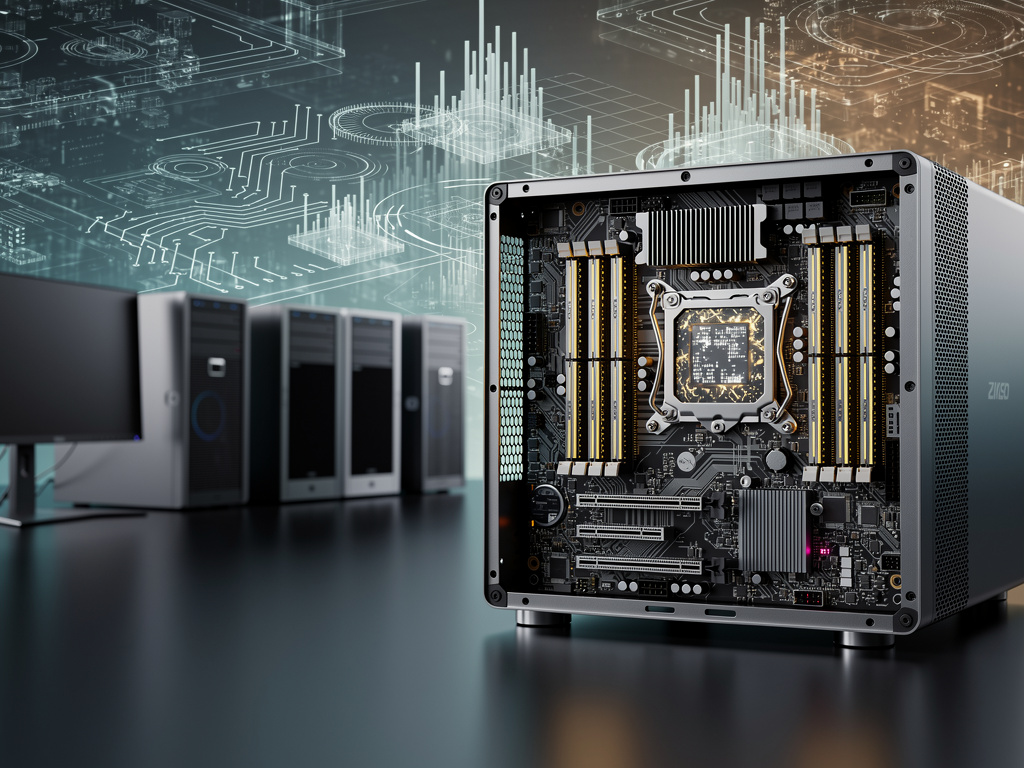
Intel Corporation has launched its most ambitious assault on the professional desktop workstation market in years, introducing the Xeon 6900E series processors that represent a fundamental shift in the company’s competitive strategy against AMD’s entrenched EPYC dominance. The new lineup, built on the Granite Rapids microarchitecture, brings server-class performance to desktop environments with configurations reaching 86 cores and support for up to 4TB of memory—specifications that would have seemed fantastical in desktop systems just a generation ago.
According to TechRadar, Intel’s re-entry into the desktop workstation segment comes after a prolonged absence that saw AMD capture significant market share with its Threadripper PRO processors. The timing proves critical as artificial intelligence workloads, computational fluid dynamics simulations, and massive dataset processing increasingly demand desktop systems that rival traditional server capabilities. Intel’s decision to bring its Granite Rapids architecture—previously reserved for data center deployments—to workstation form factors signals the company recognizes that the boundaries between server and professional desktop computing have effectively dissolved.
The Xeon 6900E processors leverage Intel’s refined Intel 3 process technology, delivering what the company claims represents a 2x performance improvement in certain workloads compared to previous generation Xeon W-3400 series chips. The flagship 6980E model features 86 cores and 172 threads with a base frequency of 2.0 GHz and boost speeds reaching 3.9 GHz, while thermal design power ratings span from 205W to 330W depending on configuration. These specifications position Intel’s offerings in direct competition with AMD’s Threadripper PRO 7000 WX-Series, which currently dominates rendering farms, scientific research institutions, and high-frequency trading operations.
Memory Capacity Breakthrough Addresses Data-Intensive Computing Demands
Perhaps the most significant technical advancement in the Xeon 6900E series involves memory architecture. The processors support eight-channel DDR5 memory with speeds up to DDR5-6400, enabling configurations that can address up to 4TB of system RAM—a specification that positions these workstations as viable alternatives to entry-level server deployments for organizations seeking to consolidate infrastructure. This massive memory capacity proves particularly relevant for genomics research, financial modeling with Monte Carlo simulations, and machine learning model training that previously required dedicated server infrastructure.
Intel has also integrated advanced security features throughout the Xeon 6900E lineup, including Intel Software Guard Extensions (SGX), Total Memory Encryption (TME), and Trust Domain Extensions (TDX). These capabilities address the growing concerns among enterprise customers regarding data sovereignty and protection of intellectual property in environments where workstations process sensitive financial data, proprietary engineering designs, or regulated healthcare information. The security architecture represents a competitive advantage over consumer-oriented high-end desktop processors that lack enterprise-grade protection mechanisms.
Platform Partners and Ecosystem Development
Intel’s workstation resurgence depends heavily on hardware partners delivering complete systems that leverage the Xeon 6900E capabilities. Major workstation manufacturers including Dell Technologies, HP Inc., and Lenovo have announced plans to integrate the new processors into their professional product lines, though specific model availability and pricing remain undisclosed. The W790 chipset that accompanies these processors provides 112 PCIe 5.0 lanes, enabling configurations with multiple high-performance GPUs, NVMe storage arrays, and specialized accelerator cards for cryptographic operations or video encoding.
The expansion slot capabilities prove particularly crucial as workstation users increasingly deploy multiple NVIDIA RTX 6000 Ada or AMD Radeon PRO W7900 graphics cards for GPU-accelerated rendering, AI model inference, or computational visualization. The ability to populate systems with four or more professional graphics cards without PCIe lane compromises represents a tangible advantage over mainstream desktop platforms limited to 20-24 PCIe lanes. This architectural headroom future-proofs investments as software applications continue evolving toward heterogeneous computing models that distribute workloads across CPU cores, GPU shader units, and specialized AI accelerators.
Competitive Positioning Against AMD’s Threadripper Dominance
Intel faces formidable competition from AMD’s Threadripper PRO 7995WX, which offers 96 cores and has established strong brand recognition among professional users in media production, scientific computing, and engineering simulation. AMD’s platform supports eight-channel DDR5 memory and provides 128 PCIe 5.0 lanes, specifications that exceed Intel’s offerings in certain dimensions. However, Intel counters with claimed advantages in single-threaded performance—critical for CAD applications and certain simulation tools that cannot fully parallelize—and tighter integration with the company’s OneAPI programming framework for heterogeneous computing.
Pricing strategy will ultimately determine market reception. AMD’s Threadripper PRO 7995WX commands approximately $10,000 for the processor alone, with complete systems frequently exceeding $20,000 when configured with appropriate memory, storage, and graphics capabilities. Intel has not disclosed Xeon 6900E pricing, though industry analysts anticipate the flagship 6980E will position competitively against AMD’s top-tier offerings while mid-range models with 48-64 cores may undercut AMD equivalents to accelerate market share recapture.
Software Optimization and Performance Validation
The success of Intel’s workstation initiative extends beyond raw hardware specifications to encompass software ecosystem maturation. Intel has partnered with independent software vendors including Autodesk, Dassault Systèmes, and Adobe to optimize professional applications for the Xeon 6900E architecture. These collaborations focus on exploiting the processors’ advanced vector extensions (AVX-512), improving memory access patterns to maximize eight-channel bandwidth utilization, and implementing thread scheduling algorithms that account for the processors’ hybrid core configurations in certain SKUs.
Benchmark results from early testing suggest the Xeon 6900E processors deliver substantial performance improvements in multi-threaded workloads including video encoding, 3D rendering with Chaos V-Ray and Maxon Cinema 4D, and computational fluid dynamics simulations using ANSYS Fluent. Single-threaded performance in applications like AutoCAD and SolidWorks—where responsiveness during interactive design sessions proves paramount—shows more modest gains, reflecting the inherent challenges of improving per-core performance as transistor scaling benefits diminish with each process node generation.
Market Implications for Enterprise IT Strategy
Intel’s aggressive workstation push arrives as organizations reassess remote work infrastructure and distributed computing strategies. The COVID-19 pandemic accelerated adoption of remote desktop virtualization and cloud-based workstation services, yet many organizations discovered that latency, bandwidth costs, and data sovereignty concerns make local workstations preferable for certain use cases. High-performance desktop systems capable of handling AI model development, large-scale data analysis, and real-time simulation enable organizations to maintain computational capabilities on-premises while selectively leveraging cloud resources for burst capacity.
The Xeon 6900E processors also address emerging requirements in edge computing deployments where organizations need server-class reliability and management capabilities in office environments rather than traditional data centers. Financial services firms conducting algorithmic trading, healthcare organizations processing medical imaging, and engineering consultancies running structural analysis can deploy these workstations as departmental compute resources that provide centralized processing power without requiring dedicated server room infrastructure.
Long-Term Strategic Considerations
Intel’s workstation market re-entry represents more than tactical product positioning—it signals the company’s recognition that professional computing segments offer higher margins and greater customer loyalty than consumer markets increasingly commoditized by adequate-performance alternatives. Workstation customers typically maintain multi-year refresh cycles, demand extensive validation and support services, and prove less price-sensitive when performance improvements translate directly to productivity gains or competitive advantages.
The company’s ability to sustain this market position depends on maintaining competitive process technology, delivering consistent generation-over-generation performance improvements, and preventing the execution missteps that allowed AMD to capture workstation market share during Intel’s 14nm process node challenges. The transition to Intel 3 process technology and roadmap commitments for Intel 20A and Intel 18A nodes in coming years provide the foundation for continued competitiveness, though successful execution remains imperative given AMD’s demonstrated ability to leverage TSMC’s manufacturing capabilities.
As professional computing workloads continue evolving toward AI integration, massive dataset processing, and real-time simulation, the workstation market represents a strategic battleground where Intel must demonstrate technological leadership to maintain credibility across its broader product portfolio. The Xeon 6900E series provides the company a credible platform for this competitive engagement, though ultimate success will require sustained innovation, aggressive pricing, and flawless execution across hardware, software, and ecosystem development dimensions.


 WebProNews is an iEntry Publication