
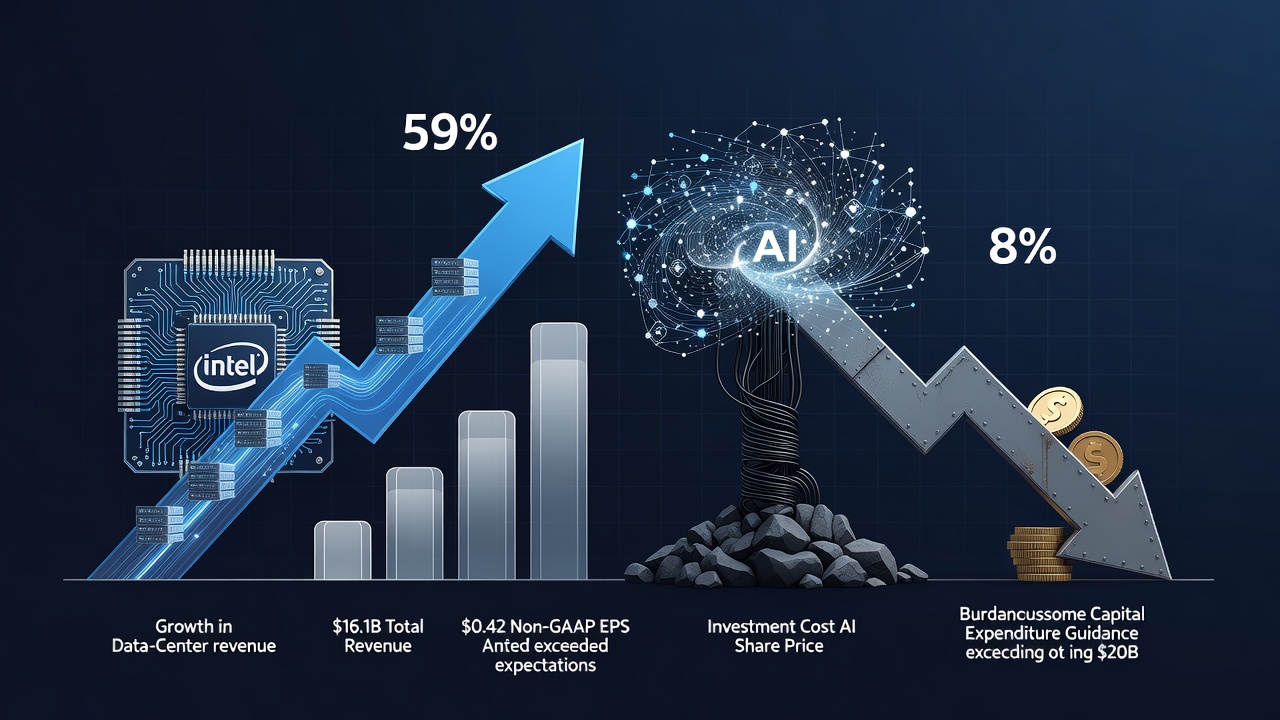
Intel posted its strongest revenue growth in more than 15 years. The numbers beat Wall Street forecasts by wide margins. Yet shares dropped nearly 8% the next day. The market’s cool reaction said as much about future spending as it did about past success.
Second-quarter revenue hit $16.1 billion. That marked a 25% jump from a year earlier. Non-GAAP earnings per share reached $0.42. Analysts had expected just $0.21. The beat extended a streak now at seven straight quarters of topping guidance. But the real story lay in where the money came from — and where it must go next.
Data Center and AI revenue exploded 59% to $6.3 billion. Client Computing and Physical AI Group brought in $8.9 billion, up 13%. Intel Foundry added $5.8 billion, a 31% increase. These figures, pulled straight from the company’s official release, show clear momentum in AI-driven demand. CEO Lip-Bu Tan struck an optimistic tone. “AI is driving unprecedented demand for compute, and as we continue to execute, Intel is well-positioned to capture sustainable growth across our CPU franchise, ASICs, advanced packaging and vast wafer foundry network,” he said.
The gains didn’t appear by accident. CFO Dave Zinsner pointed to better factory yields, faster cycle times and pricing discipline. “We delivered a strong second quarter, exceeding our financial guidance on robust demand and improved execution, including volume upside driven by higher factory yields and improved cycle times,” Zinsner explained in the earnings materials. Non-GAAP gross margin expanded to 41.8%. That ran 280 basis points above the company’s own forecast. Higher average selling prices and a favorable product mix helped.
Cash from operations reached $7 billion. Balance sheet liquidity looked solid. Yet one number overshadowed the celebration. Intel now expects capital expenditures above $20 billion for 2026. Previous guidance sat near $18 billion. Spending in 2027 will climb even higher. The increase targets equipment, clean rooms and substrates to feed both product growth and foundry ambitions. Zinsner framed it as necessary. “AI-driven compute continues to strengthen, and to support expected growth this year and next across products and foundry, we are meaningfully increasing our investments in equipment, clean room space, and substrates.”
Investors weighed that bill against near-term gains. Shares popped in after-hours trading Thursday but gave back ground Friday. The Yahoo Finance report captured the swing. The stock had already climbed more than 130% year-to-date before the print. Enthusiasm cooled once the bigger capex picture emerged. Some analysts trimmed price targets even as they acknowledged the operational progress.
Foundry remains the longest bridge to cross. External customers have been slow to commit at scale. Intel 18A technology entered high-volume manufacturing for Panther Lake. Partnerships with Fortinet on custom silicon and capacity expansions at multiple sites signal intent. A €5 billion investment in European manufacturing for Xeon processors adds to the bet. Still, losses in the foundry business persist. The company continues to absorb inventory charges in certain segments. Progress exists. Validation at the scale of TSMC or GlobalFoundries has not yet arrived.
Third-quarter guidance projects revenue between $15.8 billion and $16.8 billion. Non-GAAP EPS should land near $0.38. Gross margin guidance points to roughly 42% on a non-GAAP basis. Those figures sit above consensus estimates. Demand appears to outrun supply even after recent yield improvements. Tan highlighted physical AI and robotics collaborations with Foxconn and Siemens. Rack-scale AI infrastructure and disaggregated inference solutions round out the product push.
The contrast with prior years feels sharp. Q1 2026 revenue stood at $13.6 billion. The acceleration in Q2 reflects both cyclical recovery and AI tailwinds. Xeon 6 processors and next-generation parts are winning sockets. Client PC refreshes tied to new operating systems add volume. Yet competition from AMD in servers and Nvidia in accelerators has not vanished. Market share data from independent trackers will arrive in coming weeks. Early signals from social discussion on X suggest analysts still hunt for proof of a sustained CPU share rebound.
Leadership changes at Intel Foundry earlier in the year aimed to sharpen focus. New executives carry mandates to accelerate external customer wins. The 18A process node represents the make-or-break bet. If yields continue climbing and major cloud providers sign on, the foundry narrative could flip. If not, the elevated capital spending risks weighing on free cash flow for longer than shareholders prefer.
Recent coverage reinforces the tension. A Investor’s Business Daily analysis noted the data-center surge and the post-earnings stock move. Coverage from Investing.com highlighted the $40 billion in total liquidity and the credible path toward higher gross margins. Those pieces, published within the past 48 hours, echo the same themes. Execution has improved. The investment cycle has intensified.
So Intel stands at a crossroads. The financials show genuine progress. The stock reaction reveals lingering doubt. Higher spending today buys capacity for tomorrow’s AI infrastructure and foundry services. Whether customers show up in sufficient numbers will decide if the strategy pays off. For now the numbers look better than they have in years. The bill for sustaining that momentum just grew larger. And the clock on proving the foundry model keeps ticking.


 WebProNews is an iEntry Publication