
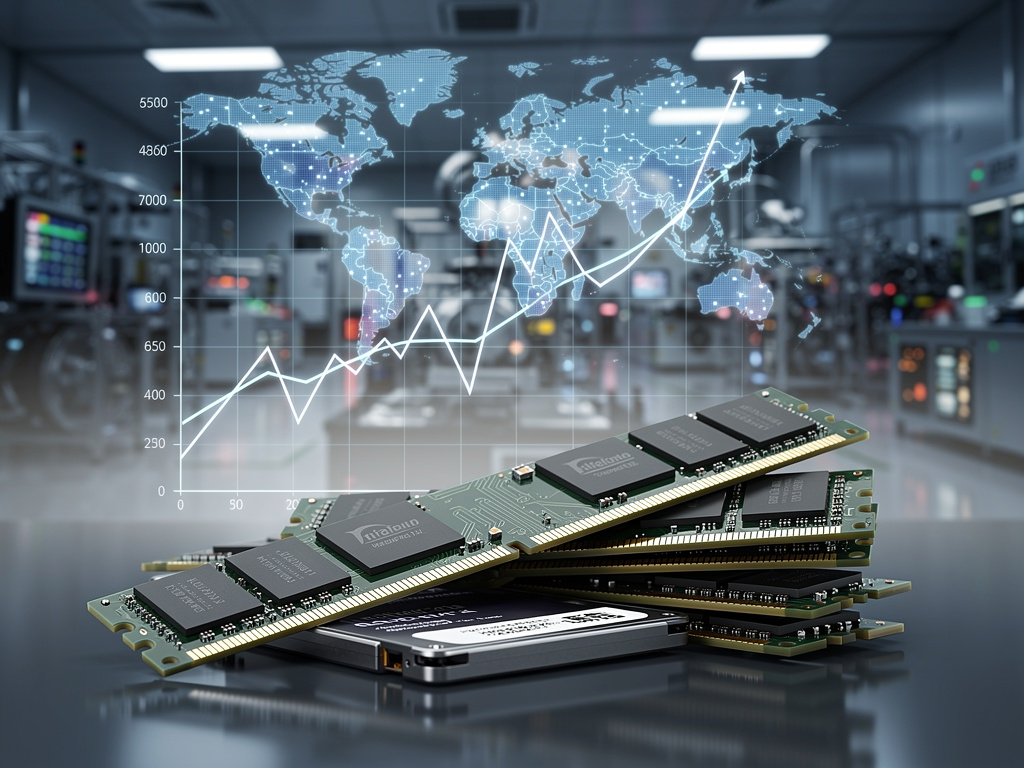
The semiconductor industry faces an extended period of elevated memory prices as supply constraints continue to plague manufacturers and consumers alike, according to Intel’s chief executive. The warning comes at a critical juncture for the technology sector, where expectations for relief from years of volatile pricing have been repeatedly dashed by persistent supply-demand imbalances and geopolitical complexities that show no signs of abating.
Intel CEO Pat Gelsinger’s recent statements have sent ripples through the technology sector, effectively puncturing hopes that memory prices would normalize in the near term. Speaking at industry events and in recent communications, Gelsinger emphasized that the fundamental supply constraints affecting DRAM and NAND flash memory production remain deeply entrenched, with no quick resolution on the horizon. This assessment contradicts earlier optimistic projections from market analysts who had anticipated a gradual easing of prices throughout 2024.
The memory shortage represents more than a temporary inconvenience for the technology industry—it threatens to reshape product development cycles, pricing strategies, and competitive dynamics across multiple sectors. From personal computers to data centers, smartphones to automotive electronics, the ripple effects of constrained memory supply are forcing companies to recalibrate their strategies and manage customer expectations in an increasingly challenging environment.
Manufacturing Bottlenecks and Capital Investment Challenges
The root causes of the ongoing memory shortage extend deep into the semiconductor manufacturing ecosystem. According to Digital Trends, the complexity of modern memory fabrication facilities and the astronomical capital requirements for expanding production capacity have created significant barriers to rapid supply increases. Building new fabrication plants, or fabs, requires investments measured in tens of billions of dollars and construction timelines that stretch across multiple years.
Major memory manufacturers including Samsung, SK Hynix, and Micron Technology have announced capacity expansion plans, but these initiatives face their own headwinds. The lead time between breaking ground on a new facility and achieving volume production can exceed three years, meaning that even aggressive investment today won’t translate into meaningful supply relief until well into the latter half of the decade. This temporal disconnect between investment and output creates a structural rigidity in the memory market that exacerbates price volatility.
Geopolitical Tensions Compound Supply Uncertainties
Beyond manufacturing constraints, geopolitical factors have emerged as significant wildcards in the memory supply equation. The concentration of advanced memory production in East Asia, particularly in South Korea and Taiwan, creates vulnerabilities that extend beyond pure economics. Trade tensions between major economic powers, export controls on advanced semiconductor manufacturing equipment, and concerns about supply chain resilience have all contributed to an environment of heightened uncertainty.
The United States government’s push to reshore semiconductor manufacturing through initiatives like the CHIPS Act represents a long-term strategic response to these vulnerabilities, but offers little immediate relief for current supply constraints. Domestic memory production capacity remains limited, and the expertise required to operate advanced memory fabs at competitive yields takes years to develop. Intel’s own memory business, which it sold to SK Hynix in a deal that closed in 2021, highlighted the challenges even well-capitalized American firms face in this highly specialized market segment.
Demand Dynamics Shift Across Market Segments
While supply constraints dominate headlines, demand patterns have also evolved in ways that complicate price forecasting. The artificial intelligence boom has created unprecedented demand for high-bandwidth memory (HBM), a specialized memory type essential for training and running large language models and other AI workloads. This surge in HBM demand has diverted manufacturing capacity away from conventional DRAM production, tightening supply for mainstream memory products even as overall fab utilization remains high.
Data center operators, cloud service providers, and AI infrastructure companies have shown remarkable price insensitivity when procuring memory for their systems, willing to pay premium prices to secure supply for revenue-generating infrastructure. This willingness to absorb higher costs has created a bifurcated market where enterprise buyers compete in a different pricing tier than consumer-focused manufacturers, further complicating supply allocation decisions for memory producers.
PC and Consumer Electronics Markets Bear the Brunt
The personal computer industry, still recovering from pandemic-era boom-and-bust cycles, finds itself particularly vulnerable to sustained high memory prices. PC manufacturers operate on thin margins and face intense price competition, making it difficult to pass memory cost increases through to consumers without risking market share losses. The result has been compressed margins, delayed product refreshes, and in some cases, specifications that compromise on memory capacity to hit target price points.
Smartphone manufacturers face similar pressures, though the premium smartphone segment has shown somewhat greater resilience. Apple, Samsung, and other flagship device makers have maintained generous memory allocations in their high-end models, absorbing cost increases rather than risking product differentiation. However, mid-range and budget smartphone segments have seen more pronounced impacts, with some manufacturers reducing memory specifications or extending product lifecycles to manage costs.
Enterprise and Cloud Infrastructure Priorities Reshape Allocation
The enterprise computing sector’s voracious appetite for memory, driven by cloud computing expansion and AI infrastructure buildouts, has fundamentally altered how memory manufacturers approach capacity allocation. Server-grade memory commands premium pricing and typically offers better margins than consumer-grade products, creating strong incentives for manufacturers to prioritize enterprise customers even when doing so exacerbates consumer market shortages.
Cloud service providers have responded to tight supply conditions by extending server refresh cycles, optimizing workload placement to maximize memory utilization, and in some cases, developing custom memory solutions in partnership with manufacturers. These strategies provide some buffer against price increases but cannot fully insulate these companies from market dynamics. The capital intensity of cloud infrastructure means that even modest memory price increases translate into significant cost impacts when multiplied across millions of servers.
Technology Transitions Add Complexity to Supply Planning
The ongoing transition to newer memory technologies adds another layer of complexity to supply planning and pricing dynamics. DDR5 memory, the latest generation of mainstream DRAM, continues its gradual market penetration, but adoption rates have been slower than initially anticipated due to platform costs and limited compelling use cases for mainstream users. This creates an awkward overlap period where manufacturers must maintain production capacity for both DDR4 and DDR5, reducing overall efficiency and contributing to tighter supply conditions.
In the NAND flash market, the transition to higher-layer 3D NAND architectures presents similar challenges. While these advanced architectures promise better cost-per-bit economics at scale, the transition requires significant process development and manufacturing adjustments. Yield challenges during technology transitions can temporarily reduce effective capacity, even as manufacturers invest billions in new equipment.
Price Forecasting Remains Fraught with Uncertainty
Industry analysts have repeatedly revised their price forecasts as the expected relief from supply constraints fails to materialize. What began as predictions of price normalization in early 2024 has been pushed back multiple times, with some analysts now suggesting that meaningful price declines may not occur until 2025 or beyond. This uncertainty makes planning difficult for companies across the technology ecosystem, from component buyers to end-product manufacturers.
The historical cyclicality of memory markets offers limited guidance in the current environment. Previous cycles were driven primarily by capacity additions and demand fluctuations, with relatively predictable boom-bust patterns. Today’s market faces a more complex array of factors including geopolitical constraints, technology transitions, and structural demand shifts that make historical patterns less reliable as predictive tools. Memory buyers who delayed purchases hoping for price declines have, in many cases, ended up paying even higher prices as the market continued to tighten.
Strategic Implications for Technology Companies
Intel’s warning carries particular weight given the company’s central position in the computing ecosystem and its historical involvement in the memory business. For technology companies navigating this environment, the message is clear: planning should assume extended periods of elevated memory prices rather than banking on imminent relief. This reality is forcing strategic recalibrations across multiple dimensions, from product roadmaps to pricing strategies to inventory management approaches.
Some companies are exploring alternative approaches to mitigate memory constraints, including more aggressive memory compression techniques, workload optimizations that reduce memory requirements, and in some cases, fundamental architecture changes that alter memory utilization patterns. These adaptations, while valuable, cannot fully offset the impact of sustained high prices and tight supply. The memory market’s challenges represent a constraint that will shape technology industry dynamics for years to come, influencing everything from product capabilities to competitive positioning to end-user pricing across the digital economy.


 WebProNews is an iEntry Publication