
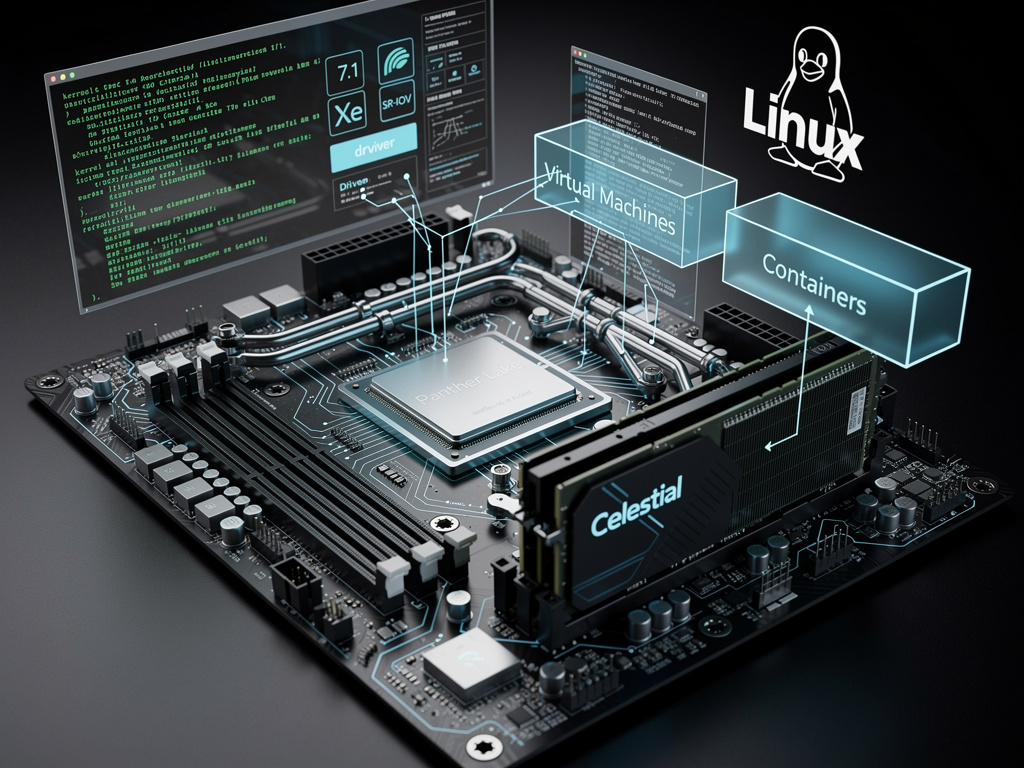
In the quiet corners of the Linux kernel mailing lists, far removed from the flashing lights of consumer product launches, Intel Corp. is systematically laying the software pavement for its next generation of silicon. The company’s open-source graphics team has submitted a substantial batch of updates for the upcoming Linux 7.1 kernel, signaling a maturation of its driver strategy that extends beyond mere hardware support. According to a detailed report by Phoronix, the latest pull request for the "Xe" Direct Rendering Manager (DRM) driver introduces critical enablement for the forthcoming Panther Lake processors and the Celestial discrete graphics architecture.
This development cycle represents a pivotal moment for Intel’s software infrastructure. The Xe driver, designed to replace the aging i915 driver for modern graphics hardware (Gen12 and newer), is transitioning from an experimental alternative to the default standard. The changes queued for Linux 7.1, which serves as the testing ground for features that will eventually trickle down to enterprise distributions, suggest that Intel is accelerating its timeline for 2025 hardware availability. By pushing these updates now, the semiconductor giant aims to ensure that when its 18A-process Panther Lake chips arrive, the Linux operating environment is ready to receive them without friction.
Panther Lake and the 18A Ambition
The most immediate commercial implication of these updates concerns Panther Lake. This processor family is not merely a routine refresh; it is the flagship vehicle for Intel’s 18A process node, a manufacturing technology essential to CEO Pat Gelsinger’s IDM 2.0 strategy. The updates highlighted by Phoronix reveal that support for Panther Lake integrated graphics is moving closer to a validated state. Specifically, the removal of "force_probe" requirements for certain Panther Lake device IDs indicates that the driver team possesses sufficient confidence in the hardware’s stability to allow it to load automatically.
For industry observers, the timing of these patches offers a glimpse into Intel’s production schedule. Hardware enablement in the Linux kernel typically precedes silicon availability by six to twelve months. The stabilization of Panther Lake support in Linux 7.1 aligns with an expected volume ramp in the latter half of 2025. This software readiness is vital for the data center and workstation markets, where Linux dominance requires that hardware support be upstreamed well in advance of deployment. Failure to secure this support early can lead to the kind of rocky launches that have plagued other hardware vendors in the server space.
Celestial and the Discrete Graphics Trajectory
While Panther Lake addresses the client and integrated graphics market, the Linux 7.1 updates also shed light on Intel’s discrete graphics aspirations. The patches include initial enablement for "Celestial," the codename for the third generation of Intel’s Arc graphics architecture (Xe3). This follows the Alchemist (Xe) and the impending Battlemage (Xe2) architectures. The inclusion of B0 stepping support for Celestial suggests that engineering samples are active in Intel’s labs and that the software team is already iterating on the next-generation logic.
The simultaneous development of Battlemage and Celestial drivers illustrates the parallel engineering tracks required to compete with NVIDIA and AMD. As noted in the Phoronix analysis, the Celestial support is currently hidden behind a dedicated configuration option, keeping it isolated from the stable code paths used by current hardware. This isolation allows developers to build the foundation for future GPUs without destabilizing the experience for users of current Arc A-series cards. It demonstrates a disciplined approach to version control that is necessary when managing overlapping hardware generations.
Virtualization and the Enterprise Edge
Beyond new hardware IDs, the technical substance of the Linux 7.1 update focuses heavily on virtualization, a critical requirement for cloud computing and Virtual Desktop Infrastructure (VDI). The pull request includes significant work on Single Root I/O Virtualization (SR-IOV). SR-IOV allows a single physical PCIe device, such as a GPU, to appear as multiple separate physical devices. This capability is essential for sharing GPU resources among multiple virtual machines in a data center environment.
Intel’s legacy i915 driver often struggled with the complexity of virtualization, an area where NVIDIA’s vGPU software has long held a stronghold. The Xe driver was architected from the ground up to handle these modern workloads more efficiently. The recent patches introduce new structures for managing virtual functions (VFs) and physical functions (PFs), signaling that Intel is prioritizing the cloud-native capabilities of its GPUs. By improving how the driver handles memory mapping and interrupt routing for virtualized instances, Intel is effectively removing barriers to entry for its GPUs in the lucrative cloud gaming and remote workstation markets.
Refining the Observation Architecture
A less visible but equally significant aspect of the update concerns the Observation Architecture (OA). This subsystem is responsible for hardware performance counters—the telemetry data that developers use to profile and optimize their applications. The Linux 7.1 updates refactor how the Xe driver manages OA streams, particularly in how it handles buffer flows and stream status checks. While esoteric to the average user, these changes are vital for high-performance computing (HPC) developers who need granular visibility into how their code executes on the silicon.
The updates effectively decouple the OA logic from legacy dependencies, allowing for more accurate data collection with lower overhead. For software vendors optimizing professional applications for Intel hardware, reliable performance counters are non-negotiable. The refinement of this subsystem indicates that Intel is responding to feedback from the developer community, ensuring that the diagnostic tools available on Linux match the fidelity of those available on Windows.
Memory Management and Code Hygiene
The transition to the Xe driver also brings improvements to memory management, specifically regarding huge pages. The latest patches implement a transparent huge page (THP) splitting mechanism for system memory used by the GPU. In high-bandwidth scenarios, managing memory in larger chunks (huge pages) reduces the overhead on the Translation Lookaside Buffer (TLB), thereby improving performance. However, there are instances where these pages must be split to accommodate specific memory constraints or migration tasks.
The code changes detailed by Phoronix show a more sophisticated approach to handling these memory transitions, preventing potential lockups or corruption during intense compute workloads. Furthermore, the development team has used this cycle to purge temporary workarounds. "Wa_14020338487," a specific hardware workaround, has been removed for newer steppings of the hardware, reducing the driver’s complexity. This process of adding support and subsequently cleaning up the technical debt is characteristic of a healthy software lifecycle.
The Strategic Shift from i915
The broader context of these updates is the gradual sunsetting of the i915 driver for new hardware. For over a decade, i915 was the monolithic codebase governing Intel graphics on Linux. However, as GPU complexity exploded with the advent of compute shaders, ray tracing, and AI accelerators, the legacy driver became unwieldy. The Xe driver represents a clean break, designed to leverage modern kernel features like the DRM scheduler and more efficient memory locking primitives.
By aggressively pushing updates for Panther Lake and Celestial into the Xe branch rather than i915, Intel is enforcing a migration path for its partners. Hardware vendors and operating system maintainers must now prioritize the Xe driver stack. This consolidation simplifies validation efforts; instead of maintaining two divergent codebases for modern hardware, resources can be focused on optimizing Xe. The Linux 7.1 updates confirm that there is no turning back: future silicon will rely exclusively on this new architecture.
Looking Toward the Merge Window
The Linux 7.1 merge window has not yet officially opened, but the queuing of these changes in the `drm-xe-next` branch ensures they will be ready for immediate inclusion when Linus Torvalds opens the gates. This proactive approach contrasts with the scrambling often seen in hardware enablement, where drivers arrive months after the hardware launches. Intel’s strategy here appears to be one of predictability and stability.
For enterprise IT decision-makers and hardware partners, the message is clear: the software foundation for Intel’s 2025 roadmap is being poured today. The enabling of Panther Lake and Celestial in the mainline kernel ensures that by the time these products reach the loading docks, the open-source operating system powering the world’s servers and supercomputers will be fluent in their language.


 WebProNews is an iEntry Publication