
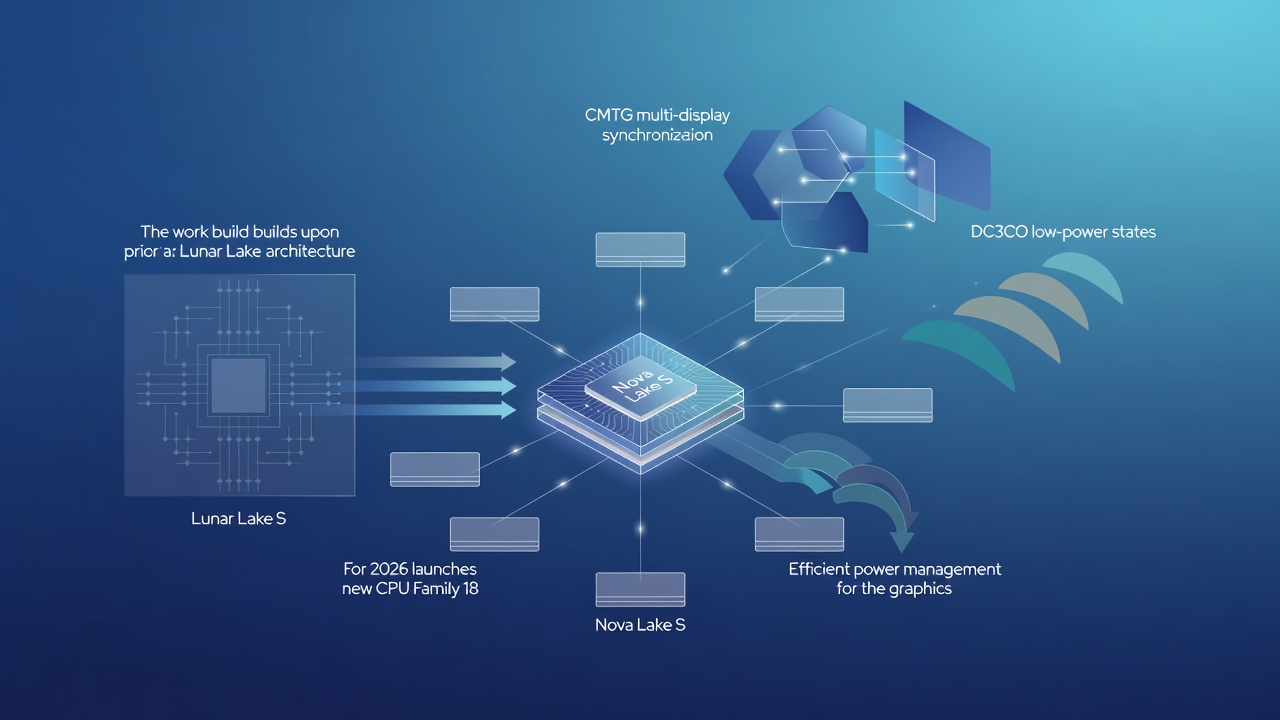
Intel engineers continue their methodical push to ready the next major processor architecture for open-source systems. With the Linux 7.3 kernel still months from its merge window, patches already outline substantial graphics support for Nova Lake S. The latest contributions add two more PCI device IDs to the Xe driver. They drop one that no longer qualifies. The total now stands at seven distinct graphics identifiers for the platform’s Xe3P integrated graphics.
But the activity stretches far beyond simple identification numbers. Separate patches wire up display hardware capabilities that first appeared in Lunar Lake. And they introduce power-saving modes designed to keep the display engine efficient even when the system idles. These moves signal serious preparation for silicon that won’t reach customers until late 2026 at the earliest.
The additions surfaced in the first drm-xe-next pull request for the upcoming kernel. Phoronix reported that device IDs 0xD74A and 0xD74B now appear as valid Nova Lake S parts. Engineers removed 0xD744, likely because it represented an early engineering sample or a variant no longer tied to the final design. Some of the seven IDs may still serve pre-production hardware or remain unused. The pattern matches Intel’s usual practice of seeding driver support long before product announcements.
That early seeding matters. Linux distributions and hardware vendors rely on upstream kernel support to ship functional systems on day one. When Arrow Lake and Lunar Lake debuted, similar PCI ID work preceded official launches by many months. Nova Lake follows the same script but with a notable architectural shift. The new processors will carry the Family 18 designation, retiring the two-decade-old Family 6 model that defined Intel CPUs since the Pentium Pro era.
Phoronix first covered that family change in August 2025. The kernel patches explicitly list Nova Lake as Family 18 Model 1 and Nova Lake L as Model 3. Desktop versions target a late 2026 arrival. Mobile parts come later. The refactoring required changes to how the kernel identifies and initializes Intel processors. Those foundational updates now allow graphics and other subsystem patches to reference the new family without compatibility headaches.
Graphics work dominates the recent submissions. A parallel drm-intel-next pull request delivered display enablement for the same platform. It activates the Common Mode Timing Generator, known as CMTG, for Nova Lake’s Intel Display version 35 block. The feature originated in Lunar Lake. It synchronizes timing signals across multiple outputs. Laptop users gain precise alignment between the internal eDP panel and an external DisplayPort monitor. Without it, multi-monitor setups risk tearing or inconsistent refresh rates.
The same batch enables DC3CO. Short for Display C3 with Clock Off, this low-power state shuts down the display engine’s power well during PSR2 idle periods. The result is lower energy consumption without sacrificing the ability to wake quickly. Phoronix detailed both features on July 3, 2026, noting they represent “nice features to see now in place” as preparation for Nova Lake’s integrated graphics launch. The article also highlighted that it remains unclear which kernel version Intel will ultimately declare as the baseline supported release.
Additional changes touch firmware handling. Starting with Nova Lake’s Media 35 engine, the Protected Xe Path security feature drops its dependency on HuC firmware loaded by the kernel. Instead, user-space loads the firmware. The shift simplifies kernel responsibilities and aligns with Intel’s evolving driver architecture. The Xe pull request also includes Nova Lake-specific workarounds, improvements to DRM reliability accounting and service, plus assorted fixes and code cleanup.
These patches arrive against a backdrop of broader kernel evolution. Linux 7.1 and 7.2 already incorporated early Nova Lake references alongside support for other forthcoming hardware from AMD and Intel. Recent X posts reflect community awareness. One July 3 thread linked to coverage of the Xe3P driver updates and CMTG synchronization capabilities. Earlier discussions around Linux 7.0 and 7.1 mentioned Nova Lake graphics in the same breath as Zen 6 preparations and filesystem improvements. The steady drumbeat shows how upstream developers treat these future platforms as active development targets rather than distant speculation.
Intel’s approach carries risks and advantages. Early driver work invites community testing on engineering samples. It surfaces bugs months or years before volume shipments. Yet it also commits engineering resources to hardware that could still change. PCI IDs sometimes get reassigned. Features can shift between generations. The dropped 0xD744 ID illustrates exactly that fluidity. Still, the pace of submissions suggests confidence in the current direction.
Observers note that Nova Lake will introduce the Xe3P graphics architecture. Details remain sparse. The focus so far rests on enabling existing Xe driver infrastructure for the new silicon rather than wholesale architectural overhauls. That incremental strategy proved effective for previous generations. It lets kernel maintainers merge stable code early while leaving room for performance tweaks closer to launch.
Power management receives particular attention. DC3CO builds on prior display C-states. It targets scenarios where the panel stays static for long periods. Such optimizations matter for both desktop and mobile variants, though the latter stand to benefit most. CMTG, meanwhile, addresses a practical pain point for users who dock laptops or run multi-monitor desktops. Precise timing synchronization reduces visual artifacts that once required manual adjustment or driver hacks.
The Linux 7.3 merge window sits in late August. Intel typically sends several more graphics pull requests before then. Each round tends to expand feature coverage and refine existing code. By the time the kernel ships, Nova Lake support could include substantially more than seven PCI IDs and basic display enablement. Subsequent point releases will almost certainly add runtime power tuning, additional media capabilities, and performance fixes based on real hardware testing.
Downstream distributions watch these developments closely. Ubuntu, Fedora, and SUSE often backport key Intel patches to their LTS kernels. Enterprise users deploying workstations or servers built on Intel silicon want confidence that the open-source stack will recognize and properly drive new processors from the first boot. The current activity lays that groundwork.
Of course, kernel support forms only one piece of the puzzle. Firmware, user-space drivers, toolchains, and application libraries must align as well. Intel has already begun related work. Compiler patches and media driver updates have referenced Nova Lake in recent quarters. The combined effort points to a coordinated push across the software stack.
Industry watchers expect Nova Lake to emphasize efficiency and AI acceleration alongside traditional CPU and GPU improvements. The Linux enablement activity offers a narrow but revealing window into those plans. Every added PCI ID, every wired-up timing generator, every power state represents concrete progress toward production readiness. The process unfolds in public view through mailing lists and sites that track kernel patches. For hardware vendors, systems integrators, and developers who build on Linux, that transparency provides months of lead time to prepare.
The latest patches don’t deliver flashy benchmarks or dramatic claims. They simply add recognition for more hardware variants and activate features that make the platform work as expected. Yet their cumulative weight matters. Year after year, this quiet upstream collaboration has shortened the gap between silicon tapeout and functional open-source support. Nova Lake appears poised to follow that pattern. And with the family transition to 18 now codified, the kernel community has formally turned the page on an architectural era that lasted longer than many current engineers have been coding.


 WebProNews is an iEntry Publication