
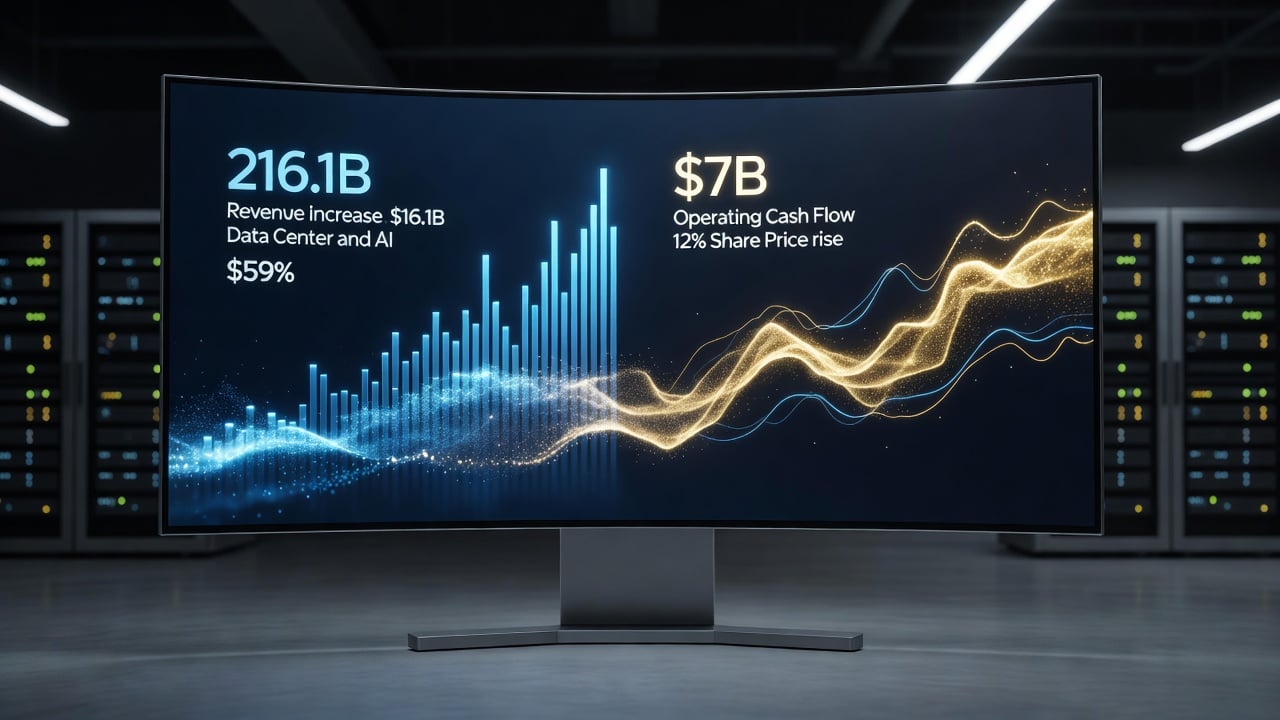
Intel shares soared after the chipmaker posted strong second-quarter results that beat expectations and highlighted a dramatic improvement in cash generation. The Santa Clara, California-based company reported revenue of $16.1 billion. That’s a 25% jump from the same period a year earlier.
Non-GAAP earnings per share came in at 42 cents. The figures marked a clear step forward in Chief Executive Lip-Bu Tan’s efforts to steady the company amid fierce competition from Nvidia and others in artificial intelligence chips. But the standout detail? Cash from operations reached $7 billion. It reflected operational discipline that investors had long demanded.
The market reacted immediately. Shares jumped as much as 12% in after-hours trading following the July 23 release. The move signaled relief among holders who watched the stock slump earlier this summer amid broader semiconductor selloffs. Strong execution. Better margins. Clear AI momentum.
Client computing revenue climbed 13% to $8.9 billion. Data Center and AI posted even stronger gains. That segment generated $6.3 billion. A 59% increase year over year. Intel Foundry, the company’s contract manufacturing arm, added $5.8 billion. Up 31%. These numbers tell a story of diversification finally paying dividends.
Yet not everything looked perfect. GAAP results showed a loss. The company continues to absorb restructuring costs and heavy capital spending on new fabs. Still, the cash flow figure stood out. It offered tangible proof that Intel can fund its ambitious plans without endless dilution or debt.
From Foundry Bet to AI Infrastructure Leader
The turnaround narrative gained fresh fuel with these results. Tan, who took the helm last year, has pushed hard to refocus Intel on process technology leadership and foundry services. The Q2 print shows early wins. Demand for Intel’s Gaudi accelerators and Xeon processors in AI training and inference environments accelerated. Customers ranging from cloud providers to enterprises snapped up capacity.
Analysts had penciled in more modest growth. Intel topped those marks across key segments. The company now guides third-quarter revenue between $15.8 billion and $16.8 billion. Non-GAAP EPS around 38 cents. Guidance that struck a balance between optimism and realism given ongoing macroeconomic uncertainty.
But here’s where the story gets interesting. Memory shortages emerged as a major bottleneck for AI infrastructure buildouts. Tan highlighted the issue directly on the earnings call. “The memory become the big supply constraint challenge,” he said. Intel is working closely with the three major memory suppliers to secure DRAM and high-bandwidth memory. The collaboration aims to keep customer deployments on track.
This admission underscores a broader industry tension. AI spending continues at breakneck speed. Yet the supporting supply chain strains under the weight. Intel positions itself as both a beneficiary and a potential solution provider through its foundry offerings. Its Intel 18A process node, slated for production later this year, could attract new customers seeking alternatives to TSMC.
Recent industry reports reinforce the momentum. A Yahoo Finance analysis published just before the results noted expectations for Data Center and AI revenue around $5.5 billion. Intel exceeded that handily. The beat adds credibility to Tan’s strategy.
Investors have reasons for caution too. The semiconductor sector faced sharp declines in early July as questions swirled around the sustainability of AI capital expenditures. A Forbes report from July 8 detailed how the Philadelphia Semiconductor Index dropped over 10%. Intel shares fell more than 20% at one point. The Q2 rebound offers a counterpoint. Cash generation of this magnitude gives Intel breathing room to invest without panic.
Compare this to the picture painted in earlier coverage. A briefing from The Information captured the immediate market reaction to the cash flow strength. While that piece focused on a $4.5 billion cash generation figure from preliminary data, the final release showed even stronger operational cash flow at $7 billion. The difference highlights how final adjustments and working capital improvements exceeded initial expectations.
Intel’s foundry bet carries high stakes. The company has poured billions into U.S. and European facilities. A recent announcement detailed a €5 billion investment to expand manufacturing on the continent. That move aims to reduce geopolitical risks and capture more government incentives. Success here could reshape the global chip supply chain. Failure would leave Intel further behind.
So what changed? Cost discipline played a big role. The company has streamlined operations. It shed non-core assets. Leadership emphasized profitable growth over market share at any cost. CFO Dave Zinsner noted on the call that the team is “increasing AI investments” while delivering results. The balance appears delicate but effective so far.
Wall Street’s response mixed relief with questions about longevity. Can Intel sustain this trajectory? Memory constraints could slow AI server deployments industrywide. Competition from custom chips at hyperscalers remains intense. And the foundry business must win external customers to justify the capital outlay.
Still, the cash position changes the conversation. Earlier periods showed negative free cash flow and heavy spending. Now positive signals emerge. The company can fund its roadmap, pursue partnerships like the recent Google Cloud collaboration on AI agents, and potentially resume shareholder returns down the line.
Industry watchers point to Intel’s progress on its 18A node as a pivotal test. If it delivers on promised performance and power efficiency, major cloud operators could shift some production. That would validate years of investment. Tan’s background in semiconductors and venture capital brings a fresh perspective. He stresses execution speed and customer intimacy.
Recent layoffs in the Data Center and AI group signal continued restructuring. Electronics Weekly reported additional cuts aimed at aligning skills with long-term needs. Such moves, though painful, support the efficiency drive that produced this quarter’s cash flow.
The broader context matters. AI adoption accelerates across enterprises. Data centers require not just GPUs but CPUs, networking, memory and custom silicon. Intel supplies pieces across that stack. Its latest results suggest it captures more of that spend than skeptics anticipated.
Shares had traded below some analysts’ price targets before the report. Post-earnings sentiment shifted. The 12% pop erased some of the summer losses. Yet the stock remains well off its highs from earlier AI enthusiasm.
Looking ahead, several factors will decide if this marks a lasting inflection. Delivery on 18A ramp. Continued foundry wins. Management of memory and other supply constraints. And above all, consistent cash generation that funds innovation without eroding the balance sheet.
Intel isn’t out of the woods. The chip industry cycles rapidly. Geopolitical tensions complicate manufacturing plans. But this quarter’s numbers provide evidence that the turnaround efforts have traction. Cash doesn’t lie. And right now, Intel is generating plenty of it.
That fact alone won’t silence every critic. The company must prove it can compound these gains. For an industry that rewards momentum, however, the combination of revenue growth, segment beats and strong cash flow offers a compelling new chapter. Investors will watch the next few quarters closely to see if the story holds.


 WebProNews is an iEntry Publication