
Intel has finally crossed into high-volume manufacturing with its 18A process node. The achievement caps years of heavy investment and technical resets. And it arrives at a moment when the chipmaker’s future hangs on whether this node can deliver both internal wins and external foundry customers.
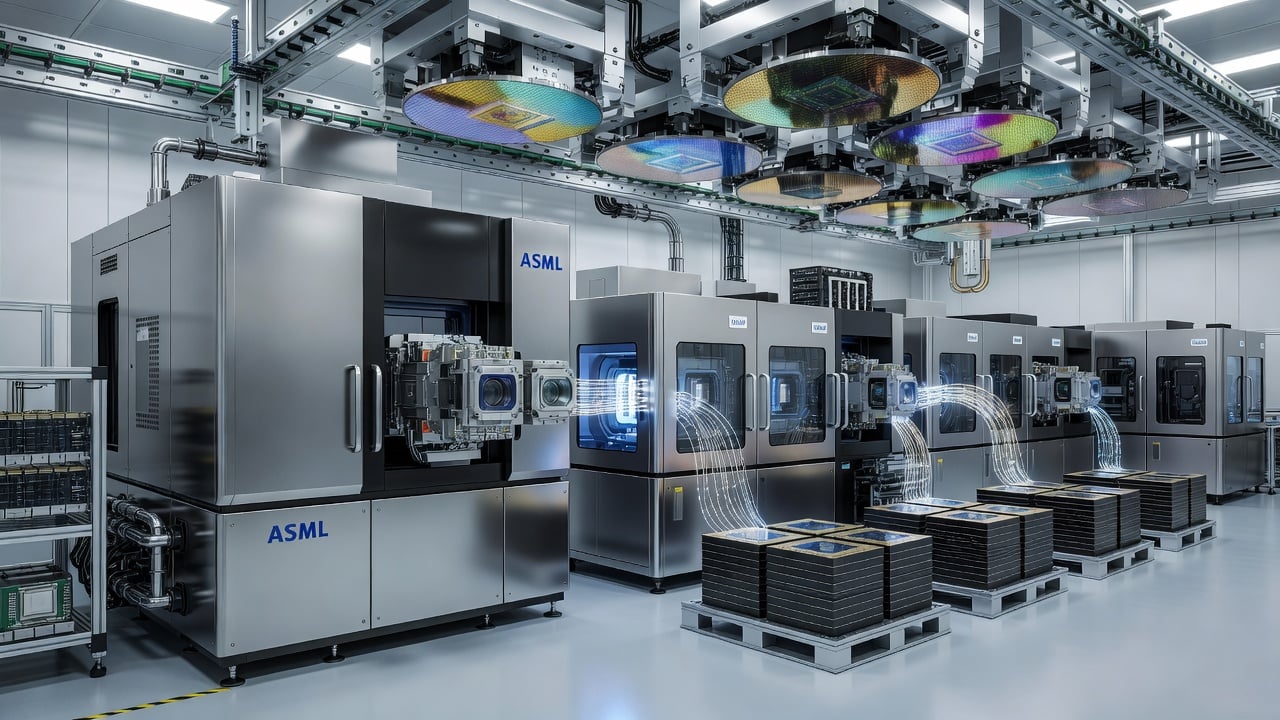
Just days ago, ASML CEO Christophe Fouquet told investors that commercial Intel products now come from the company’s most advanced lithography tool. “Some of the product you buy today from Intel have been created with a High-NA machine,” he said during the equipment maker’s earnings call. Yahoo Finance reported the comment, labeling it “a very important milestone.” The $400 million systems mark a shift from prototype to real output. Short sentence. Long one that connects the dots between lithography breakthroughs, backside power delivery and the urgent need to close the gap with TSMC.
Intel’s 18A node integrates RibbonFET gate-all-around transistors with PowerVia backside power delivery. These features first appeared in lead products Panther Lake for client systems and Clearwater Forest for servers. Both powered on and booted operating systems less than two quarters after tape-out. The company announced that progress in August 2024, with production targeted for 2025. Intel Newsroom detailed the early success and noted the first external customer tape-out expected in the first half of 2025.
But the road proved bumpy. Reports surfaced in 2025 of yields hovering near 10 percent. Mass production looked economically unviable at those levels. Korean media and analysts flagged delays. Intel adjusted. It never planned full high-volume manufacturing of 18A by the end of 2024. Panther Lake chips began shipping in volume in early 2026. Wccftech covered the yield concerns and the strategic patience behind pushing volume into 2026.
By January 2026 Intel officially launched high-volume manufacturing for the node. The move completed CEO Pat Gelsinger’s five nodes in four years plan. Panther Lake, branded as Core Ultra Series 3, became the first client processor built on 18A. It reached shelves through dozens of PC makers. Performance claims included significant gains over prior generations. FinancialContent described the milestone as the culmination of an aggressive turnaround.
From Risk Production to Performance Gains
Progress continued. At the VLSI Symposium in June 2026 Intel revealed that 18A-P, the first performance-enhanced version of the family, had entered risk production. The node delivers 9 percent higher performance at the same power or 18 percent lower power at the same performance compared with base 18A. Thermal resistance improves 20 to 40 percent. Via resistance drops 10 to 30 percent. Design rules stay fully compatible so intellectual property carries over without rework.
“Our updates and presentations at VLSI signal to Intel Foundry customers and partners that we are fully committed to leading edge process innovation over the long term,” said Naga Chandrasekaran, executive vice president and general manager of Intel Foundry. “This is a journey, and while we have more work ahead, we appreciate the opportunity to share the progress we are making with Intel 18A-P and our longer-range R&D.” The comments appeared in the official symposium recap. Intel Newsroom published the details on June 16, 2026.
Reuters picked up the same announcement. It noted CEO Lip-Bu Tan had begun viewing 18A as a viable offering for outside clients, a reversal from earlier internal-only plans. Finance chief David Zinsner echoed that shift in March. The company forecast second-quarter revenue between $13.8 billion and $14.8 billion. Reuters framed the risk production step as evidence Intel follows through on manufacturing commitments.
Yields have climbed. CFO Zinsner told analysts in late 2025 that the process sat in the middle of the yield ramp curve. He expected cost-appropriate levels by the end of 2026 and industry-standard results in 2027. Capacity additions would stay measured. “I would not expect significant capacity increases in the near term,” he said. The node will remain in use for years. Peak supply may not arrive until the end of the decade. Tom’s Hardware reported those remarks in October 2025.
Recent chatter on X shows the conversation has broadened. Engineers debate transistor density metrics. Some note that metal pitch in SMIC’s latest 7-nanometer-class process appears tighter than 18A in certain layers, even without EUV tools. Others counter that raw density numbers miss the full picture of performance, power and system-level gains. One post highlighted that Intel’s 18A high-density library trades some density for PowerVia headroom and overall efficiency. These discussions reflect how node comparisons have grown more application-specific.
Panther Lake itself combines CPU, GPU and other tiles in a system-on-chip design. Early benchmarks from CES 2026 showed strong integrated graphics performance in games. Laptops using the chips reached the market in volume despite initial supply constraints. A June 2026 report from Culpium noted shortages of Panther Lake and related 18A parts, a sign demand outstripped early output. Culpium cited multiple sources in the supply chain.
Longer term Intel continues research beyond 18A. Work on complementary FET transistors at 45-nanometer gate pitch, gallium nitride integration on silicon and subtractive ruthenium interconnects aims to extend scaling. These projects appeared in the same VLSI presentations. They signal the company wants to offer not just a competitive node today but a technology roadmap that keeps customers engaged for generations.
The stakes remain high. Intel’s foundry business needs external tape-outs to justify the enormous capital spent on U.S. fabs in Arizona and Oregon. Panther Lake success helps. So does the demonstrated progress on 18A-P. Yet TSMC’s 2-nanometer process and Samsung’s advances keep pressure intense. One milestone rarely settles the race. Consistent execution across yields, cost and customer wins will decide if Intel regains process leadership or settles into a strong second place.
So the High-NA machines now churn out real silicon. Commercial products already reach buyers. The question shifts from whether Intel can reach this point to how far it can push from here. Yields continue improving. New derivatives arrive. External customers watch closely. The next chapters will test whether this manufacturing foundation can support a durable resurgence.


 WebProNews is an iEntry Publication