
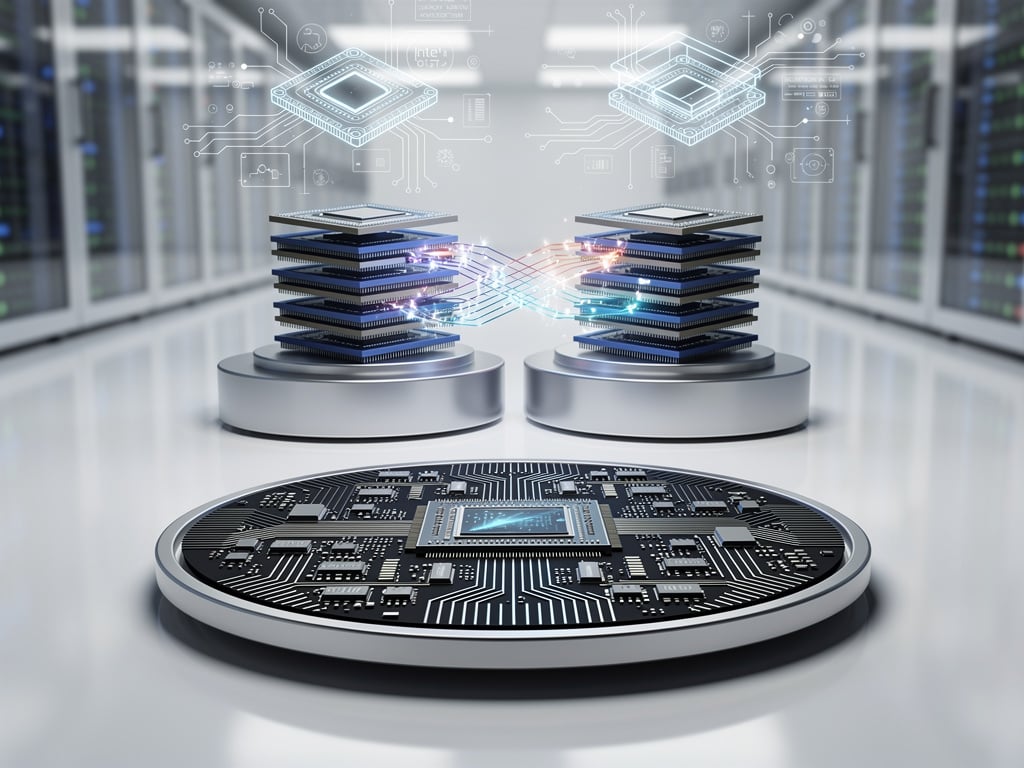
Intel shares jumped more than 12 percent in early trading after the company announced a major agreement with Hitachi to jointly develop and produce advanced semiconductor packaging technologies. The partnership focuses on creating high-performance solutions for data centers, artificial intelligence systems, and high-end computing applications that require greater power efficiency and processing density than current methods allow.
The deal comes at a critical moment for Intel, which has faced mounting pressure from investors and customers over delays in its manufacturing roadmap and increased competition from Taiwan Semiconductor Manufacturing Company and Samsung Electronics. Under the terms of the agreement, the two companies will combine their expertise in advanced packaging to speed up development of new technologies that stack multiple chips together in ways that improve speed while reducing energy consumption. Hitachi brings decades of experience in materials science and precision manufacturing, areas where Intel has sought to strengthen its position through external collaborations.
According to details released by both companies, the collaboration will center on hybrid bonding techniques and other next-generation packaging approaches that allow for much finer connections between different silicon components. These methods can dramatically increase bandwidth between processors, memory, and specialized accelerators while lowering latency and power requirements. Such capabilities have become essential as artificial intelligence models grow larger and data center operators search for ways to manage exploding electricity costs.
Intel has positioned advanced packaging as one of its primary competitive advantages against foundry rivals. The company’s EMIB and Foveros technologies already power some of its most successful products, including certain Xeon processors and the Ponte Vecchio data center GPU. By working with Hitachi, Intel aims to accelerate progress on even more sophisticated stacking methods that could appear in future generations of its products. The Japanese industrial giant operates extensive research facilities and has long supplied critical materials and equipment to the semiconductor industry worldwide.
The stock reaction reflected relief among investors who have watched Intel’s market value erode over the past three years. Shares had fallen more than 60 percent from their 2021 peak before this announcement, as the company repeatedly pushed back production timelines for its Intel 3 and Intel 18A process nodes. Chief Executive Pat Gelsinger has repeatedly emphasized that packaging innovation represents an equally important lever for performance gains when traditional transistor scaling becomes more difficult and expensive.
This pact with Hitachi forms part of a broader strategy that includes multiple partnerships across the supply chain. Intel has also expanded its foundry services business with the goal of attracting external customers who might otherwise rely exclusively on TSMC. The company recently broke ground on new fabrication facilities in Ohio, Arizona, and Germany as it seeks to rebuild manufacturing capacity inside the United States and Europe. Government support through the CHIPS and Science Act has provided billions in grants and loans to offset the enormous capital costs involved.
Hitachi, for its part, views the agreement as a way to expand its footprint in the rapidly growing advanced packaging segment. The company already produces specialized materials used in semiconductor assembly and has invested heavily in research around thermal management and high-density interconnects. Japanese technology firms have historically maintained close relationships with domestic chip producers, but many have broadened their focus to serve global customers as demand for sophisticated computing hardware spreads beyond traditional personal computer and smartphone markets.
Analysts following the semiconductor industry suggest the collaboration could help both companies address technical challenges that have slowed progress across the sector. As transistors reach atomic-scale dimensions, further improvements in raw processing power have become harder to achieve through traditional lithography alone. Packaging innovations that allow multiple specialized chips to work together as a single system have therefore taken on greater importance. Companies like AMD and Nvidia have already demonstrated the performance advantages of chiplet architectures in their latest graphics processors and server CPUs.
The financial terms of the Intel-Hitachi agreement were not disclosed, but similar partnerships in the industry often involve shared research funding, technology cross-licensing, and joint manufacturing investments. Both organizations indicated that initial development work has already begun at facilities in Japan and the United States. Engineers from each company will collaborate on materials research, process refinement, and reliability testing required to bring these new packaging technologies to high-volume production.
Market reaction extended beyond Intel to other companies in the semiconductor equipment and materials sector. Suppliers of advanced packaging tools, including Applied Materials and Lam Research, saw modest gains as investors anticipated increased demand for equipment capable of handling the finer pitches and more complex assembly processes being developed. Tokyo Electron, a major Japanese equipment maker with close ties to Hitachi, also traded higher on the news.
This partnership arrives as governments around the world push for greater supply chain resilience in critical technologies. The United States, European Union, Japan, and South Korea have all launched incentive programs designed to bring more advanced semiconductor manufacturing and research activities within their borders. Intel’s decision to team up with a Japanese partner aligns with these goals while potentially qualifying for additional public funding from both American and Japanese sources.
Intel has committed to investing more than 20 billion dollars in its Ohio factory complex, which is expected to include advanced packaging capabilities once fully operational. The company has indicated that some of the technologies developed with Hitachi could eventually be manufactured at these new sites, helping to create high-skilled jobs and strengthen domestic supply chains for defense, automotive, and data center customers.
For Hitachi, the agreement represents continued evolution from its traditional heavy industrial roots into higher-technology markets. The conglomerate has steadily increased its focus on digital solutions, energy storage, and advanced materials over the past decade. Semiconductor-related businesses now form an important growth area as the company navigates slower expansion in its railway and construction equipment divisions.
Industry observers expect the collaboration to produce initial prototypes within the next 12 to 18 months, with potential commercialization following successful qualification by major customers. The technologies being targeted could benefit not only traditional server processors but also specialized artificial intelligence accelerators, networking chips, and high-performance computing systems used in scientific research.
The surge in Intel’s stock price also reflected broader market sentiment that the company may have turned a corner after several difficult quarters. Recent reports suggested that Intel’s latest process technology improvements are beginning to show promising yields in early testing, and the company has won several design wins for its upcoming Lunar Lake and Arrow Lake consumer processors. The Hitachi partnership adds another positive data point for investors seeking evidence that Intel’s long-term strategy remains on track.
Competitive dynamics in the semiconductor industry have shifted noticeably in recent years. Where once process node leadership determined market success, today a combination of manufacturing, architecture, software, and packaging determines which products deliver the best performance per watt. Companies that master multiple aspects of this equation stand to capture greater value as artificial intelligence workloads drive unprecedented demand for computing resources.
Intel has repeatedly stated its intention to regain process technology leadership by 2025 while simultaneously expanding its foundry business to third-party customers. The agreement with Hitachi supports both objectives by enhancing packaging capabilities that can be offered to external clients through Intel Foundry Services. Several major technology companies have already expressed interest in using Intel’s advanced packaging for their own custom silicon designs.
Financial analysts have adjusted price targets and ratings following the announcement, with several firms citing the potential for accelerated innovation and improved competitive positioning. While challenges remain in execution and market conditions continue to fluctuate, the Hitachi collaboration demonstrates Intel’s willingness to pursue creative partnerships rather than attempting to solve every technical problem internally.
The semiconductor industry has always depended on complex webs of collaboration between suppliers, manufacturers, and customers. This latest agreement between Intel and Hitachi fits squarely within that tradition while addressing some of the most pressing technical requirements for the next decade of computing progress. As both companies commit resources and talent to the project, the results could influence product roadmaps across data centers, artificial intelligence systems, and high-performance computing applications for years to come.
Beyond the immediate stock movement, the partnership highlights how materials science and precision engineering have become as vital as pure transistor design in determining which companies lead the market. Hitachi’s expertise in polymers, metals, and thermal interface materials complements Intel’s strengths in silicon architecture and high-volume manufacturing. The combination may yield breakthroughs that neither company could achieve working alone.
Industry trade groups have welcomed the news as evidence that international cooperation on semiconductor technology remains possible even as geopolitical tensions rise over supply chain security. Both the United States and Japan have identified advanced computing as a strategic priority, and this type of technical collaboration aligns with broader policy objectives in both countries.
As development work proceeds, the companies will need to overcome significant engineering hurdles related to thermal management, signal integrity, and long-term reliability at the extremely fine dimensions required for next-generation hybrid bonding. Success in these areas could establish new benchmarks for performance and efficiency across multiple computing segments.
Intel’s ability to translate this partnership into tangible product improvements will ultimately determine its long-term impact on the company’s market position. Investors will watch closely for updates on technical milestones and potential customer adoption in the quarters ahead. For now, the announcement has provided a welcome boost to confidence in Intel’s strategy at a time when the company faces no shortage of challenges and opportunities in the global semiconductor market.


 WebProNews is an iEntry Publication