
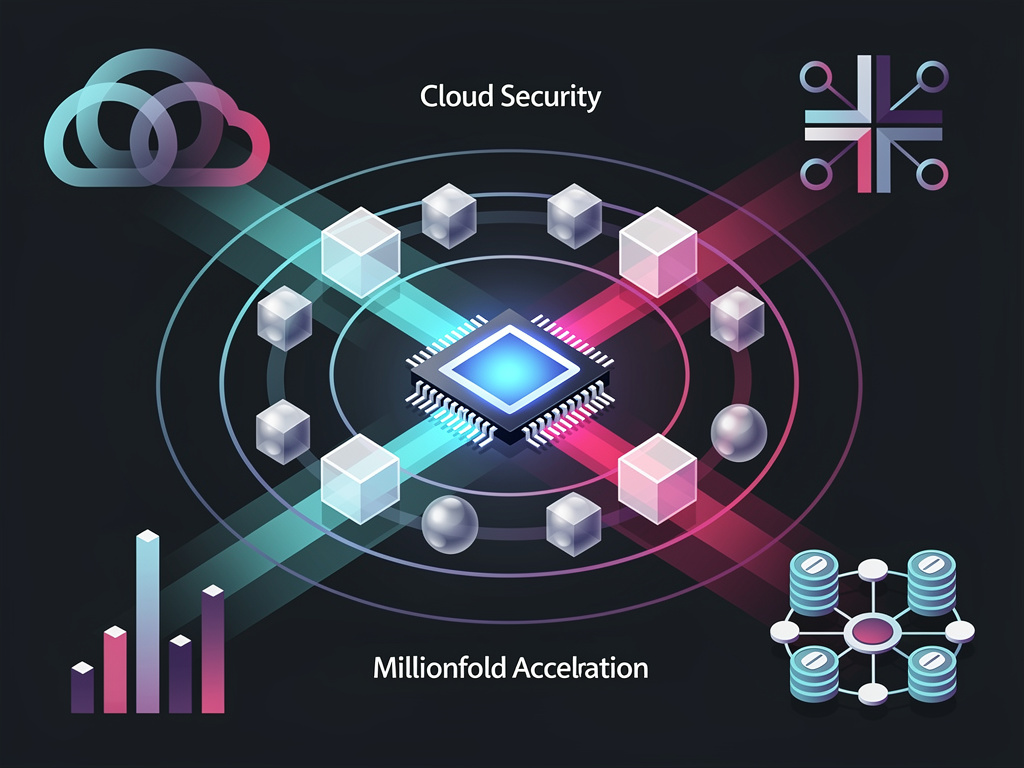
Intel just made a significant leap toward making fully homomorphic encryption (FHE) usable in the real world. The chipmaker, working alongside Microsoft and the Defense Advanced Research Projects Agency (DARPA), has developed a dedicated ASIC that accelerates FHE computations by roughly a millionfold compared to running them on standard software. That’s not a typo.
The implications are massive. FHE allows computation on encrypted data without ever decrypting it — a concept cryptographers have chased since Craig Gentry’s breakthrough proof-of-concept in 2009. The problem has always been performance. FHE operations running on conventional CPUs are so painfully slow that practical deployment has been essentially impossible for most applications. Intel’s new chip, developed under DARPA’s Data Protection in Virtual Environments (DPRIVE) program, aims to change that calculus entirely, as reported by IEEE Spectrum.
Why FHE Matters — and Why It’s Been Stuck
Here’s the core idea: traditional encryption protects data at rest and in transit. But the moment you need to actually do something with that data — run a query, train a model, perform analytics — you have to decrypt it first. That decrypted state is a vulnerability window. FHE eliminates it.
Imagine a hospital sending encrypted patient records to a cloud service for analysis. With FHE, the cloud provider could run computations and return encrypted results without ever seeing the underlying data. Financial institutions could perform fraud detection on encrypted transactions. Government agencies could query encrypted databases. No exposure. No trust assumptions about the infrastructure operator.
But the math is brutal. FHE operations inflate data sizes enormously and require staggering amounts of computation. A single operation that takes microseconds on plaintext can take minutes or hours under FHE on a general-purpose processor. According to IEEE Spectrum, Intel’s research team found that software-based FHE introduces a computational overhead of roughly 100,000x compared to unencrypted processing. Some estimates run even higher.
That overhead has kept FHE in the academic curiosity category for over a decade. Interesting in theory. Useless in practice.
Intel’s ASIC changes the equation. The chip is purpose-built to handle the specific mathematical operations FHE demands — primarily very large polynomial multiplications and number-theoretic transforms. By designing silicon specifically for these workloads, Intel claims the chip can close the performance gap to the point where FHE becomes viable for real applications.
The DARPA DPRIVE program, which funded this work, set an explicit goal: bring FHE performance to within striking distance of plaintext computation. Intel’s chip reportedly gets within range, reducing the overhead from six orders of magnitude to something manageable. Not parity with unencrypted processing. But close enough to matter.
Inside the Silicon
The technical approach is worth examining. Intel’s ASIC integrates specialized functional units optimized for the core bottlenecks in FHE schemes — particularly the CKKS and BGV encryption schemes that dominate current research. The chip handles massive ciphertext polynomials natively, with on-chip memory designed to minimize the data movement that cripples FHE performance on conventional hardware.
Data movement is actually the hidden killer. FHE ciphertexts are enormous — often megabytes per encrypted value. Shuffling them back and forth between processor and memory creates bandwidth bottlenecks that dwarf the computational cost. Intel’s design addresses this with large on-chip SRAM and a memory hierarchy tuned specifically for FHE access patterns, according to the IEEE Spectrum report.
And this isn’t Intel’s first move in this space. The company has been building toward this for years, contributing to open-source FHE libraries and publishing research on hardware acceleration. Microsoft, Intel’s partner on DPRIVE, has its own deep investments in FHE through its SEAL (Simple Encrypted Arithmetic Library) project. The collaboration brings together Microsoft’s cryptographic expertise with Intel’s silicon design capabilities.
DARPA’s involvement signals that national security applications are a primary driver. The agency has been funding FHE research aggressively, recognizing that secure cloud computing for classified workloads could transform how defense and intelligence organizations process data. But the commercial implications extend far beyond government use cases.
Cloud computing is the obvious market. Every major cloud provider — AWS, Azure, Google Cloud — faces the fundamental trust problem: customers must trust the provider with their unencrypted data. FHE could eliminate that requirement entirely. So could it reshape the cloud security model? Potentially. But only if the performance penalty drops low enough that customers will actually use it.
Healthcare, finance, and advertising are all sectors where privacy-preserving computation has clear demand. The EU’s GDPR and similar regulations worldwide have made data handling a compliance minefield. FHE offers a technical path through it — process data without possessing it, in a legal sense.
There are caveats. Intel’s chip is a research prototype, not a product. The path from DARPA-funded ASIC to commercially available hardware is long and uncertain. Manufacturing economics matter: will there be enough demand to justify producing FHE accelerators at scale? Or will this remain a niche technology for high-security applications?
Competition is also emerging. Several startups — including Duality Technologies (now Duality), Cornami, and Optalysys — are pursuing FHE acceleration through different approaches, from optical computing to alternative chip architectures. DARPA has funded multiple teams under DPRIVE, not just Intel. The field is active and the technical approaches are diverging.
There’s also the software problem. Even with fast hardware, developers need tools, compilers, and frameworks that make FHE accessible. Writing FHE applications today requires deep cryptographic expertise. Intel and Microsoft have been working on compiler toolchains that can automatically convert conventional programs into FHE-compatible versions, but this work is still maturing.
And FHE isn’t the only privacy-preserving computation technique in play. Secure multi-party computation (MPC), trusted execution environments (TEEs like Intel’s own SGX), and differential privacy all address overlapping use cases with different tradeoff profiles. FHE’s advantage is that it requires no trust in the computing infrastructure at all — a stronger guarantee than TEEs, which depend on hardware security assumptions that have been repeatedly challenged by side-channel attacks.
Still, the millionfold speedup Intel claims is striking. If it holds up under independent evaluation and translates to real workloads — not just microbenchmarks — it represents a genuine inflection point for the technology. FHE has been the cryptographic holy grail for fifteen years. A purpose-built chip that makes it practical, even for limited use cases, would be a significant engineering achievement.
The bottom line for industry professionals: FHE is moving from theoretical to feasible. Intel’s ASIC demonstrates that hardware acceleration can overcome the performance barriers that have blocked adoption. Commercial availability is still years away, but the trajectory is clear. Organizations handling sensitive data — particularly in regulated industries — should be tracking this space closely. The era of computing on encrypted data isn’t here yet. But it’s getting close.


 WebProNews is an iEntry Publication