
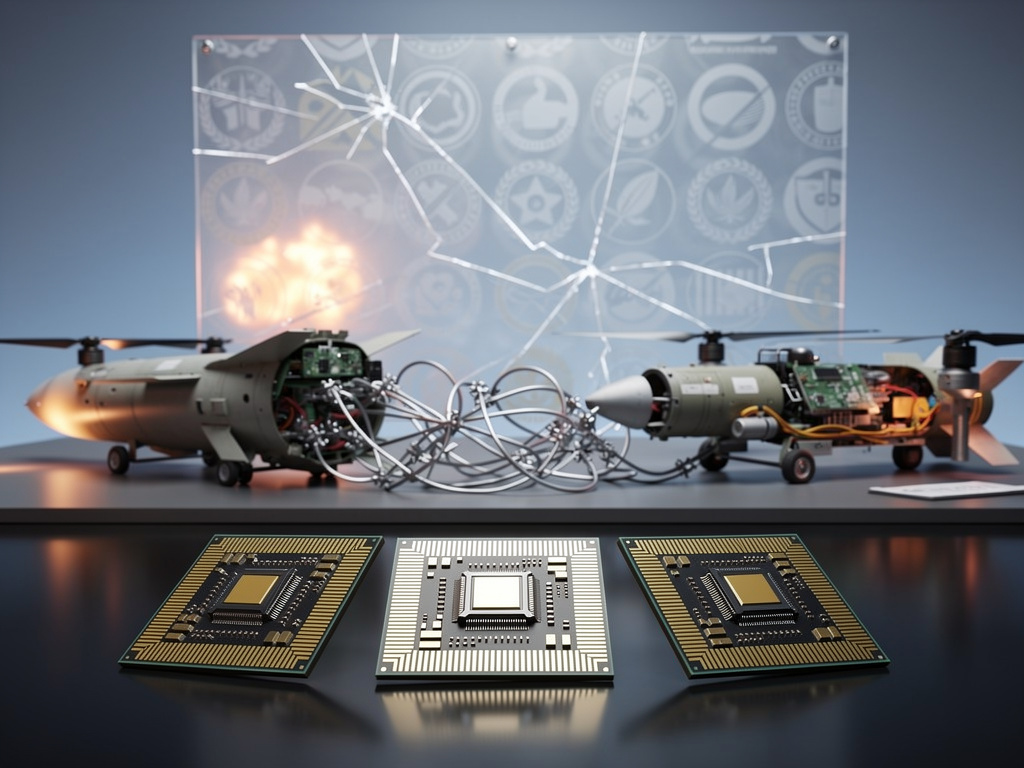
Chips in the Crossfire: How U.S. Tech Giants Allegedly Fueled Russia’s Arsenal
In the shadowy world of global supply chains and geopolitical tensions, a series of lawsuits has thrust semiconductor giants Intel Corp. and Advanced Micro Devices Inc. (AMD) into the spotlight, accusing them of failing to prevent their high-tech chips from powering Russian missiles and drones used in attacks on Ukrainian civilians. Filed on behalf of dozens of victims, these legal actions paint a picture of corporate oversight lapses amid stringent U.S. sanctions aimed at curbing Russia’s military capabilities. The allegations, detailed in court documents, suggest that despite export controls imposed after Russia’s 2022 invasion of Ukraine, components from these American firms have continued to find their way into lethal weaponry.
The lawsuits, brought forward by prominent attorney Mikal Watts and the law firm Baker & Hostetler, target not only Intel and AMD but also Texas Instruments Inc., claiming “willful ignorance” in monitoring third-party resellers. According to reports from Bloomberg, the complaints reference specific incidents between 2023 and 2025, including strikes involving Iranian-made drones and Russian KH-101 cruise missiles that allegedly incorporated Intel and AMD technology. These claims build on a broader narrative of sanctions evasion, where intermediary countries like Turkey and Hong Kong serve as conduits for restricted goods.
Industry experts argue that the complexity of modern supply chains exacerbates these issues. Semiconductors, essential for everything from consumer electronics to advanced weaponry, are produced in vast quantities and distributed through a web of distributors and resellers. U.S. regulations, enforced by the Commerce Department’s Bureau of Industry and Security, prohibit exports to Russia without licenses, yet enforcement relies heavily on companies’ internal compliance programs. The suits allege that Intel and AMD did not adequately vet or audit their distribution networks, allowing chips to be rerouted illicitly.
Unraveling the Supply Chain Web
Delving deeper, investigations reveal patterns of circumvention that have persisted despite international efforts. A report from TechSpot earlier this year highlighted Russia’s use of “workarounds,” such as front companies in allied nations, to import U.S. processors. Customs data from Russia’s Federal Customs Service, as cited in various analyses, shows a sharp decline in official imports but a surge through unofficial channels, suggesting smuggling operations valued in the hundreds of millions.
Posts on social media platform X, formerly Twitter, have amplified public scrutiny, with users sharing reports of ongoing chip flows. For instance, discussions point to a U.S. Senate investigation that accused Intel, AMD, and others of ignoring re-exports, echoing findings from outlets like The Insider. These online sentiments underscore a growing frustration with corporate accountability, as tech firms navigate the dual pressures of profit and geopolitics.
The technical specifics are telling: Programmable logic integrated circuits from Intel and AMD are prized for their versatility in missile guidance systems and drone navigation. According to a piece in East Bay Times, debris from downed Russian missiles recovered in Ukraine has yielded chips traceable to these manufacturers, complete with serial numbers that should have triggered red flags in compliance databases.
Corporate Responses and Regulatory Gaps
Intel and AMD have publicly denied direct violations, emphasizing their adherence to sanctions. In statements, Intel has reiterated its suspension of shipments to Russia since 2022, as noted in coverage from Yahoo Finance. Similarly, AMD has pointed to its cooperation with U.S. authorities, but critics argue these measures fall short. The lawsuits demand not just compensation for victims—estimated in the millions—but also systemic changes, including enhanced tracking technologies like blockchain for supply chain transparency.
Regulatory experts highlight gaps in the current framework. The U.S. Export Administration Regulations require companies to perform due diligence on end-users, yet the sheer volume of transactions—Intel alone ships billions of chips annually—makes comprehensive oversight challenging. A recent Reuters exclusive, Reuters, revealed Intel’s testing of tools from sanctioned Chinese entities, raising questions about broader compliance lapses in the industry.
Beyond the courtroom, these accusations ripple through the tech sector. Stock prices for Intel and AMD dipped following the lawsuit announcements, as reported in financial posts on X, reflecting investor concerns over potential fines and reputational damage. Analysts from firms like Gartner suggest that such incidents could prompt tighter export controls, possibly extending to AI chips and other emerging technologies.
Geopolitical Ramifications and Industry Precedents
The broader implications extend to international relations. Ukraine’s government has long lobbied for stricter enforcement, with officials like Inna Sovsun highlighting in social media posts how Western components fuel Russian aggression. This echoes a 2022 NEXTA report on X about Russia’s acquisition of $777 million in chips via proxies, underscoring the persistent challenge of sanctions enforcement in a globalized economy.
Historically, similar cases have set precedents. The 2018 ZTE scandal, where the Chinese telecom giant violated sanctions on Iran and North Korea, led to massive penalties and operational bans. For Intel and AMD, the stakes are high: potential liabilities could mirror those in product liability suits, but with added layers of national security. Coverage in The Business Times notes that the suits invoke the Alien Tort Statute, allowing foreign nationals to sue U.S. companies for aiding human rights abuses.
Industry insiders point to internal corporate cultures as a factor. At Intel, a focus on rapid innovation and market share may have overshadowed compliance, according to anonymous sources in tech forums. AMD, meanwhile, has invested in AI-driven monitoring, but the lawsuits claim these efforts were insufficient against sophisticated evasion tactics like shell companies and falsified end-user certificates.
Technological Countermeasures and Future Safeguards
To combat this, some propose embedding kill-switches or geofencing in chips, rendering them inoperable in sanctioned regions. However, such measures raise privacy concerns and could hinder legitimate uses. A Tom’s Hardware article, Tom’s Hardware, quotes the plaintiffs’ lawyer labeling the firms as “merchants of death,” a stark rhetoric that amplifies calls for accountability.
On the enforcement side, the U.S. government has ramped up investigations. The Commerce Department’s recent task force on export violations has seized millions in illicit goods, as per updates from official channels. Yet, experts like those at the Center for Strategic and International Studies argue for multilateral agreements, involving allies like the EU and Japan, to close loopholes in third countries.
The human cost remains central. Victims’ stories, detailed in filings, describe devastating attacks: a 2024 missile strike on a Kyiv apartment block that killed 15, allegedly guided by AMD processors. These narratives, shared in media like The Japan Times, humanize the abstract world of semiconductors, pressing companies to prioritize ethics over expediency.
Evolving Strategies in a Tense World
As the cases progress, tech giants are bolstering defenses. Intel has announced expanded audits of distributors, while AMD invests in AI analytics for anomaly detection. Industry groups like the Semiconductor Industry Association advocate for balanced regulations that don’t stifle innovation, but the lawsuits may force a reckoning.
Geopolitically, this saga underscores the weaponization of technology. Russia’s reliance on Western chips exposes vulnerabilities, yet it also highlights the limits of sanctions in an interconnected market. Posts on X from financial analysts speculate on long-term shifts, such as diversified manufacturing in India or Vietnam to reduce dependency on vulnerable routes.
Ultimately, these allegations challenge the tech industry’s self-image as a force for good. With trials looming, the outcomes could reshape how companies navigate the intersection of commerce and conflict, ensuring that innovations meant to advance humanity don’t inadvertently sustain destruction. As one expert noted in a Cybernews piece, Cybernews, the real test will be whether these suits catalyze genuine reform or merely symbolic gestures.
Lessons from the Front Lines
Reflecting on the timeline, sanctions began in earnest post-2022 invasion, with Intel and AMD halting direct sales, as per early reports from PC Gamer on X. Yet, persistent findings in missile wreckage, documented by Ukrainian forensics teams, suggest gaps in post-sale tracking. This has spurred innovations like tamper-evident packaging and digital passports for components.
For industry insiders, the key takeaway is risk management. Companies must integrate geopolitical intelligence into operations, perhaps through dedicated compliance officers with access to real-time threat data. Financial Post coverage, Financial Post, emphasizes the economic fallout, with potential class-action expansions if more victims join.
In this evolving scenario, collaboration is crucial. Partnerships between governments and tech firms could enhance intelligence sharing, as seen in recent U.S.-EU pacts. Meanwhile, the lawsuits serve as a wake-up call, reminding executives that in the high-stakes game of global tech, oversight can have deadly consequences.
Pathways to Accountability
Looking ahead, resolution may involve settlements, with funds aiding Ukrainian reconstruction. But deeper changes—mandatory end-to-end traceability—could redefine standards. Bitcoin Ethereum News, Bitcoin Ethereum News, reports on the suits’ potential to set global precedents for corporate liability in warfare.
The narrative also touches on ethical sourcing. With chips integral to modern life, ensuring they don’t arm aggressors requires vigilance beyond regulations. As tensions persist, the industry must adapt, balancing innovation with responsibility to prevent future breaches.
These developments highlight the intricate ties between technology and international security, urging a proactive stance to safeguard against misuse.


 WebProNews is an iEntry Publication