
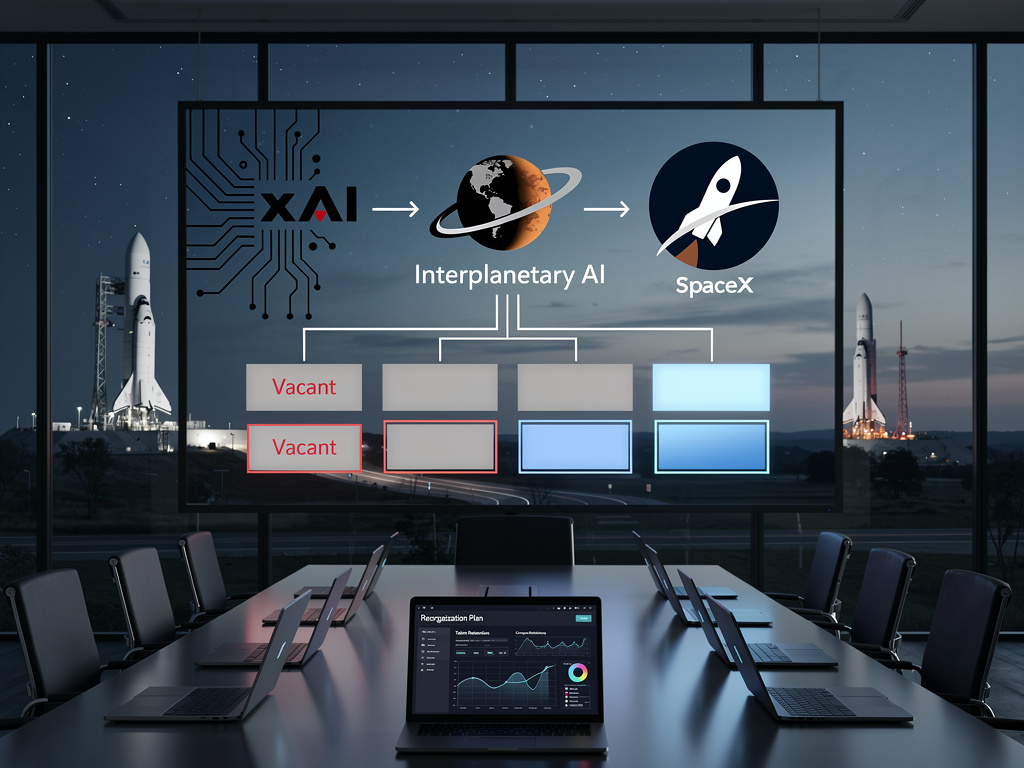
Elon Musk’s artificial intelligence venture xAI is undergoing a sweeping reorganization that has cost the company at least two co-founders and an undisclosed number of additional staff, raising pointed questions about the strategic direction of one of the world’s most ambitious AI enterprises just as it merges operations with SpaceX.
The restructuring, announced by Musk on Wednesday via his social media platform X, comes at a pivotal moment for the company. xAI, which Musk founded in 2023 to compete with OpenAI, Google DeepMind, and Anthropic, has been integrating with SpaceX following a merger that has reoriented the AI startup’s mission toward interplanetary applications. The departures and reorganization signal that this integration is proving far more disruptive internally than Musk’s public statements have previously suggested.
Musk Frames Departures as Necessary Growing Pains
In a post on X, Musk acknowledged the upheaval directly. “xAI has gone through a re-org that unfortunately required parting ways with some people,” he wrote. The official xAI account echoed the message, framing the reorganization as essential to aligning the company’s structure with its expanded mission following the SpaceX merger. The company emphasized that the changes would allow xAI to “move faster and more efficiently” as it pursues what it described as civilization-scale AI deployment, including off-world applications.
The most notable casualties of the reorganization are two of xAI’s original co-founders. As reported by The Verge, these departures follow a pattern of senior talent leaving the company in recent months, a trend that has accelerated since the SpaceX merger was formalized. Ars Technica noted that the loss of another co-founder marks a significant erosion of the founding team that Musk assembled with great fanfare less than three years ago, when he recruited top researchers from institutions including DeepMind, the University of Toronto, and other leading AI labs.
Co-Founders Break Their Silence on Social Media
The departing co-founders did not go quietly. Chace, one of the co-founders who confirmed his exit, posted on X about his departure, expressing gratitude for the experience while hinting at philosophical differences about xAI’s direction. The tone was measured but unmistakable — the SpaceX merger had fundamentally altered the company he had signed up to build. Another departing team member, posting under the handle textangel, shared a more pointed reflection on the changes, suggesting that the reorganization went beyond routine corporate restructuring.
The departures have sparked a vigorous debate within the AI research community. Ramez Naam, a prominent technologist and author, weighed in on X, questioning whether the brain drain at xAI could hamper the company’s ability to compete at the frontier of AI research. Others in the industry noted that co-founder departures are not uncommon at fast-growing startups, but the pace and concentration of exits at xAI have been unusual, particularly for a company that has been operational for less than three years and has raised tens of billions of dollars in funding.
The SpaceX Merger: Catalyst for Conflict
At the heart of the turmoil is xAI’s merger with SpaceX, which has fundamentally reoriented the AI company’s mission. According to CNBC, the merger has created a combined entity that aims to deploy advanced AI systems not just for terrestrial applications like Grok — xAI’s chatbot that competes with ChatGPT — but for autonomous systems aboard SpaceX rockets, Starship missions, and eventually Mars colonization infrastructure. It is an audacious vision, but one that has created significant tension between AI researchers who joined xAI to push the boundaries of large language models and machine intelligence, and SpaceX engineers whose priorities are rooted in aerospace engineering and mission-critical reliability.
The Information reported that the restructuring involved consolidating several research teams under new leadership drawn from SpaceX’s engineering ranks, a move that effectively sidelined some of xAI’s original AI researchers. Sources familiar with the matter told the publication that disagreements over resource allocation — particularly the division of compute resources between Grok development and SpaceX-oriented AI projects — had been simmering for months before erupting into the current reorganization.
Interplanetary AI: Ambition or Overreach?
In a public all-hands meeting that was partially disclosed this week, xAI leadership laid out what TechCrunch described as “interplanetary ambitions” for the company. The vision includes developing AI systems capable of operating autonomously on Mars, managing life-support systems, coordinating robotic construction, and eventually serving as the cognitive backbone of a multi-planetary civilization. Musk has long spoken about making humanity a multi-planetary species; the xAI-SpaceX merger appears to be his most concrete step toward embedding artificial intelligence into that vision.
But the ambition has come at a cost. The Wall Street Journal reported that the reorganization affected not just senior researchers but also mid-level engineers and product managers who had been working on Grok’s consumer-facing features. Some of these employees were offered transfers to SpaceX-adjacent roles, while others were let go entirely. The Journal noted that the exact number of affected employees was not disclosed, but people familiar with the situation described it as a “significant” reduction in the pure-AI research headcount.
A Pattern of Talent Exodus Across Musk’s Ventures
The departures at xAI fit into a broader pattern that has characterized Musk’s management style across his companies. When he acquired Twitter in 2022 and rebranded it as X, he slashed roughly 80% of the workforce in a matter of weeks, arguing that the company was bloated and inefficient. At Tesla, executive turnover has been a persistent feature, with numerous senior leaders departing over the years amid Musk’s demanding management approach. The question now is whether the same playbook can work at an AI research lab, where institutional knowledge and researcher continuity are often considered essential to maintaining competitive momentum.
Benzinga reported that investors have so far remained publicly supportive of the reorganization, with some noting that Musk’s track record of ruthless efficiency has ultimately benefited his other companies. However, the publication also noted that xAI operates in a domain where talent is extraordinarily scarce and highly mobile. Top AI researchers can command multi-million-dollar compensation packages at Google, Meta, Anthropic, or OpenAI, and the departure of co-founders could trigger a cascading effect as other senior researchers reassess their own positions.
The Global Affairs Dimension
Adding another layer of complexity to the situation, the Global Affairs account on X highlighted the geopolitical implications of xAI’s reorganization. As AI becomes an increasingly strategic technology — with the United States, China, and the European Union all racing to establish dominance — the stability of leading American AI companies has become a matter of national interest. The merger of xAI with SpaceX, a company that holds sensitive government contracts including classified national security launches, raises questions about how AI development priorities will be balanced against defense and intelligence community needs.
Digitimes reported that the reorganization has drawn attention from Asian technology analysts, who view the xAI-SpaceX integration as a potential model for how AI and aerospace could converge in the coming decade. The publication noted that companies in China, Japan, and South Korea are closely monitoring the merger’s progress, with some viewing it as a signal that the next frontier of AI competition will extend beyond chatbots and enterprise software into physical-world applications including space exploration, autonomous vehicles, and robotics at scale.
What Grok’s Future Looks Like Post-Reorganization
For the millions of users who interact with Grok through the X platform, the immediate question is whether the reorganization will affect the chatbot’s development trajectory. Grok has been one of xAI’s most visible products, competing directly with OpenAI’s ChatGPT, Google’s Gemini, and Anthropic’s Claude. The chatbot has differentiated itself with a more irreverent tone and fewer content restrictions than some competitors, a reflection of Musk’s personal philosophy about free speech and AI alignment.
According to CNBC, xAI has assured users and partners that Grok development will continue and that the next major model update remains on schedule. However, with key researchers departing and compute resources potentially being redirected toward SpaceX-oriented projects, some industry observers are skeptical. The AI industry moves at a blistering pace, and even a few months of disruption can allow competitors to open up significant leads in model capability, safety research, and enterprise adoption.
The Broader Stakes for the AI Industry
The xAI reorganization arrives at a moment of extraordinary ferment in the artificial intelligence sector. OpenAI, once a nonprofit, has completed its transition to a for-profit structure and is reportedly raising funds at a valuation exceeding $300 billion. Anthropic has secured major investments from Amazon and Google. Meta continues to pour billions into its Llama open-source model family. Against this backdrop, any sign of instability at xAI is magnified — not because the company is the largest player, but because it is led by the world’s richest person and is now fused with one of the most strategically important aerospace companies on the planet.
The Verge noted that the departures also raise questions about xAI’s approach to AI safety and alignment — areas where the co-founders had played significant roles. As AI systems grow more powerful, the researchers who understand their architectures, limitations, and failure modes become irreplaceable institutional assets. Losing them doesn’t just mean losing talent; it means losing the deep contextual knowledge that informs how a company navigates the increasingly complex ethical and technical challenges of building frontier AI systems.
Musk’s Bet: Disruption as Strategy
For Musk, the reorganization appears to be less a crisis than a calculated bet. His career has been defined by a willingness to endure short-term chaos in pursuit of long-term transformation. He nearly bankrupted Tesla before it became the world’s most valuable automaker. He pushed SpaceX to the brink of failure before it revolutionized space launch economics. He gutted Twitter’s workforce before reshaping it into X, a platform that, whatever its critics say, remains one of the most influential information networks on earth.
The question is whether the same approach will work in AI, a field where the competitive dynamics are fundamentally different from manufacturing cars or launching rockets. In AI, the primary asset is human capital — the researchers, engineers, and scientists whose ideas and expertise drive breakthroughs. Unlike a factory, which can be rebuilt, or a rocket, which can be redesigned, the loss of a brilliant researcher cannot be easily remedied by hiring a replacement. The knowledge, intuitions, and collaborative relationships that drive AI research are deeply personal and largely non-transferable.
As Ars Technica observed, Musk’s xAI is now at an inflection point. The company can either emerge from this reorganization as a leaner, more focused entity with a genuinely unique interplanetary AI mission — or it can find itself hemorrhaging the very talent that made it a credible competitor in the first place. The coming months will reveal which outcome prevails, and the entire AI industry will be watching closely.


 WebProNews is an iEntry Publication