
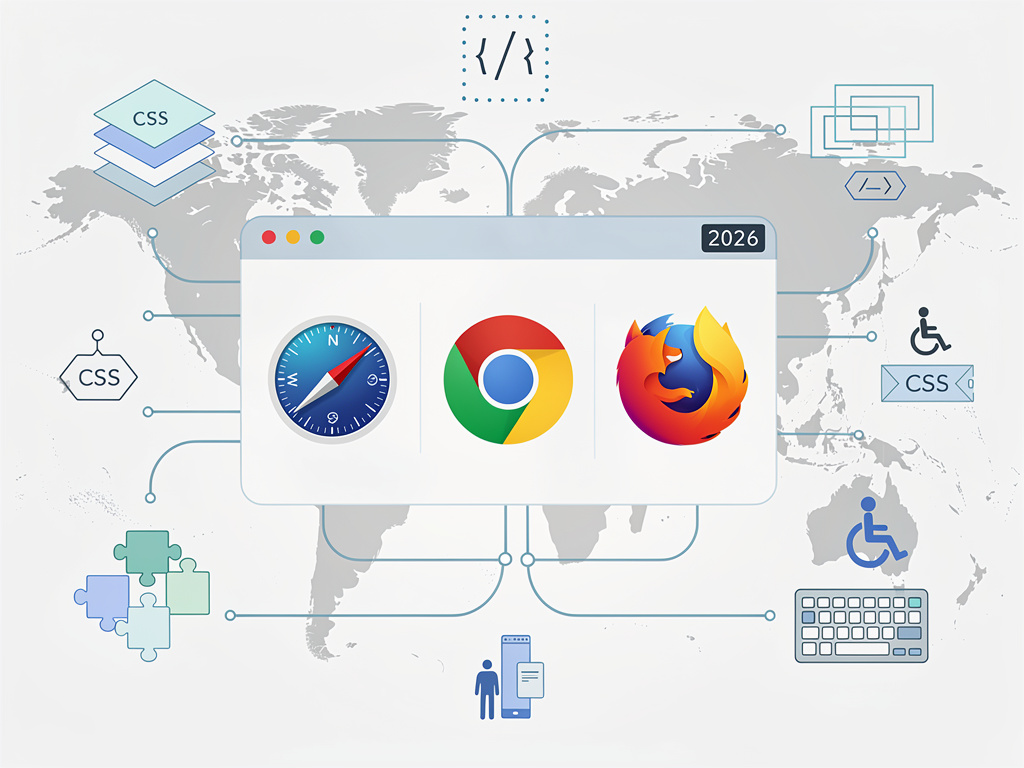
For years, web developers have wrestled with a frustrating reality: code that works flawlessly in one browser can break spectacularly in another. That fragmentation has persisted even as the major browser engines — Apple’s WebKit, Google’s Blink, and Mozilla’s Gecko — have converged on many modern standards. Now, Apple’s WebKit team is laying out an ambitious set of priorities for 2026 that signals a renewed commitment to closing the remaining gaps, joining forces with rival browser makers in a collaborative effort that could reshape how the open web functions for billions of users.
The initiative, known broadly as Interop 2026, represents the latest iteration of an annual cross-browser project that began gaining serious momentum in 2022. Each year, engineers from Apple, Google, Mozilla, Microsoft, and other stakeholders identify the web platform features most plagued by inconsistent implementations and commit to bringing their respective engines into alignment. As reported by 9to5Mac, Apple’s WebKit team has now formally outlined its focus areas for the 2026 cycle — and the list reveals both the progress that has been made and the stubborn technical challenges that remain.
What Apple’s WebKit Team Is Prioritizing This Year
According to the 9to5Mac report, Apple’s WebKit engineers have identified several key areas where browser interoperability still falls short. Among the highest priorities are improvements to CSS features that developers rely on daily but that behave differently across engines. Layout mechanisms, typography controls, and animation APIs are all on the docket, reflecting the reality that even widely adopted CSS specifications can harbor subtle implementation differences that cause headaches at scale.
The WebKit team is also placing significant emphasis on web component interoperability, an area that has grown in importance as more enterprises and framework authors build reusable UI elements using the Shadow DOM and custom elements specifications. Ensuring that these components render and behave identically whether a user opens Safari on an iPhone, Chrome on a Chromebook, or Firefox on a Linux desktop is no small engineering feat. Apple’s willingness to prioritize this work suggests the company recognizes that web components are no longer an experimental curiosity but a foundational building block of modern web architecture.
The Interop Project’s Track Record and Growing Influence
The Interop project has delivered measurable results since its inception. In previous cycles, participating browser teams tackled issues ranging from CSS Grid inconsistencies to form control styling and viewport unit behavior. Each year, progress is tracked through a shared test suite maintained by the Web Platform Tests project, providing a transparent, data-driven scorecard that holds all participants accountable. The scores have risen steadily: where browsers once diverged on dozens of critical features, the gaps have narrowed considerably, particularly in areas like Flexbox, CSS Containment, and the :has() selector.
Apple’s participation has been particularly noteworthy given the company’s historically guarded approach to its browser engine. For years, critics accused Apple of letting Safari lag behind Chrome and Firefox in standards support, effectively holding back the web on iOS — where all browsers are required to use WebKit under Apple’s App Store rules. The Interop initiative has provided a structured forum for Apple to demonstrate good faith, and the WebKit team’s public commitment to specific 2026 priorities, as detailed by 9to5Mac, continues that trajectory.
Why Developers Should Pay Attention to the 2026 Focus Areas
For front-end engineers and product teams, the practical implications of Interop 2026 are significant. Consider the cost of cross-browser testing and bug-fixing in a typical enterprise web application. Studies from the HTTP Archive and developer surveys conducted by the State of CSS project have consistently shown that browser inconsistencies rank among the top pain points for professional developers. Every hour spent writing browser-specific workarounds or debugging rendering differences is an hour not spent on features that drive business value.
The 2026 priorities appear designed to address some of the most commercially impactful inconsistencies. Improvements to navigation API behavior, for instance, could benefit the growing number of single-page applications that rely on the History API and its successors for client-side routing. Similarly, better alignment on accessibility-related APIs — another area reportedly under discussion for Interop 2026 — would help organizations meet increasingly stringent regulatory requirements around digital accessibility, including those emerging from the European Accessibility Act and updated ADA enforcement guidance in the United States.
The Regulatory Dimension: Europe’s DMA and Browser Engine Competition
Apple’s interoperability push cannot be fully understood without considering the regulatory pressures the company faces, particularly in the European Union. The Digital Markets Act (DMA), which took full effect in 2024, designated Apple as a gatekeeper and required the company to allow alternative browser engines on iOS within the EU. That change — which enabled versions of Chrome and Firefox running their own engines on iPhones for the first time — has introduced genuine engine competition on Apple’s mobile platform.
This new competitive dynamic gives Apple additional incentive to ensure WebKit keeps pace with rival engines. If Safari on iOS begins to feel noticeably less capable than a Blink-powered Chrome or a Gecko-powered Firefox running natively on the same device, users may switch — and developers may deprioritize Safari testing altogether. By actively participating in Interop 2026 and publicly committing to specific feature areas, Apple is signaling to both developers and regulators that it intends to compete on merit rather than relying on platform lock-in.
How the Sausage Gets Made: The Interop Selection Process
The process by which Interop focus areas are chosen each year is itself a study in multi-stakeholder governance. Proposals are submitted by browser vendors, web developers, and standards body participants, then evaluated based on criteria including developer demand, the severity of existing cross-browser differences, and the maturity of the underlying specification. Features that are still in flux at the standards level are generally excluded, since aligning implementations around a moving target would be counterproductive.
Once the focus areas are agreed upon, each participating engine team works independently to improve its implementation, with progress measured against the shared Web Platform Tests suite. The results are published on a public dashboard, creating a competitive dynamic that has proven remarkably effective at motivating engineering investment. No browser vendor wants to be seen lagging on the public scoreboard, and the transparency has fostered a culture of accountability that was largely absent from browser development a decade ago.
What This Means for the Future of Safari and the Open Web
Apple’s WebKit team has made considerable strides in recent years. Safari’s release cadence has accelerated, with major feature drops now arriving multiple times per year rather than being tied exclusively to macOS release cycles. Features like CSS Nesting, the Popover API, and View Transitions — all of which were subjects of previous Interop cycles — have shipped in Safari with increasingly competitive timing relative to Chrome and Firefox.
The 2026 priorities suggest that Apple is now turning its attention to some of the deeper, more technically challenging areas of the platform. Ensuring consistent behavior across complex layout scenarios, improving the reliability of web components in edge cases, and aligning on newer APIs that enable richer application-like experiences on the web — these are the kinds of investments that pay dividends not in flashy demos but in the quiet reliability that professional developers depend on.
A Collaborative Model That Other Industries Could Learn From
Perhaps the most remarkable aspect of the Interop project is that it exists at all. Apple, Google, and Mozilla are fierce competitors in the browser market, yet they have found a way to collaborate on shared infrastructure in a manner that benefits the entire ecosystem. The model — transparent goals, shared test suites, public accountability — offers a template that other technology sectors could adopt when fragmentation threatens to undermine a shared platform.
For web developers, the message from Apple’s 2026 priorities is cautiously optimistic. The era of writing elaborate browser-specific hacks may not be entirely over, but it is receding. As the major engines continue to converge on a common, well-tested baseline, the web becomes a more predictable and powerful platform for everyone who builds on it. Apple’s WebKit team, once viewed as the reluctant participant in this process, now appears to be one of its most committed advocates — a shift that could prove as consequential for the open web as any single feature implementation.


 WebProNews is an iEntry Publication