
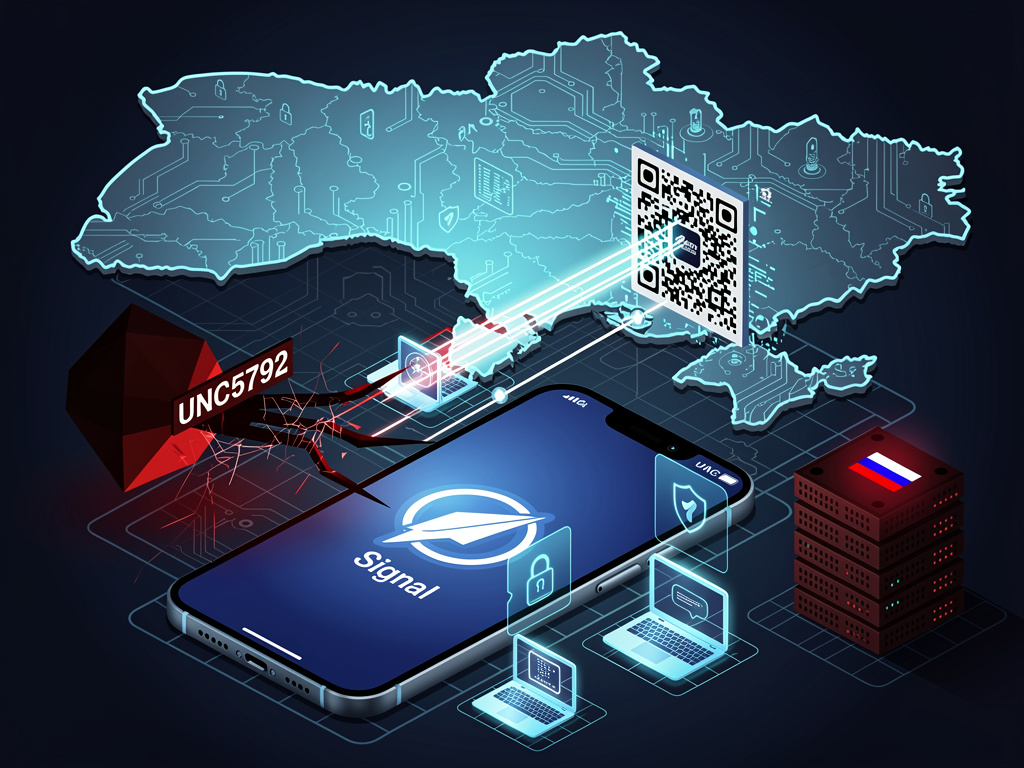
In the evolving theater of cyber warfare, the tools designed to protect privacy are increasingly being turned against the very people who rely on them most. Google’s Threat Intelligence Group has linked a suspected Russian threat actor to a sophisticated campaign exploiting the Signal messaging application, targeting individuals connected to Ukraine’s defense and diplomatic apparatus. The operation represents a chilling escalation in the use of social engineering to compromise encrypted communications platforms — and a stark reminder that even the most secure consumer technology is only as strong as its weakest human link.
The campaign, attributed to a threat cluster tracked as UNC5792, leverages a feature within Signal that allows users to link the app across multiple devices. By crafting malicious QR codes and distributing them through phishing messages, the actor effectively tricks targets into linking their Signal accounts to attacker-controlled devices. Once linked, every message the victim sends or receives is simultaneously delivered to the adversary in real time — without triggering any of the conventional alerts that might accompany a full account compromise.
A Quiet Breach of Encrypted Channels
According to The Hacker News, Google’s Threat Intelligence Group identified UNC5792 as a suspected Russia-nexus actor whose operations align with Moscow’s strategic intelligence priorities regarding the ongoing conflict in Ukraine. The group’s targeting profile includes Ukrainian military personnel, government officials, diplomats, and humanitarian aid workers — individuals whose Signal communications could yield operationally significant intelligence about troop movements, policy deliberations, and international support networks.
The technical elegance of the attack lies in its exploitation of a legitimate feature rather than a software vulnerability in the traditional sense. Signal’s device-linking functionality, which allows users to mirror their conversations on desktops and tablets, requires scanning a QR code to authenticate the new device. UNC5792 has crafted QR codes that, when scanned, silently link the victim’s account to a device controlled by the threat actor. The phishing messages containing these codes are typically disguised as group chat invitations, security alerts, or device-pairing instructions from Signal itself, lending them an air of authenticity that can fool even security-conscious users.
The Mechanics of Device-Linking Abuse
What makes this attack vector particularly insidious is the absence of traditional indicators of compromise. Unlike malware-based intrusions that leave forensic traces on a device, the device-linking exploit operates entirely within Signal’s intended architecture. The victim’s phone continues to function normally. There are no unfamiliar apps installed, no unusual battery drain, and no suspicious network traffic emanating from the device itself. The only evidence of compromise is an additional linked device listed in Signal’s settings — a detail that most users rarely check.
Google’s researchers noted that UNC5792 has refined its social engineering techniques over multiple iterations. Early versions of the phishing lures were relatively crude, but more recent campaigns have incorporated highly convincing replicas of Signal’s user interface, complete with localized language and contextually appropriate messaging. In some cases, the threat actor has embedded the malicious QR codes within documents or images shared through other platforms, including email and Telegram, broadening the attack surface beyond Signal itself.
Ukraine’s Digital Frontline Under Sustained Pressure
The targeting of Signal is not occurring in isolation. Ukraine has been subjected to relentless cyber operations since well before Russia’s full-scale invasion in February 2022, with Russian state-sponsored groups and affiliated actors targeting everything from power grids and financial systems to individual soldiers’ smartphones. The focus on encrypted messaging applications represents a natural evolution of these efforts, as Ukrainian military and government officials have increasingly migrated sensitive communications to platforms like Signal in an effort to evade Russian electronic surveillance and signals intelligence capabilities.
Signal has long been regarded as the gold standard of consumer encrypted messaging, recommended by security researchers, journalists, and human rights organizations worldwide. Its open-source protocol, end-to-end encryption, and minimal metadata retention have made it a preferred tool for anyone seeking to communicate beyond the reach of state surveillance. But as Google’s findings illustrate, the security of any communications platform ultimately depends on the operational security practices of its users. An application can encrypt messages in transit and at rest, but it cannot prevent a user from inadvertently granting an adversary access to their account.
Broader Implications for Secure Communications
The implications of UNC5792’s campaign extend well beyond Ukraine. If a state-sponsored actor can successfully exploit Signal’s device-linking feature against military and diplomatic targets, the same technique could be deployed against journalists, dissidents, corporate executives, and political figures in any country. The attack requires no zero-day exploits, no sophisticated malware, and no access to the target’s physical device — only a convincing phishing message and a moment of inattention from the victim.
Signal has acknowledged the threat and has taken steps to mitigate it. The organization has introduced additional authentication prompts and warnings when a new device is linked to an account, and has encouraged users to regularly review their list of linked devices. However, security experts caution that these measures, while helpful, are unlikely to eliminate the risk entirely. Social engineering attacks succeed precisely because they exploit human psychology rather than technical flaws, and no amount of interface redesign can fully inoculate users against deception.
The Attribution Puzzle and Russia’s Cyber Playbook
Google’s attribution of the campaign to a Russia-nexus actor is consistent with the broader pattern of Russian cyber operations documented by multiple intelligence agencies and private sector researchers. The United States Cybersecurity and Infrastructure Security Agency (CISA), the United Kingdom’s National Cyber Security Centre, and numerous European counterparts have repeatedly warned of Russian state-sponsored campaigns targeting Western and Ukrainian critical infrastructure, government networks, and communications systems.
UNC5792’s operations also reflect a broader trend in Russian cyber tradecraft: the preference for living-off-the-land techniques that leverage legitimate tools and features rather than deploying custom malware. This approach complicates detection and attribution, as the adversary’s actions are difficult to distinguish from normal user behavior. It also reduces the operational cost of the campaign, allowing the threat actor to scale its targeting without investing in the development and maintenance of bespoke exploitation tools.
Lessons for Organizations and Individuals Alike
For organizations operating in conflict zones or facing state-sponsored threats, the UNC5792 campaign underscores the need for comprehensive security awareness training that goes beyond traditional phishing simulations. Users must be educated about the specific risks associated with device-linking features, QR code-based authentication, and cross-platform social engineering. Regular audits of linked devices should be incorporated into standard operational security protocols, and organizations should consider deploying mobile device management solutions that can detect unauthorized device pairings.
At the policy level, the campaign raises difficult questions about the responsibilities of technology companies in conflict environments. Signal is a nonprofit organization with limited resources compared to tech giants like Google or Microsoft, yet its platform has become a critical communications tool for individuals operating in some of the world’s most dangerous settings. The burden of defending against state-sponsored exploitation campaigns is significant, and it is not clear that any single organization — no matter how committed to security — can bear that burden alone.
What Comes Next in the Encrypted Messaging Arms Race
The cat-and-mouse dynamic between encrypted messaging providers and state-sponsored threat actors shows no signs of abating. As platforms like Signal harden their defenses against device-linking abuse, adversaries will inevitably seek new attack vectors — whether through exploiting backup mechanisms, targeting the underlying operating systems of mobile devices, or developing novel social engineering techniques that circumvent newly introduced safeguards.
Google’s Threat Intelligence Group has indicated that it will continue to monitor UNC5792 and related threat clusters, and has shared indicators of compromise with Signal and other affected parties. The broader cybersecurity community, including organizations like MITRE, which maintains the ATT&CK framework used to catalog adversary techniques, is also working to document and disseminate information about device-linking abuse as a distinct attack pattern.
For the individuals on the front lines of Ukraine’s defense — soldiers, diplomats, aid workers, and the countless others who depend on secure communications to do their jobs and protect their lives — the stakes could not be higher. The compromise of a single Signal account could expose operational plans, endanger lives, and undermine the trust that makes secure communications possible in the first place. As The Hacker News reported, this campaign is a potent reminder that in the domain of cyber conflict, the most dangerous attacks are often the ones that exploit trust rather than technology.


 WebProNews is an iEntry Publication