
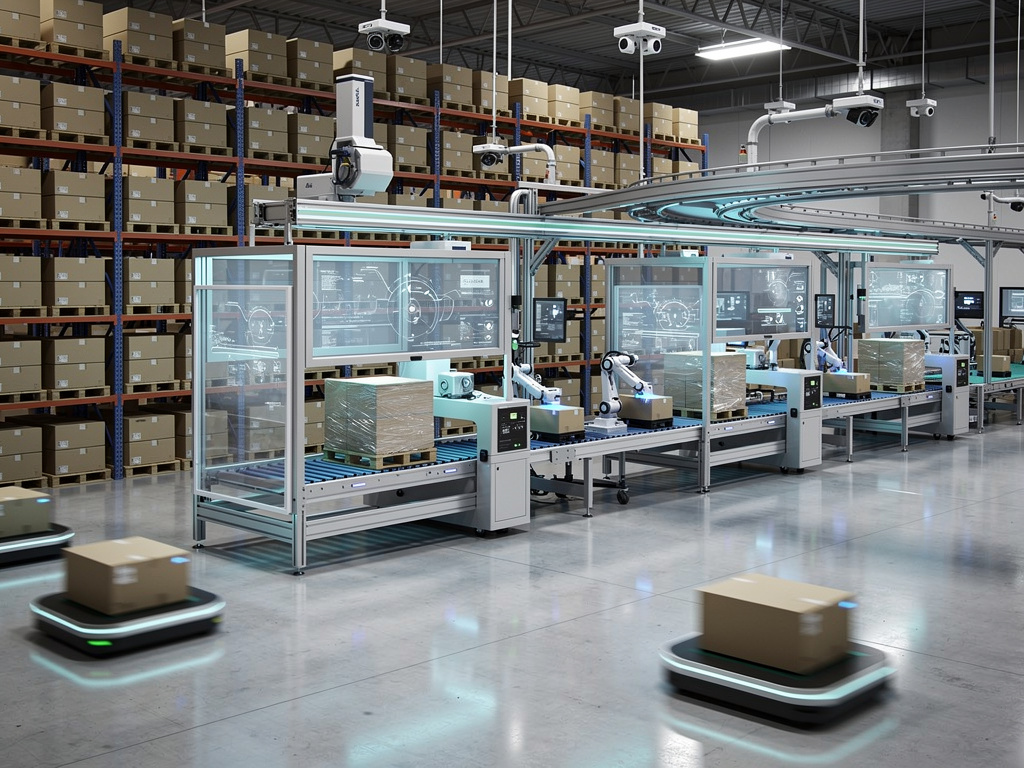
The modern warehouse is undergoing a transformation that would be unrecognizable to logistics veterans of even a decade ago. Where rows of workers once sorted, packed, and palletized goods by hand, fleets of autonomous mobile robots now glide across polished concrete floors, robotic arms pick and place items with sub-millimeter precision, and artificial intelligence orchestrates the entire ballet from cloud-based control towers. The shift is not hypothetical or aspirational — it is happening now, at scale, and the companies leading the charge say there is no turning back.
The urgency behind this automation push is rooted in a stubborn reality: the logistics industry simply cannot find enough workers. Despite wage increases, signing bonuses, and improved benefits, warehouses across the United States and Europe continue to face chronic labor shortages. The Bureau of Labor Statistics has consistently shown that the warehousing and storage sector struggles with high turnover rates, often exceeding 40% annually. As e-commerce volumes continue their relentless climb — with consumers expecting next-day or even same-day delivery — the gap between labor supply and operational demand has become an existential threat to the industry’s ability to function.
A Labor Crisis That Robots Were Built to Solve
According to reporting by CNBC, major packaging and logistics companies are accelerating their investments in warehouse automation at a pace that has surprised even industry analysts. The report details how firms across the supply chain — from third-party logistics providers to direct-to-consumer brands — are deploying robotic systems not merely as supplements to human labor, but as foundational elements of their operational strategies. The drivers are clear: labor costs that continue to rise, a demographic shift that is shrinking the pool of workers willing to take physically demanding warehouse jobs, and the relentless pressure from customers who expect faster fulfillment at lower costs.
The numbers tell a compelling story. The global warehouse automation market, valued at roughly $23 billion in 2023, is projected to surpass $40 billion by 2028, according to estimates from LogisticsIQ and other research firms. Companies like Amazon, which has long been the poster child for warehouse robotics, now operate more than 750,000 robots across its fulfillment network. But the trend has spread far beyond Big Tech. Mid-sized logistics operators, regional distributors, and even traditional packaging companies are making significant capital commitments to automation infrastructure.
Beyond Amazon: The Democratization of Warehouse Robotics
What distinguishes the current wave of automation from earlier efforts is its accessibility. A decade ago, deploying robotics in a warehouse required massive upfront capital expenditures, extensive facility redesigns, and long implementation timelines. Today, a new generation of robotics-as-a-service (RaaS) providers has lowered the barrier to entry dramatically. Companies like Locus Robotics, 6 River Systems (owned by Shopify), and Berkshire Grey offer subscription-based models that allow warehouse operators to scale their robotic fleets up or down based on seasonal demand — paying per pick or per unit moved rather than purchasing hardware outright.
This shift has been particularly transformative for small and mid-sized enterprises (SMEs) that lack the capital reserves of an Amazon or a Walmart. As CNBC reported, several packaging companies have adopted modular automation systems that can be installed in existing facilities without the need for ground-up construction. These systems often combine autonomous mobile robots (AMRs) for goods-to-person picking with automated sortation systems and robotic palletizers, creating end-to-end workflows that dramatically reduce the number of human touches required to move a product from receiving dock to outbound truck.
The Economics of Replacing Hands With Machines
The financial calculus behind warehouse automation has shifted decisively in favor of robots. Industry executives point to several converging factors. First, the cost of robotic hardware has declined steadily, driven by advances in sensors, computing power, and manufacturing scale. A collaborative robot arm that cost $50,000 five years ago can now be purchased for under $30,000, and its capabilities have improved markedly. Second, labor costs have moved in the opposite direction. Average hourly wages for warehouse workers in the United States have risen by more than 20% since 2020, according to data from the Bureau of Labor Statistics, and total compensation costs — including benefits, training, and turnover-related expenses — have climbed even faster.
The return on investment for automation projects has compressed accordingly. Where warehouse operators once expected payback periods of five to seven years for major automation installations, many are now seeing returns in two to three years. For high-volume operations running multiple shifts, the math can be even more favorable. Automated systems do not require overtime pay, do not call in sick, and can operate around the clock with minimal supervision. They also reduce error rates in picking and packing — a significant cost driver in an era when returns processing can eat into razor-thin margins.
Packaging Companies Step Into the Automation Arena
One of the more notable developments in recent months has been the aggressive move by packaging companies into automation. Firms that have traditionally focused on manufacturing boxes, wraps, and protective materials are now investing in automated packaging lines that integrate directly with warehouse management systems. The logic is straightforward: if a robotic arm can pick an item, why not have another robotic system measure it, select the optimal box size, pack it, seal it, and label it — all without human intervention?
Companies like Sealed Air, Ranpak, and Packsize have developed automated packaging solutions that use algorithms to determine the smallest possible box for each order, reducing dimensional weight charges from carriers and cutting material waste. These systems are increasingly being deployed alongside robotic picking systems, creating fully automated fulfillment cells that can process hundreds of orders per hour. The integration of packaging automation with warehouse robotics represents a convergence that is reshaping how logistics operators think about facility design and workflow optimization.
The Human Factor: Displacement, Reskilling, and New Roles
The rapid adoption of automation has inevitably raised questions about the future of warehouse employment. Industry leaders are quick to point out that automation does not necessarily mean fewer jobs — it means different jobs. As routine, physically demanding tasks are handed off to machines, human workers are being redeployed into roles that require judgment, problem-solving, and technical skills. Robot technicians, automation engineers, data analysts, and system supervisors are among the fastest-growing job categories in the logistics sector.
However, the transition is not without friction. Many incumbent warehouse workers lack the technical training needed for these new roles, and reskilling programs — while growing — have not yet reached the scale needed to absorb all displaced workers. Labor advocates have raised concerns about the pace of change, arguing that companies have a responsibility to invest in workforce development alongside their investments in hardware. Some firms have responded with substantial training initiatives. Amazon, for example, has pledged over $1.2 billion to upskill more than 300,000 employees through its Upskilling 2025 program, offering courses in robotics maintenance, cloud computing, and machine learning.
Artificial Intelligence as the Brain Behind the Brawn
Underpinning the physical automation of warehouses is a layer of artificial intelligence that is becoming increasingly sophisticated. Modern warehouse management systems use machine learning algorithms to optimize inventory placement, predict demand patterns, and dynamically route robots through facilities to minimize travel time and congestion. Computer vision systems enable robotic arms to identify and handle an enormous variety of products — from fragile glass bottles to irregularly shaped soft goods — with a dexterity that was impossible just a few years ago.
The integration of AI with physical automation is creating what some industry observers call the “autonomous warehouse” — a facility that can largely manage itself, with human oversight focused on exception handling and strategic decision-making. Companies like Ocado, the British online grocery pioneer, have built highly automated fulfillment centers where thousands of robots work in coordinated swarms atop massive grid structures, picking and assembling grocery orders in minutes. These facilities represent the cutting edge of what is possible and offer a glimpse of where the broader industry is heading.
What Comes Next for the Automated Supply Chain
Looking ahead, the trajectory is clear: automation in warehousing and logistics will continue to accelerate. Several factors will drive this momentum. The growth of e-commerce shows no signs of slowing, with global online retail sales expected to exceed $7 trillion by 2027. Consumer expectations for speed and accuracy will only intensify. And the demographic headwinds that have constrained labor supply — aging populations in developed economies, declining interest in manual labor among younger workers — are structural forces that will not reverse.
At the same time, new technologies are emerging that promise to push the boundaries of what automated warehouses can achieve. Humanoid robots from companies like Figure AI and Apptronik are being tested in logistics environments, with the potential to perform tasks that currently require human-like dexterity and mobility. Advances in generative AI are enabling more natural human-robot collaboration, with workers issuing verbal commands to robotic systems rather than programming them through complex interfaces. And the continued buildout of 5G networks is enabling real-time communication between thousands of devices in a single facility, reducing latency and improving coordination.
For packaging and logistics companies, the message is unambiguous: automate or risk obsolescence. The companies that move fastest to integrate robotics, AI, and advanced packaging systems into their operations will be best positioned to meet the demands of an increasingly digital, speed-obsessed economy. Those that delay may find themselves unable to compete — not because their products or services are inferior, but because their operations simply cannot keep pace. The warehouse of the future is not a distant vision. It is being built today, one robot at a time.


 WebProNews is an iEntry Publication