
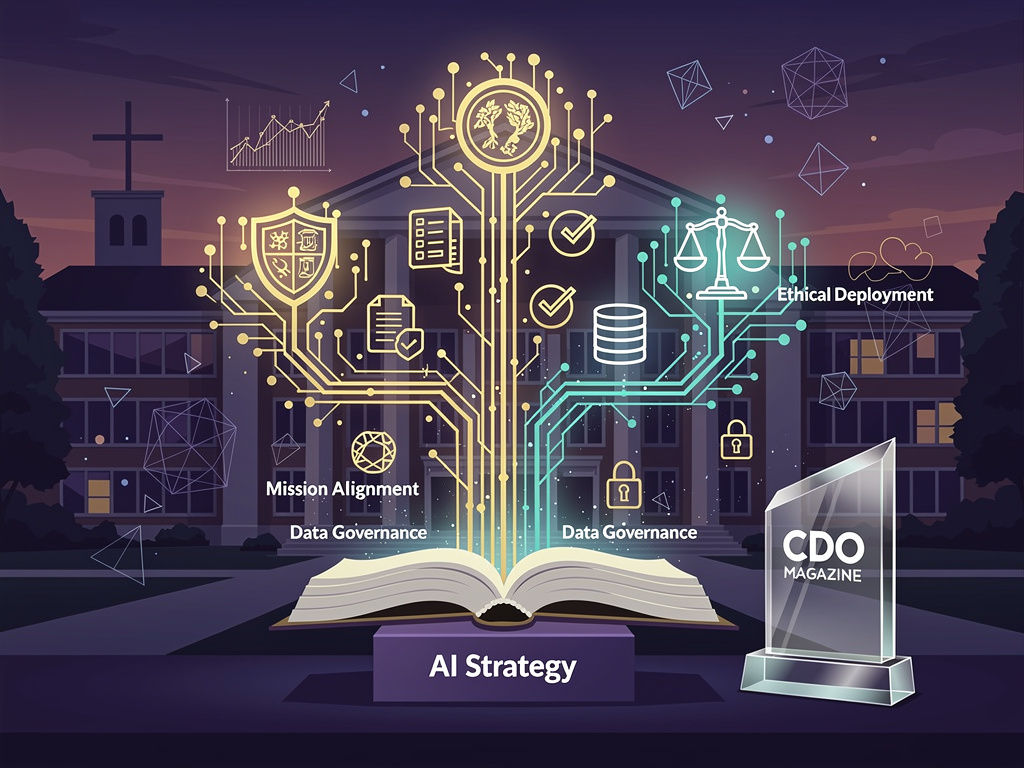
In an era when universities are racing to integrate artificial intelligence into their operations, one institution in Minnesota is taking a decidedly methodical approach — one that prioritizes mission alignment over technological spectacle. Jena Zangs, the chief data and AI officer at the University of St. Thomas, has emerged as a leading voice in the conversation about how higher education institutions should think about AI strategy, earning recognition from CDO Magazine as a featured leader in the field.
Zangs’s approach stands out not because of the scale of deployment or the sophistication of the algorithms involved, but because of the philosophical framework she has built around the university’s AI initiatives. At a time when many organizations are adopting AI tools reactively — driven by vendor pressure, peer competition, or the fear of falling behind — St. Thomas is charting a course that begins with a fundamental question: What is the purpose?
A Recognition That Reflects a Broader Movement in Higher Education
As reported by the University of St. Thomas Newsroom, Zangs was recognized by CDO Magazine for leading the university’s data and AI strategy with a purpose-driven methodology. The recognition places her among a cohort of chief data officers and AI leaders across industries who are redefining what it means to deploy intelligent systems responsibly. CDO Magazine, which covers the evolving role of data leadership in enterprise organizations, has increasingly spotlighted leaders who balance innovation with governance — a tension that is particularly acute in higher education, where the stakes involve student outcomes, academic integrity, and institutional trust.
The University of St. Thomas, a private Catholic university in St. Paul, Minnesota, enrolling roughly 10,000 students, is not typically mentioned in the same breath as the large research universities that dominate headlines about AI in academia. But Zangs’s work suggests that mid-sized institutions may be uniquely positioned to implement AI strategies that are both coherent and deeply integrated with institutional values. Unlike sprawling university systems where AI adoption can be fragmented across dozens of colleges and departments, St. Thomas has the organizational compactness to pursue a unified vision.
The Architecture of a Purpose-Driven AI Strategy
At the core of Zangs’s philosophy is the idea that AI strategy must be inseparable from institutional mission. For St. Thomas, that mission is rooted in Catholic intellectual tradition, which emphasizes the common good, human dignity, and ethical reasoning. These are not abstract principles tacked onto a technology roadmap; they are the foundation upon which every AI initiative is evaluated and prioritized.
This approach requires a different kind of leadership than what is typically found in corporate AI deployments. Rather than optimizing for efficiency or cost reduction as primary metrics, Zangs has oriented the university’s data and AI work around questions of impact: How does a given initiative serve students? How does it support faculty in their teaching and research? How does it uphold the ethical commitments that define the institution? These are questions that many organizations claim to ask but few embed structurally into their decision-making processes.
Why the Chief Data and AI Officer Role Is Gaining Ground in Academia
The creation of a chief data and AI officer position at St. Thomas reflects a broader trend in higher education. Universities across the country have been establishing dedicated leadership roles to oversee data governance, analytics, and increasingly, artificial intelligence. The role is distinct from the chief information officer, which traditionally focuses on IT infrastructure and systems management. The CDAO role, by contrast, is strategic — it sits at the intersection of technology, policy, and institutional planning.
For Zangs, the role involves not just building technical capabilities but also fostering a culture of data literacy and AI fluency across the university. This means working with faculty who may be skeptical of AI’s role in education, staff who need practical tools to improve administrative processes, and students who are navigating a world where AI competency is increasingly a prerequisite for professional success. The challenge is not merely technological; it is fundamentally organizational and cultural.
Navigating the Tension Between Innovation and Academic Integrity
One of the most pressing issues facing universities today is the impact of generative AI on academic integrity. Since the release of ChatGPT in late 2022, institutions have grappled with how to address the use of AI tools by students in coursework, examinations, and research. Some universities have responded with outright bans; others have embraced AI tools with minimal guardrails. St. Thomas, under Zangs’s guidance, appears to be pursuing a middle path — one that acknowledges the transformative potential of AI while insisting on clear ethical boundaries.
This balanced approach is consistent with the broader purpose-driven framework that Zangs advocates. Rather than treating AI as either a threat to be contained or a panacea to be celebrated, the strategy treats it as a tool whose value depends entirely on how it is deployed and governed. This nuanced perspective is increasingly resonant across higher education, where administrators are recognizing that blanket policies — whether permissive or restrictive — fail to account for the diversity of contexts in which AI is used.
Data Governance as the Foundation, Not an Afterthought
A critical element of Zangs’s strategy is the emphasis on data governance as a precondition for effective AI deployment. In many organizations, AI initiatives are launched on top of fragmented, poorly governed data ecosystems, leading to unreliable outputs and eroding trust in the technology. Zangs’s approach inverts this sequence: before deploying AI tools, the university is investing in the quality, accessibility, and ethical management of its data assets.
This governance-first philosophy has practical implications. It means establishing clear policies about who can access what data, how data is collected and stored, and how algorithmic decisions are audited and explained. For a university, these questions are particularly sensitive. Student data, financial aid information, enrollment records, and research data all carry significant privacy and ethical considerations. A governance framework that addresses these concerns proactively — rather than retroactively after a breach or controversy — is essential for maintaining the trust of students, faculty, and the broader community.
Lessons for Other Institutions and Industries
The St. Thomas model offers several lessons that extend well beyond higher education. First, it demonstrates that AI strategy need not be technology-led. By starting with mission and values rather than with specific tools or platforms, organizations can ensure that their AI investments are aligned with their most important objectives. This is a corrective to the common pattern in which organizations adopt AI because it is available, not because it is needed.
Second, Zangs’s work illustrates the importance of the CDAO role as a bridge between technical teams and institutional leadership. In many organizations, AI initiatives fail not because the technology is inadequate but because there is no one with the authority and credibility to translate between the language of data science and the language of organizational strategy. The CDAO role, when properly empowered, fills this gap.
Third, the emphasis on culture change — on building data literacy and AI fluency across the organization — is a reminder that technology adoption is ultimately a human challenge. The most sophisticated AI tools are useless if the people who are supposed to use them do not understand them, trust them, or see their relevance to their work.
The Road Ahead for AI in Higher Education
As universities continue to navigate the rapid evolution of AI capabilities, the approaches they adopt now will shape their institutional trajectories for years to come. The temptation to move fast and deploy broadly is strong, particularly as competitors announce ambitious AI initiatives and technology vendors offer increasingly polished solutions. But the experience of organizations that have rushed into AI adoption without adequate governance or strategic clarity suggests that speed without purpose often leads to waste, confusion, and reputational risk.
Jena Zangs and the University of St. Thomas are making a different bet — that deliberate, values-aligned AI strategy will ultimately prove more durable and more impactful than the alternatives. It is a bet that reflects a deep understanding of what universities are for and what they owe to the communities they serve. Whether other institutions follow this path may depend on whether they have leaders willing to ask the hard questions before reaching for the easy answers.
As the recognition from CDO Magazine suggests, the field is beginning to take notice. In a domain crowded with hype and breathless predictions, the quiet discipline of purpose-driven strategy may be the most radical innovation of all.


 WebProNews is an iEntry Publication