
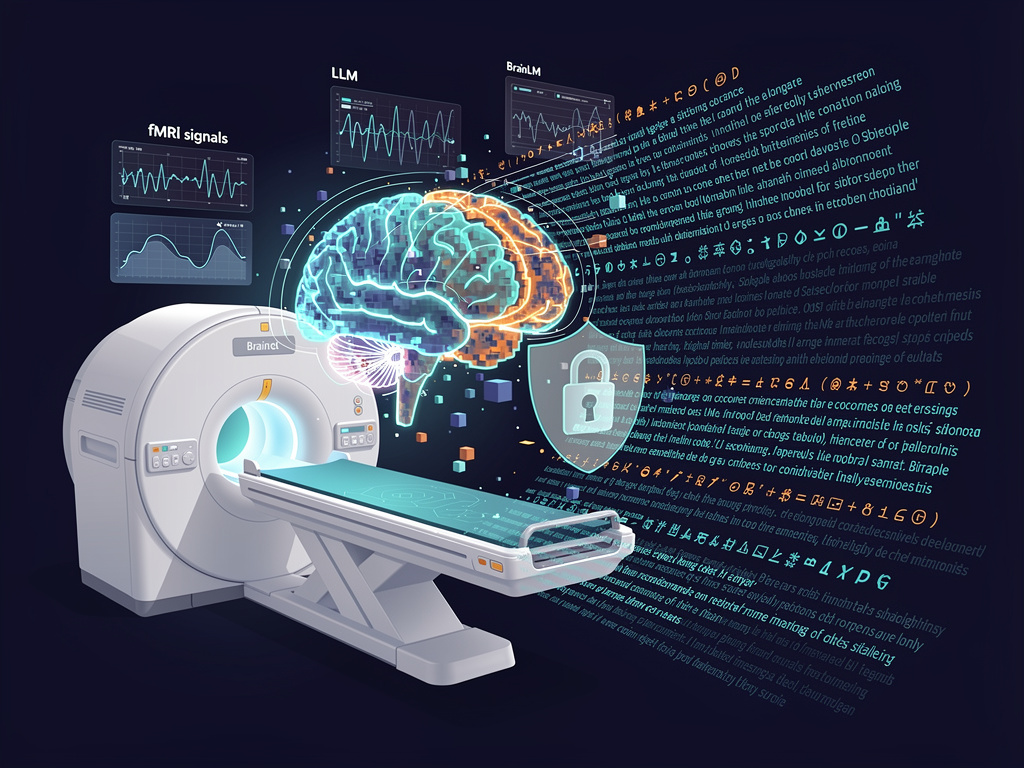
A team of researchers has quietly advanced the science of brain-computer interfaces by demonstrating that large language models can be trained to translate raw neural signals into coherent text — raising profound questions about the future of communication, privacy, and the boundaries between human cognition and artificial intelligence.
The paper, titled “BrainLM: Brain Language Model for fMRI Brain Decoding” and published on the preprint server arXiv, presents a framework that uses transformer-based architectures — the same class of models underpinning ChatGPT and similar systems — to decode language directly from functional magnetic resonance imaging (fMRI) data. The approach represents a significant step forward in the long-running effort to build machines that can interpret the neural correlates of human thought, moving beyond simple classification tasks toward open-ended language generation.
From Brain Scans to Sentences: The Technical Architecture
The core innovation described in the arXiv paper lies in how the researchers bridge the gap between the high-dimensional, noisy world of brain imaging data and the structured domain of natural language. Functional MRI captures blood-oxygen-level-dependent (BOLD) signals across the brain, producing volumetric snapshots of neural activity at relatively coarse temporal resolution — typically one scan every one to two seconds. Translating these signals into words and sentences requires a model that can learn abstract representations of meaning from spatially distributed patterns of brain activity.
The team’s approach involves a two-stage pipeline. First, a neural encoder is trained to map fMRI voxel patterns into a shared embedding space that aligns with the internal representations of a pretrained large language model. Second, the language model itself is fine-tuned or prompted to generate text conditioned on these brain-derived embeddings. The result is a system that, given a sequence of brain scans recorded while a subject listens to or reads natural language, can produce decoded text that approximates the original stimulus with surprising fidelity.
Why This Matters Beyond the Laboratory
Brain decoding research has been underway for more than two decades, but earlier efforts were largely limited to classifying which of a small set of predetermined stimuli a subject was perceiving. A system might determine, for example, whether someone was looking at a face or a house, or distinguish between a handful of words. The shift toward open-vocabulary decoding — generating arbitrary sentences rather than picking from a fixed list — marks a qualitative change in what these systems can do.
The implications extend well beyond academic neuroscience. For patients with locked-in syndrome, severe paralysis, or neurodegenerative diseases that destroy the ability to speak, brain-computer interfaces that can decode intended speech from neural activity could restore a fundamental human capacity. Companies including Neuralink, Synchron, and Meta’s Reality Labs have invested heavily in this area, each pursuing different hardware and algorithmic strategies. The arXiv research contributes to the algorithmic side of the equation, showing that off-the-shelf language model architectures can be adapted for neural decoding without requiring invasive brain implants — fMRI is entirely non-invasive, though impractical for everyday use due to the size and cost of the scanners.
The Role of Large Language Models as Neural Decoders
One of the more striking aspects of the work is how naturally large language models lend themselves to the brain decoding task. Transformer architectures were originally designed to process sequences of tokens — words or subwords — and predict what comes next. But their internal representations, particularly in the middle and later layers, encode rich semantic information about meaning, context, and syntax. Neuroscience research over the past several years has shown that these artificial representations bear a non-trivial resemblance to the way the human brain organizes language.
This correspondence is not accidental. Both biological brains and large language models are, in a sense, optimized to predict upcoming linguistic input. The brain does this to facilitate rapid comprehension; the model does it because that is its training objective. The researchers behind BrainLM exploit this alignment by learning a mapping function that translates brain activity patterns into the model’s embedding space, effectively treating the brain as another input modality — analogous to how multimodal AI systems accept images, audio, or video alongside text.
Accuracy, Limitations, and the Question of What Is Actually Being Decoded
The decoded outputs reported in the paper are impressive but imperfect. The system captures the general semantic content of stimuli — the topic, key concepts, and approximate meaning — more reliably than it reproduces exact wording. This is consistent with what neuroscientists understand about how the brain represents language: fMRI signals reflect broad patterns of semantic processing rather than precise phonological or lexical details. A subject hearing the sentence “The dog chased the cat across the yard” might produce a decoded output closer to “A dog was running after a cat outside” — semantically faithful but lexically different.
This distinction matters. It suggests that current non-invasive brain decoding systems are reading meaning, not words. They capture the gist of what someone is thinking about, not a verbatim transcript of inner speech. For clinical applications aimed at restoring communication, this level of decoding may be sufficient and even preferable, since patients may think in concepts rather than fully formed sentences. But it also means that the technology is not yet a mind-reading device in the science-fiction sense — a point the researchers themselves are careful to emphasize.
Privacy and Ethical Dimensions That Cannot Be Ignored
Even with these limitations, the ethical questions are substantial. If a system can determine with reasonable accuracy what someone is thinking about based on their brain activity, questions about consent, data ownership, and potential misuse become urgent. Who owns a decoded thought? Can brain data be subpoenaed? Could employers or insurers demand neural screenings?
These are not hypothetical concerns. In 2023, researchers at the University of Texas at Austin published a related study in Nature Neuroscience demonstrating continuous language decoding from fMRI using GPT-based models, and the ethical discussion that followed was immediate and intense. The BrainLM work on arXiv adds to this growing body of evidence that the technical barriers to thought decoding are falling faster than the legal and ethical frameworks needed to govern it. Neuroethicists have called for preemptive regulation, including the establishment of “cognitive liberty” as a recognized right — the idea that individuals should have absolute sovereignty over their own mental processes and neural data.
The Hardware Gap: Why fMRI Is a Stepping Stone, Not a Destination
For all its scientific value, fMRI-based decoding faces a fundamental practical constraint: the technology requires a person to lie motionless inside a multi-ton, multi-million-dollar magnet. This makes it unsuitable for real-world communication aids. The real promise of this research lies in demonstrating algorithmic principles that could eventually be applied to more portable neural recording technologies.
Electroencephalography (EEG), functional near-infrared spectroscopy (fNIRS), and implanted electrode arrays all offer pathways to mobile brain-computer interfaces. Invasive approaches, such as the Utah arrays used by BrainGate or the flexible electrode threads developed by Neuralink, provide much higher spatial and temporal resolution than fMRI but carry surgical risks. Non-invasive wearable devices are safer but produce noisier signals. The algorithmic insights from studies like BrainLM — particularly the demonstration that pretrained language models can serve as powerful priors for neural decoding — are likely transferable across recording modalities, potentially accelerating progress on all fronts.
What Comes Next for Brain-to-Text Technology
The trajectory of this field is clear, even if the timeline remains uncertain. As language models grow more capable and neuroscientific understanding of the brain’s language system deepens, the accuracy and granularity of neural decoding will continue to improve. Multimodal models that can simultaneously process brain signals alongside contextual information — the identity of a conversation partner, the topic of discussion, visual input — could further enhance performance.
The research community is also beginning to explore decoding of imagined speech, not just perceived speech. If a person can simply think a sentence and have it decoded, the clinical utility increases enormously. Early results in this area are promising but preliminary, with accuracy rates well below those achieved for perceived speech. The gap is expected to narrow as training datasets grow and models become more sophisticated.
For now, the BrainLM framework published on arXiv stands as a demonstration of principle: that the same AI architectures transforming industries from finance to medicine can also be turned inward, toward the most complex information-processing system known — the human brain. Whether society is prepared for what these systems will eventually be able to do remains an open and urgent question.


 WebProNews is an iEntry Publication