
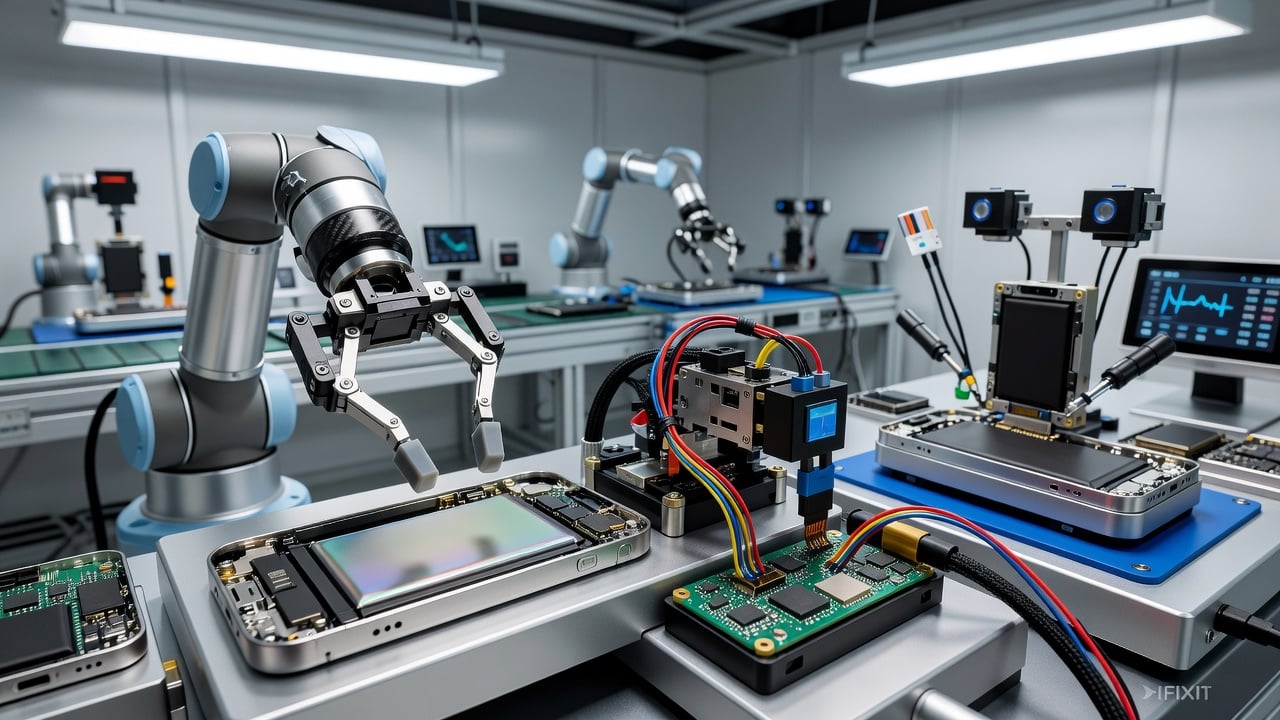
Apple sells hundreds of millions of iPhones every year. Each one depends on a slender lithium-polymer cell that most owners never see or think about until it starts to fade. A new video from iFixit pulls back the curtain on what happens after that bare cell leaves the coating machines. The result surprises even seasoned repair advocates. The process mixes sophisticated electronics with hands-on assembly steps that look almost old-school.
Shot inside one of China’s largest battery factories, the footage shows iFixit’s lead teardown technician Shahram Mokhtari building a replacement battery from start to finish. He programs the battery management system, mates it to the cell, folds the board, runs it through quality-control stations and applies the adhesive strips Apple uses to hold the pack in place. Then he drops the finished unit into an iPhone, powers it on and watches the device boot. The entire sequence feels deliberate. Almost nothing runs at full robotic speed.
From raw cell to phone-ready pack, every decision balances safety, capacity and repairability.
The video, titled “How iPhone Batteries Are Really Made,” opens with a tour of the massive production floor. Millions of cells move through the plant each month. Yet the post-cell steps that turn those pouches into safe, smart batteries still require human hands at key moments. Mokhtari sits at a workstation and flashes software onto the small printed circuit board that will become the BMS. That board monitors voltage, current, temperature and state of health. Get the firmware wrong and the battery could overheat, report false data or fail to work with iOS at all.
Next comes physical assembly. He attaches the BMS to the cell using precise tape to prevent shorts. He folds the flexible board down against the pouch and secures it. These steps look simple on camera. In reality they demand steady hands and strict process control. A single misplaced crease or speck of dust can trigger failures later. The factory’s quality-control station then runs the pack through a series of automated tests. Impedance checks. Capacity measurements. Over-current protection validation. Only units that pass every gate receive the final adhesive strips that Apple designed to make removal cleaner in authorized service centers.
iFixit published the video on July 2, 2026. Within hours repair communities on X lit up with fresh appreciation for the hidden complexity. The 9to5Mac report that broke the story called the workflow “surprisingly analog.” Many manual steps remain even in 2026. That observation lands with force for an industry that markets every new silicon process as revolutionary. Here the story is different. The engineering sits inside layers of chemistry, firmware and meticulous final integration.
Apple itself describes its batteries as “rigorously designed, tested, and manufactured to meet Apple quality and performance standards,” according to the company’s support page on genuine parts. The iFixit footage gives outsiders a rare look at those standards in action. After final testing, Mokhtari reads the battery’s health data. The pack reports 101 percent state of health on the factory-fresh unit. Temperature readings stay stable. Charge level and design capacity match expected values. He then installs the battery in an iPhone. The phone recognizes it immediately and boots without error. That successful handoff matters. Third-party batteries have struggled for years with pairing issues and throttled performance. iFixit’s parts aim to avoid those pitfalls by replicating the full factory sequence.
The video arrives at a moment when consumers pay more attention to battery longevity. A recent ZDNet piece described one writer’s experience replacing an iPhone 14 Pro battery at an Apple Store and learning how quickly health can drop under heavy use. Older iPhones in 2026 often show degraded capacity even with careful charging habits. Apple’s own support documentation explains that lithium-ion batteries lose capacity over time through chemical aging, not just cycle count. Factors such as heat, fast charging and calendar age all play roles.
Yet the manufacturing side receives less public scrutiny. Most coverage focuses on teardowns after the fact or debates over right-to-repair laws. iFixit has spent years pushing for better access to genuine or high-quality replacement parts. Its factory visit puts concrete images behind those arguments. Viewers see the clean rooms, the precision fixtures and the mix of automation and handwork that produces a component small enough to fit inside a phone yet sophisticated enough to protect against thermal runaway.
One moment in the video stands out. Mokhtari applies the pull-tab adhesive strips that have become a signature of modern iPhone battery service. Those tabs allow technicians to remove the pack without prying against delicate components. The design choice reflects years of iteration. Early iPhones used glue that made battery swaps risky. Later models improved. The current generation balances adhesion strength with serviceability. iFixit’s decision to replicate that exact adhesive in its replacement kits signals respect for both safety and practicality.
Battery factories in China supply not only Apple but the broader electronics and electric-vehicle worlds. A Nordson analysis from April 2026 noted that battery manufacturing continues to scale in Asia while new regional hubs open in Europe and North America. Yield rates, scrap reduction and safety protocols remain top priorities across the sector. The iFixit video illustrates why. A defect that slips through can lead to recalls, fires or devices that throttle performance to protect users. The multiple test stations exist for good reason.
And the engineering runs deeper than most realize. The lithium-polymer cell itself consists of dozens of ultra-thin electrode layers stacked with microscopic precision. Electrolyte formulation, separator thickness and tab welding all affect final performance. Once the cell leaves that part of the line, the BMS adds intelligence. Firmware calibration tailors the pack to iPhone hardware and software. Without that step, even a perfect cell can report incorrect health metrics or fail to charge at optimal rates.
iFixit has built its reputation on transparent teardowns and repair guides. This video continues that tradition but shifts focus upstream. Instead of dissecting a finished product, the team shows how one key component comes to life. The approach offers repair professionals, supply-chain analysts and even curious owners a clearer picture of the real costs and constraints behind smartphone longevity.
Consumers increasingly want batteries that last longer and phones that remain repairable years after purchase. Apple has responded with improved battery health tools, recycled materials in newer models and claims of 100 percent recycled cobalt in some designs. The iFixit footage shows the other side of that equation. Real-world factories still blend automation with human judgment. Quality gates remain strict. And every finished pack carries the accumulated decisions of chemists, firmware engineers, process technicians and final assemblers.
The video ends on a practical note. Mokhtari powers on the iPhone with the fresh battery. The screen lights up. Normal operation resumes. For viewers who have ever swapped a swollen or dead battery themselves, the sequence feels satisfying. It also drives home a larger point. The smartphone in your pocket contains components that demand factory-level expertise to produce and replace safely. That reality shapes everything from product design to environmental impact to the economics of the repair industry.
Industry insiders already know these details at some level. They see the teardowns, read the supplier reports and track battery chemistry advances. Yet visual documentation like this remains rare. iFixit’s access to the factory floor gives the public a window that few companies offer. The company’s own replacement batteries, sold through its online store, follow the same process shown on camera. That consistency matters for technicians who rely on third-party parts when official channels prove too expensive or slow.
Recent discussions on X echo the video’s themes. Repair advocates highlight the manual steps as evidence that right-to-repair should include access to the same components and instructions used in factories. Others focus on the testing protocols, arguing that consumers deserve transparent data on how replacement batteries perform over time. The conversation feels timely. As phones grow more powerful and batteries push physical limits, the systems that manage and maintain them grow more critical.
In the end the iPhone battery is both commodity and sophisticated module. It starts as layered foil and electrolyte. It finishes as a calibrated, tested, adhesive-backed pack carrying firmware tuned for one specific family of devices. The journey between those states involves chemistry, software, hands, machines and dozens of quality gates. iFixit’s video makes that journey visible. For an industry built on invisible progress inside tiny packages, that visibility counts.


 WebProNews is an iEntry Publication