
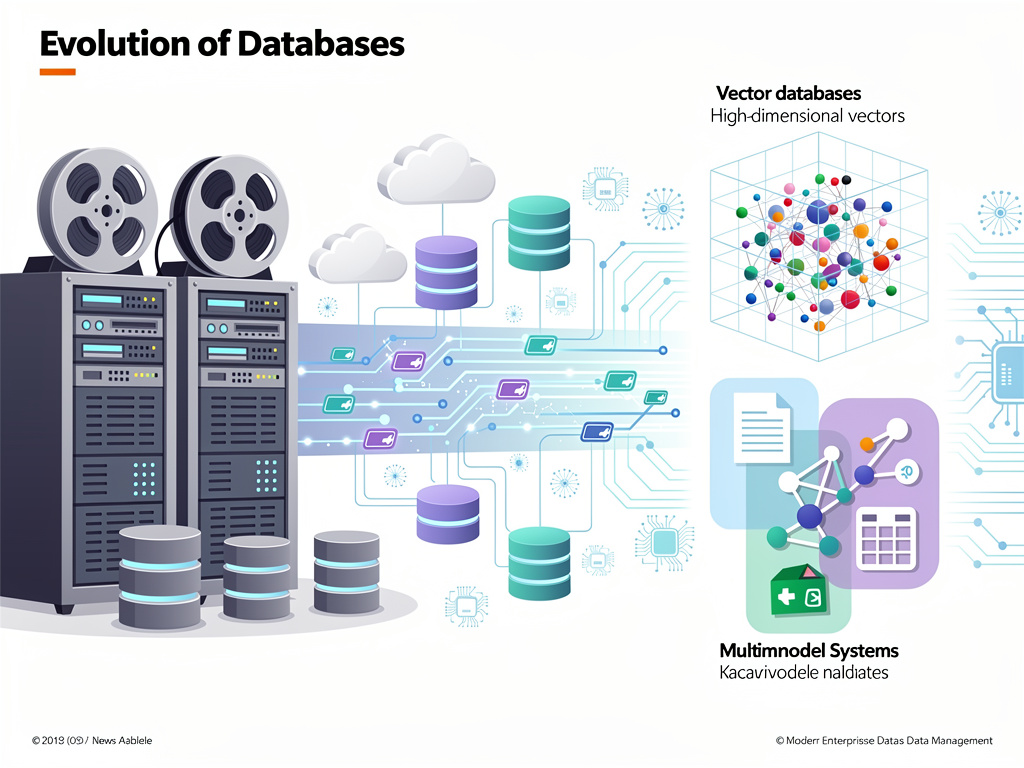
The modern enterprise runs on data, and at the heart of every digital operation lies a technology so fundamental that its absence would bring global commerce to a standstill. Databases have evolved from simple sequential storage systems into sophisticated platforms that power everything from e-commerce transactions to artificial intelligence applications, yet their journey remains largely invisible to those outside the technology sector.
According to Amazon Web Services, a database is an electronically stored, systematic collection of data that can contain any type of information, including words, numbers, images, videos, and files. Database management systems (DBMS) enable organizations to store, retrieve, and edit this data efficiently. What began as magnetic tapes storing sequential records has transformed into complex, high-performing systems with their own dedicated field of study, supporting the internal operations of companies while storing interactions with customers and suppliers.
The stakes for database performance have never been higher. Modern database applications manage volumes that would have seemed impossible just decades ago, scaling to millions and billions of records. As Gartner reported in November 2023, worldwide public cloud end-user spending is forecast to reach $679 billion in 2024, with database management systems representing a significant portion of that investment as organizations migrate legacy systems to cloud-native architectures.
The Foundation of Digital Commerce
The importance of databases extends far beyond simple data storage. These systems support privacy and compliance requirements, implement built-in rules to maintain data consistency, and enable the data analytics that help organizations make business decisions with confidence. Different users can access databases with varying permission levels, from read-only access to full administrative control, ensuring both security and operational flexibility.
Digital library systems, travel reservation platforms, and inventory management solutions all depend on robust database infrastructure. According to Statista, the total amount of data created, captured, copied, and consumed globally reached 120 zettabytes in 2023, up from just 2 zettabytes in 2010. This exponential growth underscores why efficient scaling has become a critical requirement for database systems, as it has become impossible to store such quantities of digital information without sophisticated database architecture.
The classification of databases reflects their diverse applications across industries. Organizations categorize databases by their contents, such as document text, statistics, or multimedia objects; by their application area, including accounting, film production, or manufacturing; and by their technical aspects, such as database structure or interface type. Each classification method serves specific organizational needs and helps enterprises select appropriate solutions for their unique requirements.
From Hierarchical Trees to Relational Tables
The evolution of database models tells the story of computing itself. In the 1970s, hierarchical databases emerged as the first major advancement beyond sequential tape storage. These systems organized data in tree structures, establishing parent-child relationships between files. A furniture retail store, for example, might define “bedroom” as a parent record with “bed,” “bedside table,” and “wardrobe” as child records, with each child record potentially containing its own children, such as “single bed,” “double bed,” and “queen bed.”
However, the hierarchical model’s limitations became apparent quickly. As IBM explains in their database overview, hierarchical systems proved complex to implement and couldn’t handle multiple parent-child relationships without significant data duplication. This constraint led to the development of the network database model, which allowed one child record to have multiple parent records and vice versa, providing greater flexibility but introducing additional complexity.
The 1980s brought the relational database revolution, a paradigm shift that would dominate enterprise computing for decades. Relational databases organized records as tables instead of linked lists, with each category represented as a table, category attributes as columns, and data records as rows. According to Oracle, this model’s productivity, flexibility, and compatibility with faster hardware made it the preferred choice for enterprise applications, a position it maintains today despite competition from newer database types.
The Cloud Native Transformation
The migration to cloud infrastructure has fundamentally altered database economics and capabilities. McKinsey research indicates that cloud adoption has accelerated dramatically, with 90% of organizations now using cloud services in some capacity. This shift has enabled businesses to scale database resources dynamically, paying only for what they use rather than maintaining expensive on-premises infrastructure.
Cloud-native databases offer advantages beyond cost savings. They provide built-in redundancy, automated backups, and geographic distribution that would be prohibitively expensive for most organizations to implement independently. Microsoft Azure highlights how modern cloud databases support both SQL and NoSQL models, allowing organizations to choose the right tool for each specific use case rather than forcing all data into a single architectural pattern.
The emergence of NoSQL databases represents another significant evolution in data management. Unlike traditional relational databases that require predefined schemas, NoSQL systems offer flexible data models that can adapt to changing requirements. MongoDB explains that NoSQL databases excel at handling unstructured and semi-structured data, making them ideal for modern applications dealing with social media content, sensor data, and other non-tabular information sources.
Real-Time Analytics and AI Integration
Modern databases have evolved beyond simple storage and retrieval systems to become analytical engines. According to Forbes Technology Council, the integration of artificial intelligence and machine learning capabilities directly into database systems represents one of the most significant developments in recent years. These intelligent databases can identify trends and patterns, make predictions, and even optimize their own performance without human intervention.
The demand for real-time analytics has pushed database technology in new directions. Traditional databases often required extracting data into separate analytical systems, introducing latency and complexity. Snowflake and similar platforms have pioneered architectures that support both transactional and analytical workloads simultaneously, eliminating the need for complex data pipelines and enabling businesses to make decisions based on current rather than historical information.
Vector databases represent the cutting edge of this evolution, specifically designed to support AI and machine learning applications. Pinecone describes how these specialized systems store and query high-dimensional vectors, enabling applications like semantic search, recommendation engines, and large language model integrations that would be impractical with traditional database architectures.
Security and Compliance in the Modern Era
As data breaches dominate headlines and regulatory requirements multiply, database security has become a boardroom concern. IBM’s Cost of a Data Breach Report 2023 found that the average cost of a data breach reached $4.45 million, with compromised credentials being the most common initial attack vector. Database security features including encryption at rest and in transit, role-based access control, and audit logging have evolved from optional features to fundamental requirements.
Compliance requirements have added another layer of complexity to database management. The General Data Protection Regulation (GDPR) in Europe, the California Consumer Privacy Act (CCPA), and industry-specific regulations like HIPAA for healthcare data mandate specific data handling practices. PostgreSQL, one of the most popular open-source databases, has added features specifically designed to support compliance requirements, including data masking, row-level security, and comprehensive audit trails.
The challenge of securing distributed databases compounds these concerns. As ZDNet reports, organizations increasingly run databases across multiple cloud providers and on-premises environments, creating a complex security perimeter that requires sophisticated identity and access management solutions. Zero-trust security models, which assume no user or system should be trusted by default, are becoming standard practice for database access control.
The Open Source Alternative
Open-source databases have emerged as serious competitors to proprietary systems, offering cost savings and flexibility that appeal to organizations of all sizes. MySQL, PostgreSQL, and other open-source platforms power some of the world’s largest applications, from social media platforms to financial services. The open-source model enables rapid innovation, with global communities of developers contributing features and fixes that might take years to appear in proprietary systems.
The commercial support ecosystem around open-source databases has matured significantly. Companies like Percona and EnterpriseDB offer enterprise-grade support, consulting, and enhanced versions of open-source databases, addressing concerns about production support that once deterred large organizations from adopting these platforms. This hybrid model combines the innovation of open source with the reliability and accountability that enterprises require.
However, the open-source database market faces challenges from cloud providers offering managed database services. TechCrunch reports that some open-source database companies have modified their licenses to prevent cloud providers from offering competing services without contributing back to the project, highlighting tensions between open-source ideals and commercial sustainability.
Performance Optimization and the Cost of Speed
Database performance optimization has evolved into a specialized discipline as organizations demand faster response times and higher throughput. Datadog explains that modern database performance monitoring involves tracking dozens of metrics including query execution time, lock contention, cache hit rates, and resource utilization. Machine learning algorithms increasingly automate optimization tasks that once required expert database administrators.
The choice between consistency and availability represents a fundamental tradeoff in distributed database design. The CAP theorem, formulated by computer scientist Eric Brewer, states that distributed systems can guarantee only two of three properties: consistency, availability, and partition tolerance. Redis and similar systems allow organizations to tune these tradeoffs based on their specific requirements, prioritizing availability for user-facing applications while maintaining stronger consistency for financial transactions.
In-memory databases have pushed performance boundaries by storing data in RAM rather than on disk, eliminating the latency associated with disk I/O operations. SAP HANA and similar platforms can process queries orders of magnitude faster than traditional disk-based systems, enabling real-time analytics on massive datasets. However, the higher cost of RAM compared to disk storage means these systems remain specialized tools rather than general-purpose solutions.
The Multimodel Future
The database industry is moving away from one-size-fits-all solutions toward multimodel databases that support different data types and access patterns within a single system. Couchbase and ArangoDB exemplify this trend, offering document, graph, and key-value storage capabilities in unified platforms. This approach reduces operational complexity by eliminating the need to maintain separate databases for different use cases.
Graph databases have gained prominence as organizations seek to understand complex relationships in their data. Neo4j, the leading graph database platform, excels at queries that traverse relationships, making it ideal for social networks, fraud detection, and knowledge graphs. According to Gartner’s analysis, graph technology will underpin 80% of data and analytics innovations by 2025, up from just 10% in 2021.
Time-series databases address the specific needs of IoT applications, monitoring systems, and financial trading platforms that generate massive volumes of timestamped data. InfluxDB and similar specialized databases optimize for write-heavy workloads and time-based queries, offering compression and retention policies designed for temporal data. As IoT Analytics projects, the number of connected IoT devices will reach 27 billion by 2025, driving continued growth in time-series database adoption.
The Human Factor in Database Management
Despite advances in automation, skilled database professionals remain in high demand. Indeed reports that database administrators command median salaries exceeding $100,000 annually in the United States, with specialized skills in cloud platforms and NoSQL systems commanding premium compensation. The shortage of qualified database professionals has accelerated the development of automated management tools, but human expertise remains essential for complex troubleshooting and architectural decisions.
The role of database administrators has evolved significantly. Rather than focusing primarily on backups and performance tuning, modern database professionals must understand cloud architecture, security best practices, and data governance frameworks. LinkedIn analysis suggests that successful database professionals increasingly combine technical skills with business acumen, helping organizations align their data infrastructure with strategic objectives.
Training and certification programs have adapted to these changing requirements. Cloud providers offer specialized database certifications, while organizations like the Data Management Association provide vendor-neutral credentials covering data governance, quality, and architecture. The investment in human capital remains as important as technology investments, with organizations that neglect training finding themselves unable to fully leverage their database infrastructure.
As databases continue to evolve, they remain the invisible infrastructure supporting digital transformation across every industry. From the hierarchical systems of the 1970s to today’s AI-powered, cloud-native platforms, database technology has consistently adapted to meet growing demands for scale, performance, and flexibility. The next generation of database systems will need to address emerging challenges including edge computing, quantum-safe encryption, and the integration of increasingly sophisticated AI capabilities, ensuring that this fundamental technology continues to evolve alongside the organizations that depend on it.


 WebProNews is an iEntry Publication