
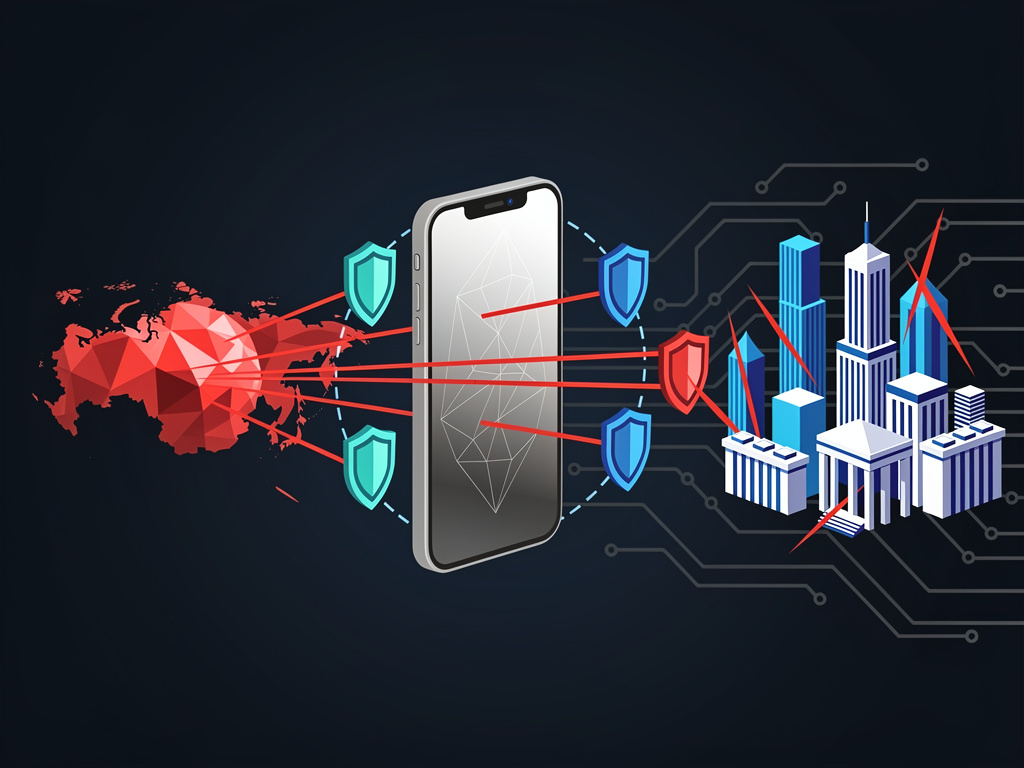
A Russian-aligned threat group has turned a leaked Israeli surveillance tool against Western diplomats and journalists, marking one of the most significant crossovers between commercial spyware and state-sponsored espionage operations documented this year. The campaign, attributed to the group tracked as TA446, exploits a weaponized version of DarkSword — an iOS implant originally developed by an Israeli firm for law enforcement clients — to silently compromise iPhones belonging to targets across Europe and North America.
The operation is brazen. And it’s effective.
According to The Hacker News, researchers first identified the campaign in early March 2026 after anomalous network traffic was flagged emanating from devices belonging to staff at a European foreign ministry. Forensic analysis revealed a sophisticated infection chain that begins with a zero-click iMessage exploit and culminates in the deployment of DarkSword, a full-featured spyware implant capable of extracting messages, activating microphones, harvesting credentials, and exfiltrating encrypted communications from apps like Signal and WhatsApp. The implant persists across reboots — a capability that distinguishes it from earlier generations of mobile spyware that were wiped by a simple device restart.
TA446, sometimes referred to by other vendor designations including ColdRiver and Star Blizzard, has long been associated with Russia’s Federal Security Service, the FSB. The group’s traditional playbook centers on credential phishing campaigns aimed at think tanks, defense officials, and NGOs. This latest operation represents a dramatic escalation in technical sophistication. Where TA446 once relied on social engineering and fake login pages, it now deploys military-grade mobile implants against hardened targets.
The provenance of DarkSword itself tells a complicated story about the global spyware market and its unintended consequences. The tool was originally built by an Israeli surveillance company — one of several firms that emerged in the wake of NSO Group’s legal and regulatory troubles — and sold exclusively to vetted government clients under export licenses. Sometime in late 2025, according to threat intelligence analysts cited by The Hacker News, the implant’s source code and deployment infrastructure were leaked, likely by a disgruntled insider or through a breach of the vendor’s development environment. Within weeks, modified versions of DarkSword began appearing in underground forums frequented by advanced persistent threat operators.
That leak changed everything.
The infection chain documented in the TA446 campaign is technically impressive and operationally disciplined. Targets receive no visible notification. The zero-click exploit targets a vulnerability in Apple’s iMessage processing framework — a class of bug that Apple has repeatedly patched but that continues to surface due to the enormous complexity of the message parsing codebase. Once initial code execution is achieved, the exploit downloads a lightweight loader that performs environment checks, verifying the device’s phone number, carrier, and geographic location before proceeding. Only devices matching a specific target profile receive the full DarkSword payload. Everyone else gets nothing. This kind of selective deployment makes the campaign extremely difficult to detect through broad telemetry analysis, because the vast majority of exploit attempts simply vanish without a trace.
Apple declined to comment on whether the specific iMessage vulnerability used in this campaign has been patched. The company has invested heavily in mobile security through features like Lockdown Mode, which restricts iMessage functionality and other attack surfaces for high-risk users. But adoption of Lockdown Mode remains low even among populations most likely to be targeted, according to security researchers. The friction it introduces — disabling link previews, blocking unknown FaceTime calls, restricting configuration profiles — makes it unappealing for everyday use. And that gap between available protection and actual deployment is precisely what groups like TA446 exploit.
The target list, as described by researchers, is focused and deliberate. Diplomats working on Russia-Ukraine policy. Journalists covering Russian intelligence operations. Researchers at Western think tanks who publish analysis on Kremlin strategy. Former government officials who retain security clearances or advisory roles. The pattern mirrors TA446’s historical targeting priorities but with a new intensity. Previous campaigns attributed to the group aimed primarily to steal email credentials and monitor communications through compromised webmail accounts. DarkSword gives the operators something fundamentally different: persistent, real-time access to a target’s most intimate digital space — their phone.
The geopolitical context matters. Relations between Russia and the West remain at their most strained point in decades, with the war in Ukraine grinding through its fourth year and diplomatic channels operating under enormous pressure. Intelligence collection against Western foreign policy officials has always been a priority for Russian services, but the tools available have grown more powerful. The proliferation of commercial spyware — built by private companies, sold to governments, and inevitably leaked or stolen — has created an arms bazaar that state actors can shop from without investing years in developing equivalent capabilities internally.
This isn’t the first time a commercial spyware tool has ended up in the hands of a state intelligence service operating outside its intended customer base. NSO Group’s Pegasus was documented by Citizen Lab and Amnesty International being used against journalists, activists, and political opponents in countries far removed from its stated counterterrorism purpose. But the DarkSword case is different in a critical respect: the tool wasn’t purchased by Russia through legitimate or gray-market channels. It was stolen. And it was then re-engineered by a group with the technical resources of a nation-state intelligence service, making it potentially more dangerous than the original product.
Researchers who analyzed the modified DarkSword implant found several enhancements over the leaked source code. The TA446 variant includes improved anti-forensics capabilities that actively detect and interfere with mobile device forensic tools commonly used by incident responders. It uses a novel command-and-control protocol that tunnels communications through legitimate cloud services, making network-level detection extremely challenging. And it incorporates a self-destruct mechanism that can wipe all traces of the implant from a device on command — or automatically, if the implant detects that the device is being examined in a forensic environment.
So what can potential targets do?
The immediate advice from security researchers is straightforward but sobering. Enable Apple’s Lockdown Mode. Keep devices updated to the latest iOS version. Be suspicious of any unexpected device behavior, including unusual battery drain, unexplained data usage, or brief screen activations. But these measures are imperfect. Zero-click exploits, by definition, require no interaction from the victim. And sophisticated implants like DarkSword are designed to evade exactly the kinds of indicators that security-conscious users might watch for.
The broader policy implications are significant. The commercial spyware industry has operated for years in a regulatory gray zone, with export controls that vary widely by jurisdiction and enforcement that has been inconsistent at best. The DarkSword leak demonstrates the catastrophic risk inherent in the proliferation of these tools. Once source code exists, it can be stolen, leaked, or sold. And once it’s in the wild, there is no retrieving it. The Israeli firm that built DarkSword reportedly ceased operations shortly after the leak became public, but the damage was already done. The code lives on, modified and improved by one of the most active state-sponsored threat groups in the world.
The U.S. government has taken steps in recent years to constrain the spyware market, including adding NSO Group and Candiru to the Commerce Department’s Entity List and issuing an executive order restricting federal agencies’ use of commercial spyware. European governments have been slower to act, despite mounting evidence that their own officials are frequent targets. The DarkSword campaign may force a more urgent reckoning. When a tool built by an allied nation’s private sector ends up being used by an adversary’s intelligence service against your diplomats, the policy failure is hard to ignore.
For the cybersecurity industry, this campaign is a case study in convergence. The line between commercial surveillance tools and state-sponsored offensive capabilities has been blurring for years. TA446’s adoption of DarkSword erases it almost entirely. The defenders — Apple’s security engineering team, government cybersecurity agencies, private threat intelligence firms — now face an adversary wielding a tool that was designed from the ground up to defeat their protections. Built by people who understood exactly how iOS security works. Refined by operators with years of experience penetrating high-value targets.
That’s a formidable combination. And it’s one that the security community will be grappling with for some time to come.


 WebProNews is an iEntry Publication