
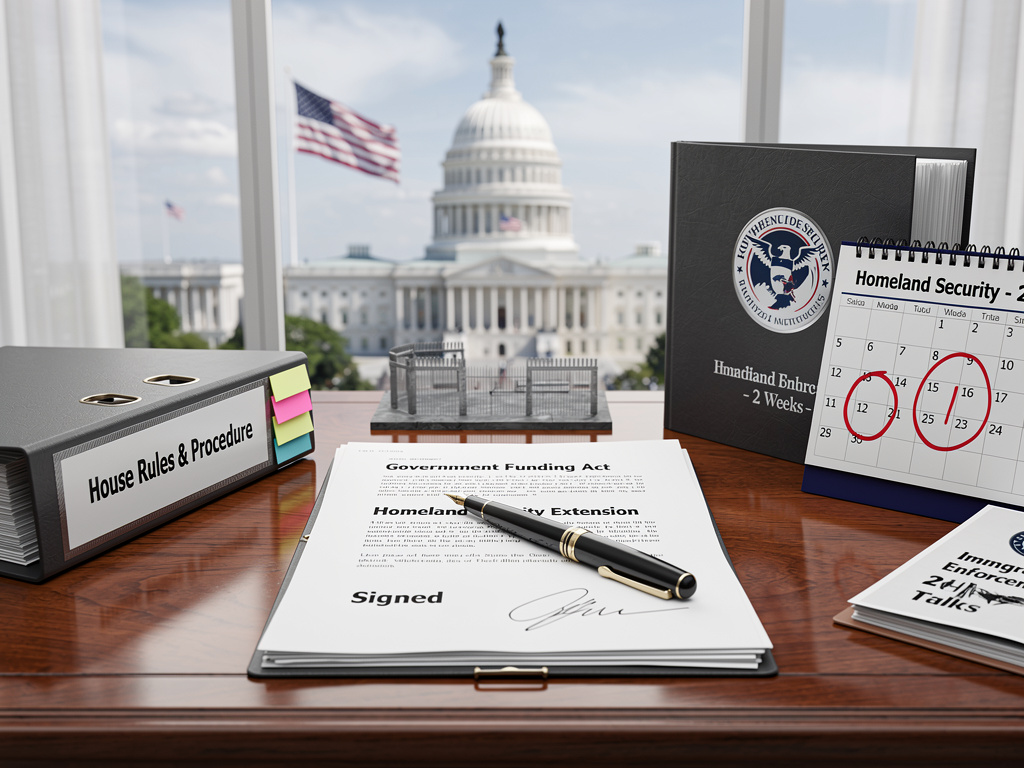
The federal government’s partial shutdown ended Tuesday evening when President Donald Trump signed legislation that had narrowly survived a procedural gauntlet in the House of Representatives, where Speaker Mike Johnson could afford to lose only one Republican vote. The 217-214 final passage, following a nail-biting 217-215 procedural vote earlier in the day, underscored the precarious mathematics governing Washington as the administration approaches its first 100 days.
According to CNBC, the appropriations package provides full-year funding through September 30 for the departments of Defense, Treasury, State, Health and Human Services, Labor, Housing and Urban Development, Transportation, and Education. Notably absent from the full-year funding: the Department of Homeland Security, which received only a two-week stopgap extension after Senate negotiators stripped the agency’s long-term appropriations in response to the fatal shootings of two U.S. citizens by federal immigration officers in Minneapolis.
The shutdown, which began Saturday morning, represented the first major legislative crisis for the Trump administration’s second term and exposed the fragility of Republican control in the House. With Democrats having sworn in a new member Monday, Johnson’s effective majority shrank to a single vote on any party-line measure, transforming every procedural motion into a high-stakes negotiation with his own conference.
The Procedural Battle That Nearly Derailed Reopening
The drama on the House floor Tuesday morning revealed the depth of internal Republican divisions. During the procedural vote on the rule governing debate—typically a formality that party leadership expects to pass easily—more than a handful of Republicans withheld their votes, and Representative John Rose of Tennessee initially voted against the measure. All Democrats voted no, following instructions from Minority Leader Hakeem Jeffries, who had informed Johnson that his caucus would not provide rescue votes on procedure.
The Republican holdouts were demanding a Senate vote on the SAVE Act, a controversial voter identification measure that has become a priority for conservative members. As reported by CNBC, this precipitated “a mad scramble on the House floor from the Republican leadership team to get the holdouts to vote yes and to flip Rose.” Eventually, Rose changed his vote and the holdouts relented, allowing the government funding bill to advance by the slimmest possible margin.
Speaker Johnson, addressing reporters in a news conference Tuesday morning, projected confidence despite the visible tension. “We’re going to pass the rule today, it was never in doubt to me,” Johnson stated. “We’re governing responsibly and we’re getting the job done.” His optimistic public posture belied the reality that House leadership had kept the chamber open much longer than expected, extending the procedural vote as whips worked individual members on the floor.
Democratic Strategy: Bipartisan on Final Passage, Unified on Procedure
The Democratic approach to the funding crisis demonstrated tactical sophistication. While Jeffries insisted that Republicans must supply their own votes for the procedural rule—a hardball tactic that maximized pressure on Johnson’s narrow majority—Democrats ultimately provided substantial support for final passage of the appropriations package itself. The 217-214 vote included members from both parties, though “many Democrats and some Republicans still opposed the bill,” according to CNBC.
Representative Rosa DeLauro of Connecticut, the lead Democratic negotiator on the spending bills, urged her caucus to support the legislation despite its omission of full-year DHS funding. “Passing these five full-year funding bills today puts us in the best position to win that fight” over DHS appropriations, DeLauro argued on the House floor. Her framing suggested that Democrats viewed the separation of Homeland Security funding as a strategic victory, creating leverage for upcoming negotiations over immigration enforcement guardrails.
The DeLauro strategy reflects a broader Democratic calculation: that the Minneapolis shootings by federal immigration officers have shifted public sentiment on enforcement tactics, providing Democrats with political capital to extract concessions in the DHS funding negotiations. By accepting the current package while isolating Homeland Security appropriations, Democrats positioned themselves to wage a focused battle on immigration policy over the next two weeks.
The Minneapolis Incident and Its Legislative Aftershocks
The killings of two U.S. citizens by federal immigration officers in Minneapolis transformed what might have been a routine appropriations process into a contentious debate over enforcement protocols. Senate negotiators responded by stripping full-year funding for the Department of Homeland Security from the broader package, a move that reflected bipartisan unease with the administration’s immigration enforcement approach.
The two-week stopgap funding for DHS now sets up an immediate confrontation between Congress and the White House over what CNBC characterized as “thorny negotiations over new guardrails on immigration enforcement.” Democrats are expected to demand enhanced oversight mechanisms, stricter use-of-force policies, and potentially limitations on certain enforcement actions in jurisdictions with large immigrant populations.
For the Trump administration, the DHS funding impasse represents a significant political challenge. Immigration enforcement has been a cornerstone of the president’s policy agenda, and any restrictions imposed by Congress could hamper operational flexibility. However, the Minneapolis incident has complicated the political dynamics, making it difficult for Republicans to portray Democratic concerns as merely obstructionist.
Governing with a One-Vote Margin
The near-collapse of Tuesday’s procedural vote illuminated the mathematical realities constraining Republican leadership. Johnson’s ability to pass legislation depends on maintaining near-perfect unity within a conference that spans from moderate members in competitive districts to hardline conservatives demanding aggressive policy positions. The SAVE Act controversy exemplified this tension: conservative members were willing to risk a government shutdown to force action on voter identification, while more moderate Republicans prioritized reopening the government.
This dynamic will likely define the remainder of the fiscal year. With Democrats holding firm against providing procedural votes, Johnson must navigate every legislative challenge with the knowledge that a single defection can derail his agenda. The swearing-in of the new Democratic member Monday further tightened these constraints, reducing Johnson’s cushion to zero on party-line votes.
The speaker’s extended floor session Tuesday—keeping the House open far longer than scheduled to secure the procedural vote—may become a recurring pattern. Leadership sources suggest that future votes on contentious measures could require similar periods of negotiation and persuasion, transforming the legislative calendar into a series of high-wire acts.
What the Shutdown Revealed About Republican Priorities
The willingness of some Republicans to initially block the funding package over the SAVE Act demonstrates the continued influence of the party’s conservative wing. These members, many representing safely Republican districts, face greater pressure from primary challengers than from general election opponents, incentivizing them to take uncompromising positions on issues like voter identification and immigration enforcement.
The eventual resolution—with holdouts relenting and Rose switching his vote—suggests that pragmatic concerns about being blamed for a prolonged shutdown ultimately prevailed. However, the close call indicates that future funding battles could produce similar brinkmanship, particularly as the DHS appropriations deadline approaches in two weeks.
For Democrats, the episode reinforced the strategic value of unity on procedural votes while maintaining flexibility on final passage. By forcing Republicans to resolve their internal divisions without Democratic assistance on procedure, Jeffries maximized his leverage while avoiding responsibility for a shutdown. This approach may serve as a template for future negotiations, particularly on the upcoming DHS funding bill.
The Road Ahead: DHS Funding and Immigration Policy
The two-week extension for Homeland Security funding sets up an immediate legislative confrontation with far-reaching implications for immigration policy. Democrats will likely demand comprehensive reforms to enforcement protocols, potentially including restrictions on workplace raids, enhanced protections for individuals in sensitive locations like schools and hospitals, and stricter accountability measures for immigration officers involved in use-of-force incidents.
Republicans, meanwhile, face pressure from their base to resist any limitations on enforcement capabilities. The Trump administration has prioritized aggressive immigration enforcement, and accepting significant restrictions could be portrayed as capitulation by conservative media and activists. This creates a difficult political calculation for Republican members, particularly those in competitive districts who may face backlash from both sides.
The Senate’s role will be crucial in these negotiations. Having already stripped full-year DHS funding in response to the Minneapolis incident, Senate Republicans have signaled some willingness to impose accountability measures. However, the degree to which they will support specific restrictions remains unclear, and the chamber’s narrower Republican majority provides Democrats with potential leverage.
Implications for Future Appropriations Battles
The successful passage of funding for most government agencies through September 30 provides some stability, but the DHS situation foreshadows potential challenges ahead. The fiscal year ends in less than eight months, and negotiations over the next year’s appropriations will likely begin while the current DHS fight remains unresolved.
Budget experts note that the recurring pattern of short-term extensions and last-minute deals undermines effective government planning. Agencies struggle to implement long-term initiatives when funding remains uncertain, and the constant threat of shutdowns creates inefficiencies throughout the federal bureaucracy. The two-week DHS extension exemplifies this problem, forcing the department to operate in crisis mode while awaiting resolution of its full-year appropriations.
For Speaker Johnson, the successful navigation of Tuesday’s votes provides a temporary reprieve but does nothing to address the underlying challenge of governing with a one-vote margin. Every future legislative battle will require similar coalition-building within his conference, and the DHS negotiations will test whether he can maintain unity on an issue that divides Republicans between enforcement hawks and members concerned about political backlash from the Minneapolis incident.
The Broader Context of Executive-Legislative Relations
The shutdown and its resolution reflect broader tensions in the relationship between the Trump administration and Congress. While Republicans control both chambers, the narrow House majority limits the president’s ability to advance controversial priorities without some level of bipartisan support or perfect party unity. The DHS funding impasse demonstrates that even on core administration priorities like immigration enforcement, congressional Republicans may diverge from White House preferences when political circumstances demand it.
This dynamic differs significantly from the administration’s first term, when Republican majorities were more substantial and leadership had greater flexibility to manage internal dissent. The current environment requires more careful calibration of policy positions and greater willingness to compromise, both within the Republican conference and potentially with Democrats on selected issues.
The coming weeks will test whether the parties can find common ground on DHS funding or whether the issue will precipitate another shutdown. Given the political sensitivity of immigration enforcement and the Minneapolis incident’s impact on public opinion, the negotiations promise to be contentious. The outcome will likely shape not only immigration policy but also the broader dynamics of congressional-executive relations for the remainder of the fiscal year.


 WebProNews is an iEntry Publication