
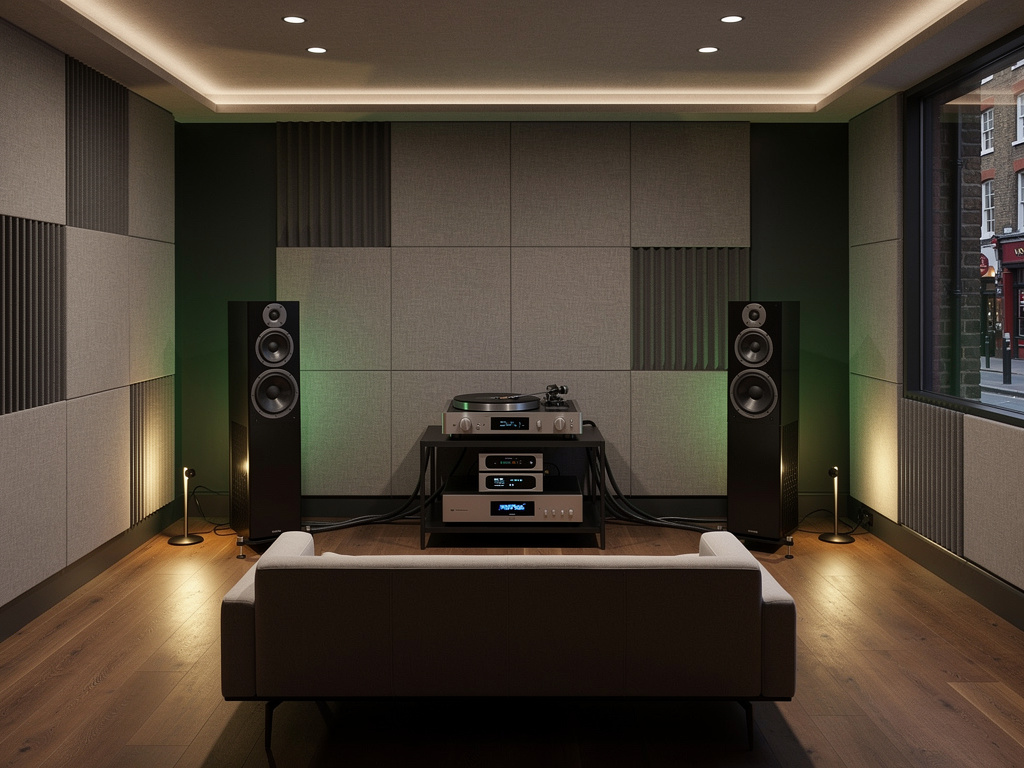
In a converted space on London’s Denmark Street — a road so steeped in British music history it’s practically a listed monument — Spotify has opened something that feels deliberately anachronistic. No algorithm. No personalized playlist. No earbuds. Just a room, two speakers, and a catalog of records you can play at proper volume.
The Spotify Listening Lounge, which opened its doors in late June 2025, is a members-only venue designed to do something the streaming giant’s app fundamentally cannot: force you to sit still and listen. Really listen. In stereo. On high-end equipment. With other people in the room.
It’s a strange move for a company that built its empire on convenience and ubiquity. And that’s exactly why it matters.
A Room Built Around Sound, Not Screens
The space was designed by Spotify’s in-house team in collaboration with audio engineers, and as TechRadar’s Becky Scarrott reported after an early visit, the result is something closer to a recording studio’s control room than a typical bar or club. The core audio rig is a bespoke stereo system — not a Dolby Atmos immersive array, not a spatial audio demonstration, but a carefully tuned two-channel setup. The signal chain runs from Spotify’s lossless-quality streams through high-grade digital-to-analog converters into a pair of premium loudspeakers positioned with the kind of precision that audiophiles spend weekends arguing about on forums.
The room itself has been acoustically treated. Absorption panels, diffusers, and careful material choices mean the space doesn’t just have good speakers — it has a good room. Anyone who’s ever placed a $5,000 pair of monitors in an untreated bedroom knows the difference that makes. It’s enormous.
Scarrott described the experience as a “reminder that stereo is forever,” a pointed observation given the industry’s recent headlong rush toward spatial and immersive audio formats. Apple has poured resources into Dolby Atmos integration for Apple Music. Sony has its 360 Reality Audio. Spotify itself has flirted with various lossless and high-res initiatives over the years, most notably the long-promised and still-undelivered Spotify HiFi tier. But the Listening Lounge sidesteps all of that. Two channels. Left and right. The way almost every song in the catalog was mixed.
The message is implicit but unmistakable: the format isn’t the problem. The listening conditions are.
Spotify has stocked the venue with a curated but extensive library that members can browse and request. The model draws obvious parallels to the vinyl listening bars that have proliferated across London, Tokyo, and New York over the past decade — places like Brilliant Corners in Dalston or JBS in Shibuya, where the point is communal, attentive listening rather than background ambiance. But where those bars typically revolve around a DJ or owner’s vinyl collection and a vintage hi-fi rig, Spotify’s version naturally runs on its own platform. The entire Spotify catalog, streamed at the highest available quality, through a system designed to make the most of it.
There’s an interesting tension in that. The company that trained a generation to treat music as an infinite, disposable stream is now building physical spaces that insist on the opposite behavior. Sit down. Don’t skip. Pay attention.
Denmark Street is no accident either. Once known as London’s Tin Pan Alley, the street was home to music publishers, instrument shops, and studios for decades. The Rolling Stones recorded there. The Sex Pistols lived above one of the shops. David Bowie busked on its pavement. In recent years, redevelopment — including the construction of the Crossrail station at Tottenham Court Road — has transformed much of the street, displacing longtime tenants and prompting fierce preservation debates. Spotify planting its flag here reads as a deliberate nod to the street’s heritage, even as the company represents the very technological forces that disrupted the music industry those old shops served.
The Business Logic Behind a Room With No Ads
So why is Spotify, a company that reported 675 million monthly active users in its most recent earnings, building a physical venue for a relative handful of people in central London?
Part of the answer is brand. Spotify has been working to reposition itself not just as a utility — the pipes through which music flows — but as a tastemaker and cultural institution. Its Wrapped campaign turned data into social currency. Its editorial playlists like RapCaviar and Pollen have become brands in their own right. The Listening Lounge extends this logic into physical space. It’s experiential marketing with exceptional production values.
But there’s a more strategic dimension. Spotify has spent the past two years executing a dramatic financial turnaround under CEO Daniel Ek, swinging from persistent losses to record profitability. The company’s stock has surged. But growth in premium subscribers — the users who actually generate meaningful margin — is the metric Wall Street watches most closely. And in mature Western markets, that growth is slowing. The Listening Lounge, and potentially spaces like it in other cities, could function as a premium brand halo, reinforcing the idea that Spotify is the platform for people who care most about music. The kind of people who pay $10.99 a month. Or $14.99 for a family plan. Or whatever the next price increase demands.
The members-only model is telling. Spotify hasn’t disclosed exact membership criteria, but early reporting suggests it’s tied to Spotify Premium subscriptions, with capacity managed through a reservation system. This isn’t a pop-up. It’s an ongoing operation with real overhead — rent on one of London’s most storied streets, staff, equipment maintenance, licensing considerations. Spotify is investing in this as an ongoing concern, not a two-week activation.
There’s also the question of what Spotify learns from the space. Which albums do people request? How long do they stay? What do they listen to when they’re not optimizing for a workout or a commute but simply sitting in a room built for sound? That behavioral data, gathered in an environment stripped of the usual contextual cues that drive streaming habits, could be genuinely valuable for the company’s recommendation engines and its pitch to record labels.
The timing coincides with a broader industry recalibration around audio quality. Spotify’s HiFi tier, first announced in February 2021, has become something of a running joke among audiophiles — perpetually “coming soon” with no release date. Apple Music, by contrast, rolled out lossless streaming at no extra cost in June 2021, a competitive move that made Spotify’s delay look increasingly awkward. The Listening Lounge doesn’t resolve the HiFi question, but it does signal that Spotify takes high-quality audio seriously, at least as an aspiration. It’s a physical proof of concept for what the company says it values, even if the app hasn’t caught up yet.
And the vinyl bar comparison isn’t just aesthetic. The listening bar phenomenon has proven that a meaningful subset of music consumers — disproportionately young, urban, and willing to spend — actively craves a more intentional relationship with recorded music. These aren’t nostalgists pining for a lost era. Many of them grew up with Spotify. They just want something more from the experience sometimes. A room where the music is the point, not the background.
Spotify appears to be betting it can serve that desire without ceding the territory to independent bars, vinyl retailers, or competing platforms. The Listening Lounge says: we’re not just the place where you queue up songs while cooking dinner. We’re the place where music sounds best. Come hear it.
Stereo’s Quiet Persistence
Perhaps the most provocative aspect of the Lounge’s design is its commitment to stereo. Not surround. Not spatial. Not immersive. Two speakers, carefully placed.
This is a statement. The audio industry has spent the better part of a decade pushing multichannel and object-based formats as the next frontier. Dolby Atmos Music, initially designed for cinema, has been adapted for headphones and home speakers alike. Apple made it the default playback format on Apple Music for compatible tracks. Record labels have invested in remixing back catalogs for Atmos. And yet the vast majority of music — including almost everything recorded before 2020 and a large portion of what’s been recorded since — exists in stereo. Two channels. The format Alan Blumlein patented in 1931.
The Listening Lounge’s design implicitly argues that stereo, done right, doesn’t need improving. That the format’s limitations are actually its strengths — the phantom center image, the spatial cues embedded in a well-mixed stereo recording, the simplicity of the playback chain. As TechRadar noted, the experience serves as a forceful reminder of how good stereo can sound when the room, the equipment, and the source material are all working in concert.
This isn’t an anti-technology position. It’s an anti-gimmick position. And it resonates with a growing sentiment among audio professionals and serious listeners that the push toward immersive formats has sometimes prioritized novelty over musical fidelity. Not every mix benefits from being spread across a dozen virtual speaker positions. Sometimes left and right is enough. More than enough.
Whether Spotify expands the Listening Lounge concept to other cities remains to be seen. The company hasn’t announced additional locations, but the infrastructure is inherently replicable — it’s a room, a system, and a catalog the company already owns access to. New York, Tokyo, Berlin, and Los Angeles would all be obvious candidates, cities with dense populations of the exact premium-subscriber demographic Spotify wants to court.
For now, the London space stands as a curious and compelling artifact: a streaming company building a temple to attentive listening, on a street that remembers when music was made with hands and sold across a counter. The contradiction is the point. Spotify knows its product has conditioned people to treat music as wallpaper. The Listening Lounge is an admission that something was lost in that transaction — and a wager that the company itself might be the one to give it back.
A room. Two speakers. Your full attention. It turns out that’s still the most advanced audio technology there is.


 WebProNews is an iEntry Publication