
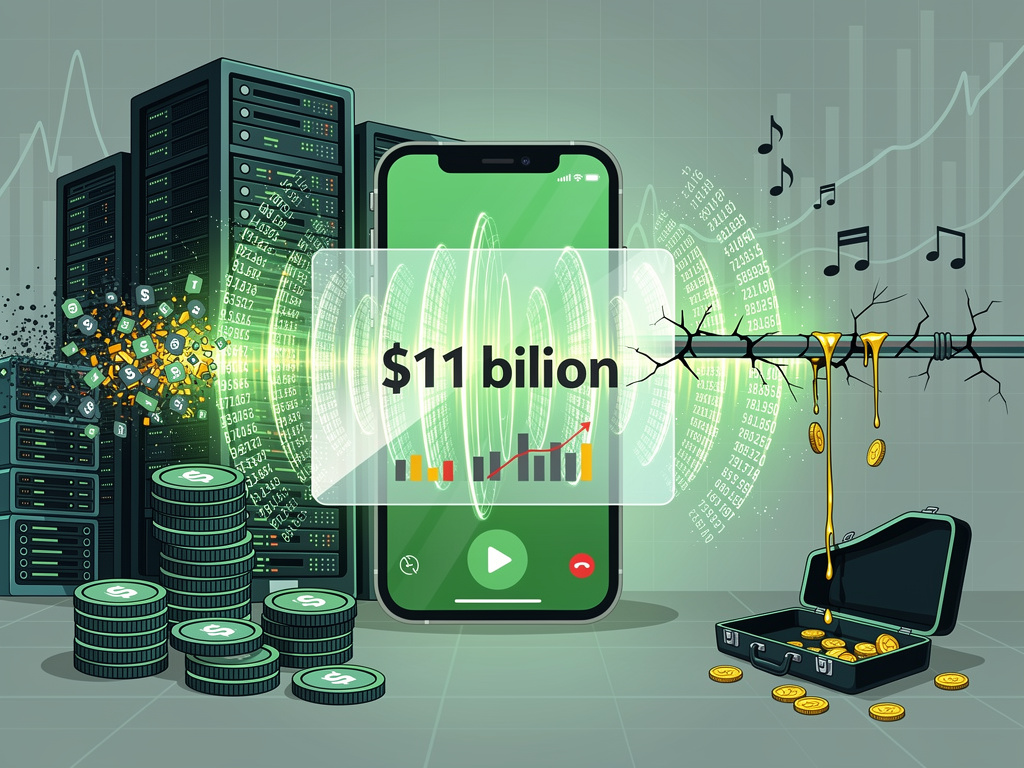
Spotify’s recent announcement that it has paid out more than $11 billion in royalties to music rights holders represents a watershed moment in the ongoing transformation of the music industry’s economic model. The streaming giant’s disclosure, while framed as a milestone achievement, has reignited fierce debates about fair compensation, market dominance, and the fundamental restructuring of how artists, labels, and platforms share revenue in the digital age. According to The Verge, this figure encompasses payments to record labels, publishers, and rights holders, though the actual amount flowing directly to artists remains considerably smaller after intermediaries take their cuts.
The $11 billion figure, impressive as it sounds, must be contextualized within Spotify’s broader financial trajectory and the complex web of music industry economics. The platform has grown to over 600 million users globally, with more than 236 million paying subscribers as of the most recent quarterly reports. This massive user base generates revenue that flows through an intricate payment structure involving multiple stakeholders: record labels typically receive the largest share, music publishers and songwriters receive mechanical and performance royalties, and artists receive what remains after their label contracts are honored. The mathematics of streaming economics reveal a sobering reality—even with billions in total payouts, individual artists often receive fractions of a cent per stream.
This payment structure has become increasingly controversial as streaming has evolved from a supplementary revenue source to the dominant force in music consumption. The traditional album-sales model, where artists could earn substantial income from physical media, has been almost entirely supplanted by streaming’s micro-payment approach. While Spotify argues that its platform has democratized music distribution and created opportunities for independent artists to reach global audiences without label backing, critics contend that the per-stream payment rates—typically ranging from $0.003 to $0.005—make it nearly impossible for mid-tier artists to sustain careers through streaming revenue alone.
The Mathematics of Streaming: Breaking Down the Payment Waterfall
Understanding how Spotify’s $11 billion translates into artist compensation requires examining the multi-layered payment waterfall that characterizes modern music economics. When a subscriber’s monthly fee or advertising revenue enters Spotify’s system, it first goes into a general pool. Spotify retains approximately 30% as its platform fee, with the remaining 70% designated for rights holders. However, ‘rights holders’ is a broad category that includes record labels, publishers, distributors, and collecting societies—each taking their contractual share before money reaches artists.
For artists signed to major labels, the traditional contract structure means they might receive only 15-20% of what the label receives from Spotify, and often only after recouping advances and production costs. Independent artists who distribute through aggregators like DistroKid or TuneCore typically retain a larger percentage—sometimes 80-90% of the streaming royalties—but these payments still amount to modest sums unless their music generates millions of streams. The Union of Musicians and Allied Workers has calculated that an artist would need approximately 250,000 to 300,000 streams per month to earn minimum wage from Spotify alone, a threshold that only a tiny fraction of the platform’s 11 million artists achieve.
Market Dominance and the Concentration of Streaming Power
Spotify’s position as the world’s largest music streaming service gives it unprecedented influence over how the entire industry operates. The platform’s algorithmic curation through playlists like ‘Discover Weekly’ and ‘Release Radar’ has become a critical discovery mechanism, capable of making or breaking careers. Getting placed on Spotify’s editorial playlists can mean the difference between obscurity and viral success, creating a new form of gatekeeping that has replaced radio promotion in many markets. This concentration of curatorial power has raised questions about fairness, transparency, and potential conflicts of interest, particularly as Spotify has experimented with promoting its own content and negotiating preferential deals with certain labels.
The competitive dynamics between Spotify, Apple Music, Amazon Music, and YouTube Music have also shaped royalty economics. While these platforms compete for subscribers, they have largely converged on similar payment structures, limiting artists’ ability to leverage competition for better rates. Apple Music has claimed to pay slightly higher per-stream rates than Spotify, though the difference amounts to fractions of a cent. Meanwhile, YouTube’s dual model—combining ad-supported free access with premium subscriptions—creates additional complexity in royalty calculations and has been a particular source of controversy, with many artists arguing that YouTube’s payments are even lower than Spotify’s.
The Independent Artist Revolution and Its Limitations
One of Spotify’s most frequently cited defenses of its payment model is that it has enabled independent artists to reach audiences without traditional label infrastructure. The platform points to success stories of bedroom producers and DIY musicians who have built careers through streaming, often supplementing their Spotify income with live performances, merchandise sales, and direct fan support through platforms like Patreon and Bandcamp. This narrative of democratization has some merit—barriers to distribution have indeed lowered dramatically, and artists can now release music globally without upfront capital or label connections.
However, the reality for most independent artists is far less glamorous than the success stories suggest. Data analysis of Spotify’s payment distribution reveals a stark concentration of wealth, with the top 1% of artists capturing the vast majority of streams and revenue. This winner-take-all dynamic mirrors broader economic inequality trends and suggests that while access to distribution has democratized, access to meaningful income has not. The platform’s algorithmic recommendation systems, while ostensibly neutral, tend to reinforce existing popularity, making it exponentially harder for new artists to break through the noise. Research has shown that playlist placement and algorithmic recommendations disproportionately benefit artists who already have significant followings or major label marketing support.
Regulatory Pressure and the Push for Payment Reform
The growing dissatisfaction with streaming economics has prompted regulatory scrutiny in multiple jurisdictions. The United Kingdom’s Parliament conducted an extensive inquiry into streaming economics in 2021, hearing testimony from artists, label executives, and streaming platforms. The inquiry’s report called for a fundamental reset of streaming payments, suggesting that the current model is weighted too heavily in favor of platforms and labels at the expense of artists. Similar investigations have been launched in the European Union, where policymakers are examining whether streaming platforms should be subject to stricter regulations regarding payment transparency and minimum compensation thresholds.
In the United States, various legislative proposals have sought to address streaming payment concerns, though progress has been slow due to the complexity of music rights and strong lobbying from both platforms and major labels. The Mechanical Licensing Collective, established under the Music Modernization Act, has improved the efficiency of royalty collection for songwriters and publishers, but has not fundamentally altered the economics of streaming. Artist advocacy groups continue to push for higher per-stream rates, greater transparency in payment calculations, and mechanisms to ensure that a larger share of streaming revenue reaches creators rather than intermediaries.
The Future of Music Economics in the Streaming Era
As Spotify continues to grow—the company projects reaching one billion users within the next several years—the sustainability of its current payment model faces increasing questions. The platform has experimented with various initiatives to address artist concerns, including direct artist payments for merchandise sales, enhanced analytics tools, and promotional opportunities. However, these efforts have been criticized as peripheral solutions that avoid addressing the core issue: the fundamental per-stream payment rate that determines how streaming revenue is distributed.
Alternative models have been proposed, including user-centric payment systems where each subscriber’s monthly fee is distributed only to the artists they actually listen to, rather than being pooled across all platform activity. Proponents argue this would create a more direct connection between fans and artists, potentially benefiting niche musicians with dedicated followings. Spotify has tested user-centric payments in limited markets but has not committed to a full rollout, citing concerns about complexity and potential disruption to existing payment infrastructure. The company has also faced pressure to increase subscription prices, which have remained largely stagnant at $9.99 per month for individual plans since streaming’s early days, despite inflation and increasing content costs.
The $11 billion milestone, while significant, ultimately represents a snapshot of an industry in ongoing transformation. For Spotify, the figure serves as evidence of its contribution to music industry revenue, which has rebounded from its early-2000s nadir thanks largely to streaming growth. For artists and their advocates, the same number highlights the vast sums flowing through the music economy while individual creators struggle to capture sustainable income. The tension between these perspectives will likely define music industry economics for years to come, as stakeholders negotiate the terms under which music is created, distributed, and monetized in the digital age. Whether streaming can evolve to better serve artists while maintaining platform profitability remains one of the most pressing questions facing the music industry, with implications extending far beyond Spotify to the entire ecosystem of digital content creation and consumption.


 WebProNews is an iEntry Publication