
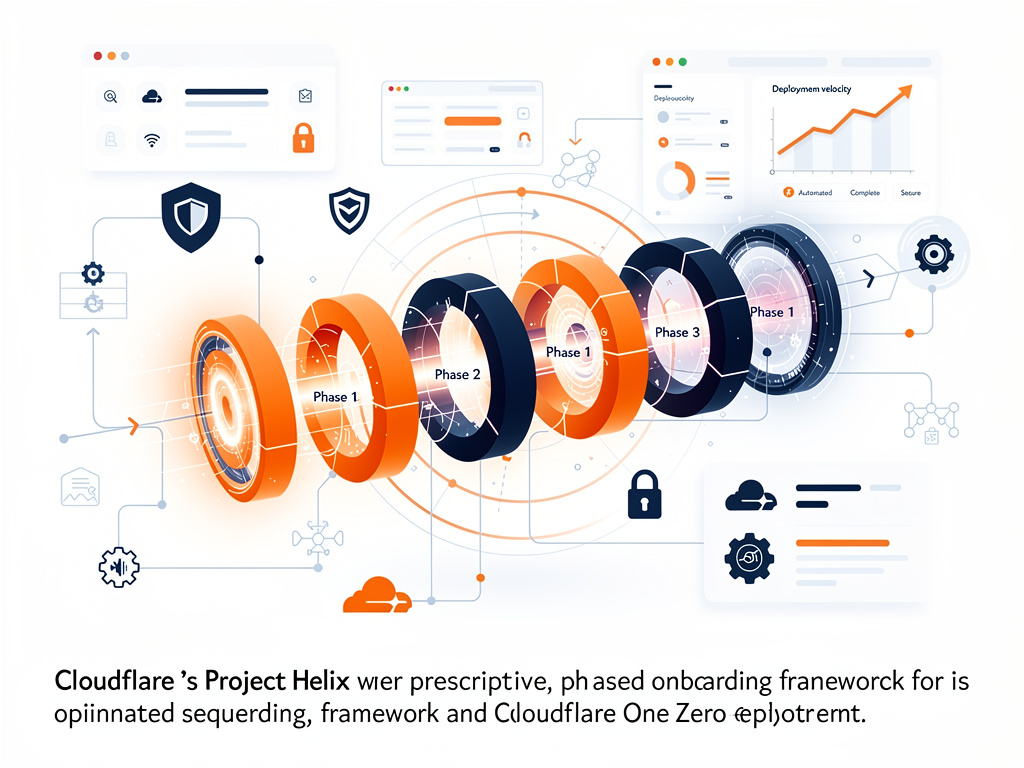
For years, enterprise security vendors have sold sprawling product portfolios with the implicit promise that customers would figure out how to stitch them together. Cloudflare, the web infrastructure and security company headquartered in San Francisco, is now betting that a radically different onboarding model — one that treats deployment as a guided, opinionated process rather than a choose-your-own-adventure exercise — will become the standard for how large organizations adopt Zero Trust security architectures.
The effort, internally dubbed Project Helix, represents Cloudflare’s most ambitious attempt to date to solve what has long been the industry’s dirty secret: most enterprises that purchase advanced security platforms never fully deploy them. According to a detailed technical post published on the Cloudflare Blog, the company has restructured its entire Cloudflare One onboarding experience around a prescriptive, phased methodology designed to get customers from contract signing to full Zero Trust enforcement in a fraction of the typical timeline.
The Deployment Gap That Plagues Enterprise Security
The problem Project Helix addresses is not unique to Cloudflare. Across the cybersecurity industry, vendors routinely report that a significant percentage of their enterprise customers fail to activate large portions of the products they have licensed. The reasons are familiar: resource constraints on the customer side, unclear deployment sequences, fear of breaking existing workflows, and the sheer complexity of integrating new security controls into heterogeneous IT environments. The result is that organizations pay for protection they never actually receive.
Cloudflare One, the company’s comprehensive Zero Trust platform, bundles secure web gateway (SWG), cloud access security broker (CASB), data loss prevention (DLP), Zero Trust network access (ZTNA), browser isolation, and email security into a single offering delivered across Cloudflare’s global network. The breadth of the platform is a selling point, but it also creates an onboarding challenge. As the Cloudflare Blog post explains, customers often struggle to determine where to begin, which components to activate first, and how to sequence policy enforcement without disrupting business operations.
A Prescriptive Playbook Replaces the Blank Canvas
Project Helix’s core innovation is structural rather than technological. Instead of handing customers a dashboard and a set of documentation links, Cloudflare has developed a phased onboarding framework that breaks the deployment of Cloudflare One into discrete, ordered stages. Each phase has defined objectives, success criteria, and recommended timelines. The approach is explicitly opinionated — Cloudflare’s engineering and customer success teams have codified what they believe is the optimal order of operations based on hundreds of prior deployments.
The phased model begins with what Cloudflare describes as foundational visibility. In the initial stage, organizations deploy the Cloudflare WARP client to endpoints and configure DNS filtering, giving security teams immediate insight into traffic patterns and potential threats without enforcing restrictive policies. This “monitor first, enforce later” philosophy is designed to build organizational confidence and surface potential conflicts before they become production incidents. According to the Cloudflare Blog, this early visibility phase also helps identify shadow IT applications and data flows that may not have been previously documented.
From Visibility to Enforcement: The Phased Progression
Subsequent phases in the Helix framework progressively tighten security controls. After the visibility stage, organizations move to implementing secure web gateway policies, blocking known-bad destinations and enforcing acceptable use controls. ZTNA policies follow, replacing legacy VPN connections with identity-aware, application-specific access rules. Later phases introduce CASB scanning for SaaS misconfigurations, DLP policies to prevent sensitive data exfiltration, and browser isolation for high-risk web activity.
Each phase is designed to build on the one before it. DNS filtering, for example, provides a low-risk entry point that familiarizes IT teams with Cloudflare’s policy engine before they are asked to configure more granular HTTP inspection rules. ZTNA deployment is sequenced after SWG policies are in place so that organizations have already established baseline traffic controls before they begin retiring VPN infrastructure. The sequencing reflects hard-won lessons from deployments that stalled or failed when customers attempted to activate too many capabilities simultaneously.
Automation and Terraform: Reducing the Manual Burden
A significant component of Project Helix is the emphasis on infrastructure-as-code tooling, particularly Terraform, to automate policy deployment and ensure consistency across large environments. The Cloudflare Blog details how the onboarding framework includes pre-built Terraform configurations that customers can adapt to their environments, reducing the manual effort required to stand up initial policies and minimizing the risk of configuration drift as deployments scale.
This automation-first approach also addresses a persistent staffing challenge. Many enterprises, particularly those in the mid-market, lack dedicated security engineering teams capable of building custom integrations from scratch. By providing opinionated templates and automation scripts, Cloudflare is effectively embedding its own deployment expertise into reusable artifacts that can be executed by generalist IT staff. The move mirrors a broader industry trend toward “as-code” security operations, where policy definition and enforcement are managed through version-controlled repositories rather than manual console interactions.
Competitive Context: The Zero Trust Onboarding Race
Cloudflare’s investment in onboarding methodology comes at a time of intensifying competition in the Secure Access Service Edge (SASE) and Security Service Edge (SSE) markets. Rivals including Zscaler, Palo Alto Networks, and Netskope have all made significant investments in customer success programs and deployment acceleration services. Zscaler, for instance, has promoted its own phased deployment methodology for its Zero Trust Exchange platform, emphasizing time-to-value metrics in competitive sales engagements.
What distinguishes Cloudflare’s approach, at least on paper, is the degree to which the onboarding framework is integrated into the product itself rather than delivered as a professional services engagement. While competitors often charge separately for deployment assistance or rely on channel partners to manage implementation, Cloudflare appears to be building the guided onboarding experience directly into the Cloudflare One platform. This product-led approach aligns with the company’s broader strategy of minimizing professional services revenue in favor of self-service and low-touch adoption models that can scale more efficiently.
The Identity Layer: A Critical Integration Point
One of the more technically significant aspects of Project Helix is its treatment of identity provider (IdP) integration as a foundational prerequisite rather than an optional enhancement. The framework requires organizations to connect their identity providers — whether Okta, Microsoft Entra ID (formerly Azure AD), or others — early in the onboarding process, ensuring that all subsequent policy decisions can be tied to authenticated user identities rather than IP addresses or network segments.
This identity-centric approach reflects the core tenets of Zero Trust architecture, where access decisions are based on who is requesting access, from what device, and under what conditions, rather than where the request originates on the network. By front-loading the IdP integration, Cloudflare ensures that organizations can immediately begin building identity-aware policies, even in the earliest visibility phases. The Cloudflare Blog notes that this early integration also enables more granular reporting, allowing security teams to attribute traffic and threat data to specific users and groups from the outset.
Measuring Success: Deployment Velocity as a KPI
Perhaps the most telling aspect of Project Helix is the metrics Cloudflare has chosen to track. Rather than measuring success solely by customer satisfaction scores or support ticket volumes, the company is explicitly tracking deployment velocity — how quickly customers progress through each phase of the onboarding framework and how completely they activate the capabilities they have licensed. This focus on activation rates suggests that Cloudflare views incomplete deployments not just as a customer success problem but as a business risk, since customers who never fully deploy are less likely to renew.
The emphasis on measurable deployment milestones also creates accountability on both sides of the relationship. Customers receive clear expectations about what they should accomplish in each phase and by when, while Cloudflare’s customer success teams can identify stalled deployments early and intervene before they become churn risks. The structured framework provides a common language for progress reviews and executive briefings, replacing vague status updates with concrete phase completion data.
What Project Helix Signals for the Broader Industry
Cloudflare’s Project Helix is ultimately a bet that the next competitive battleground in enterprise security will not be feature lists or network performance benchmarks, but deployment experience. As Zero Trust architectures become table stakes for large organizations — driven by regulatory pressure, insurance requirements, and the persistent threat of ransomware and data breaches — the vendors that can get customers to full enforcement fastest will hold a significant advantage in retention and expansion revenue.
The initiative also reflects a maturing understanding within the industry that selling security products is fundamentally different from delivering security outcomes. A firewall sitting in a box on a loading dock provides no protection, and a Zero Trust platform sitting partially configured in a cloud console is not much better. By codifying its deployment expertise into a repeatable, automated, and opinionated onboarding framework, Cloudflare is attempting to close the gap between purchase and protection — a gap that has quietly undermined the security posture of enterprises for decades.


 WebProNews is an iEntry Publication