
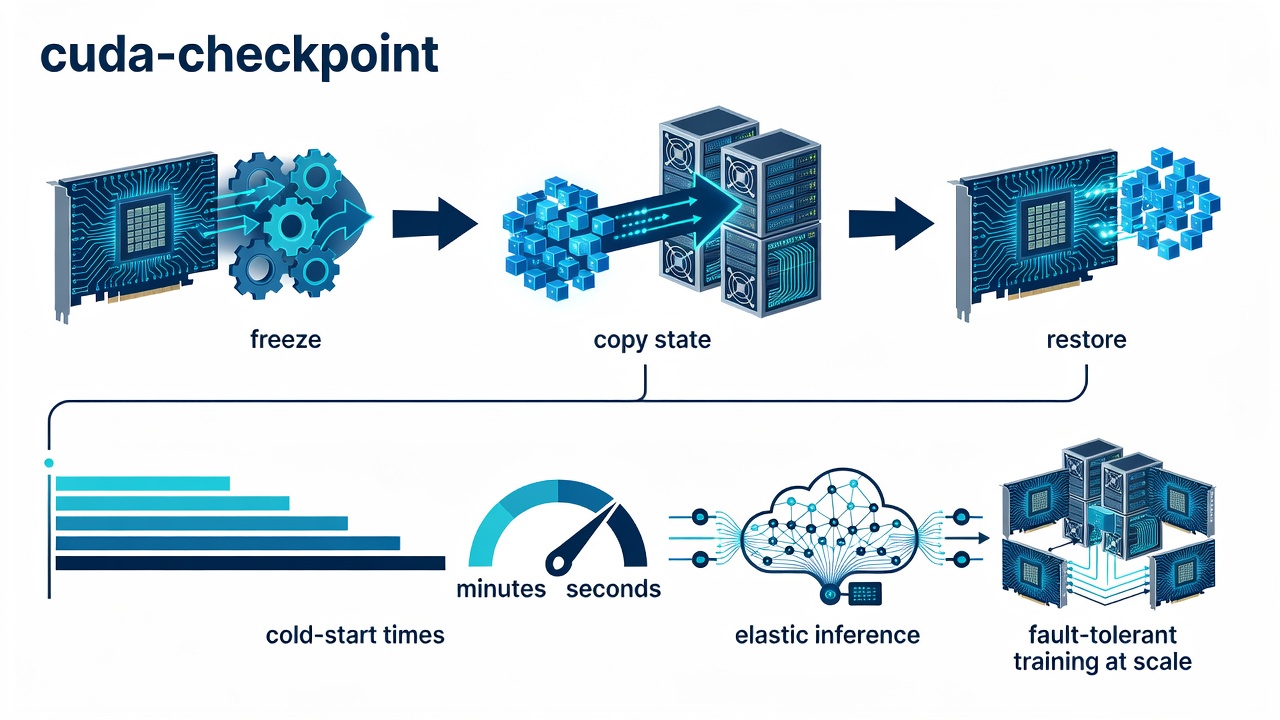
Engineers chasing faster inference startups have a new trick. They freeze a running CUDA process, dump its entire GPU state into ordinary host memory, and later snap it back to life on the same or different hardware. The result? Cold starts that once took minutes now finish in seconds.
But the mechanism itself stayed opaque. NVIDIA ships a command-line tool called cuda-checkpoint and documents the high-level steps. Few outsiders understood exactly how the closed-source driver pulled off the memory transfer or why it often ran far slower than raw PCIe bandwidth suggested. A new analysis changes that picture.
Doubleword recently reverse-engineered the utility. The blog post lays bare the internal state machine, the communication pipes, and the anonymous memory buffer that suddenly balloons by hundreds of megabytes the instant a process leaves the GPU. What the researchers found explains both the power and the performance drag.
The process begins simply enough. A small test program binds a UDP socket, waits for packets, launches a one-thread kernel that increments a device-side counter, copies the value back, and replies. Run it, ping it, watch the number climb. Then invoke cuda-checkpoint with the right flags and the program vanishes from nvidia-smi. No CUDA context remains. No GPU memory shows. Yet the counter value survives.
Three distinct phases drive the transition. First comes lock. The tool locates a special service thread inside the target process — one created by libcuda at context initialization — and sends a command down a pipe. That thread, which had been polling quietly, wakes up and prevents new CUDA calls that could alter GPU state. Existing work finishes. Streams drain. The process reaches a stable point. Nothing visible changes yet in resident memory or file descriptors.
Next, checkpoint. The same service thread orchestrates the heavy lifting. Device memory contents copy to a fresh anonymous mapping inside the process’s own address space. The mapping appears via mmap with MAP_POPULATE, forcing immediate physical backing. All NVIDIA file descriptors close. Virtual memory areas tied to the driver disappear. The process drops out of nvidia-smi entirely. Resident anonymous memory swells by roughly the size of the former GPU footprint plus a constant overhead of about ten megabytes for driver control structures.
Those control structures hold compiled kernels, parameter banks, notifier pages, and other metadata. The bulk of the new buffer, however, mirrors the original device allocations. Search the anonymous region for SASS instruction bytes from the increment kernel and they sit right there. Tweak the counter value directly inside the buffer using /proc/pid/mem, restore, unlock, and the next UDP packet returns the modified number incremented by one. The state really did move intact.
Restore reverses the sequence. The driver re-acquires GPUs, copies memory back to device addresses that match the originals, rebuilds contexts and streams, then unlocks the APIs. The service thread goes back to sleep. Execution picks up exactly where it left off.
NVIDIA’s own technical blog from July 2024 describes the same flow at a higher level. The cuda-checkpoint utility, it explains, combines with CRIU to deliver transparent per-process snapshots. CRIU handles CPU-side state — threads, sockets, files, memory mappings. The NVIDIA piece manages the GPU half that the kernel cannot see. Suspend moves device memory into host allocations managed by the driver. Resume restores mappings at the same virtual addresses. The process never notices the interruption beyond a brief pause.
That combination opened doors. Container orchestration systems could now preempt GPU workloads, migrate them across nodes, or scale them to zero during idle periods. Yet production users quickly hit friction. The memory transfer rarely saturated the bus. For models occupying tens or hundreds of gigabytes, the checkpoint step dragged.
Modal’s engineering team attacked the problem head-on. In a July 2025 post, they detailed integration of the newer CUDA driver APIs — cuCheckpointProcessLock, cuCheckpointProcessCheckpoint, cuCheckpointProcessRestore, and cuCheckpointProcessUnlock — made available in driver branches 570 and 575. Their system enumerates every active CUDA session, locks them all, waits for running kernels and stream callbacks to finish, then checkpoints. Only after every process reports the CU_PROCESS_STATE_CHECKPOINTED flag does full memory snapshotting proceed. The approach delivers sub-second restores for some models and roughly tenfold speedups on others.
Even so, the underlying transfer still relied on the same driver machinery uncovered by the Doubleword team. The anonymous buffer still grew. The copy still happened. And that copy remained the bottleneck.
Academic researchers took a different route. A paper presented at the 2026 USENIX FAST conference, “GPU Checkpoint/Restore Made Fast and Lightweight,” introduces GCR. Authors Shaoxun Zeng, Tingxu Ren, Jiwu Shu, and Youyou Lu from Tsinghua University split the problem. They keep driver-integrated handling for control state, which adds zero overhead during normal execution. For bulk data buffers they intercept allocations via LD_PRELOAD, track addresses, and copy asynchronously at higher bandwidth. Virtual and physical memory management decouple so addresses remain consistent without undocumented calls.
The gains stand out. GCR cuts checkpointing latency by 72.1 percent compared with NVIDIA’s cuda-ckpt and 63.6 percent versus the previous interception-based system PhOS. Restore latency drops 54.2 percent and 87.1 percent respectively. Normal execution slows by less than one percent. Incremental checkpoints, enabled by a clever shadow execution technique on the CPU that generates dirty-buffer templates in microseconds, shrink data sizes by 86.6 percent on average. Bandwidth during restore reaches 23 GB/s — 92 percent of practical PCIe limits.
Those numbers matter for real workloads. The paper evaluates on large language models, vision networks, and HPC codes running under vLLM, DeepSpeed, and Transformers. Elastic serverless clusters, rapid task switching, and fault-tolerant training all become more practical when snapshots finish in seconds rather than tens of seconds.
NVIDIA itself pushed the technology further. Its Dynamo Snapshot feature, detailed in a May 2026 blog, combines cuda-checkpoint with CRIU to slash cold-start times for Kubernetes inference pods. Device state dumps to CPU memory first. CRIU then serializes the host process tree. Restoration reverses the flow, with GPU memory service helping allocate and populate buffers efficiently. Early users report sub-five-second startups for production models.
Yet challenges linger. Current cuda-checkpoint supports only single processes on x86_64. Unified virtual memory and inter-process communication allocations stay unsupported. The mechanism waits for all submitted work to complete, so a long-running kernel blocks the entire checkpoint. Error handling remains brittle; a failure during the sequence often forces a full restart. Future driver releases promise to expand coverage, but the core design traces back to the same service thread and pipe protocol uncovered in the reverse-engineering effort.
That protocol itself surprises in its simplicity. The cuda-checkpoint binary does almost nothing directly to the target process. It opens file descriptors inside the target’s /proc tree, locates the reply and command pipes belonging to the CUDA service thread, and writes a four-byte opcode. Zero for lock. One for checkpoint. Two for restore. Three for unlock. The heavy work — memory copy, context teardown, resource release — happens inside the closed-source libcuda that already owns the GPU context.
Because the checkpoint buffer lives as ordinary anonymous memory, clever operators can manipulate it. Change a weight tensor before restore and the restored model runs with the edit. Patch a kernel instruction and the behavior changes on next launch. Such power carries risks. Security boundaries blur when a checkpoint image can be edited by any process with ptrace rights.
Still, the appeal grows. Inference platforms want to scale to zero when traffic dips. Training clusters need fast preemption to rebalance jobs. Serverless GPU offerings demand sub-second cold starts to compete on price. Each use case leans on the same primitive: freeze the GPU state, serialize it cheaply, restore it fast.
The Doubleword analysis ends on a practical note. By understanding exactly when and how the driver moves data, engineers can sometimes cooperate with the application to accelerate the transfer or avoid it altogether. Others will adopt GCR-style hybrid techniques once the research moves into open-source tools. NVIDIA will likely broaden driver support in coming releases.
One fact now stands clear. The black box has hinges. Peek inside and the path from a running CUDA process to a frozen image in host RAM reveals itself as a handful of pipes, a service thread, and one large anonymous mapping. Master those details and the next generation of GPU orchestration writes itself.


 WebProNews is an iEntry Publication