
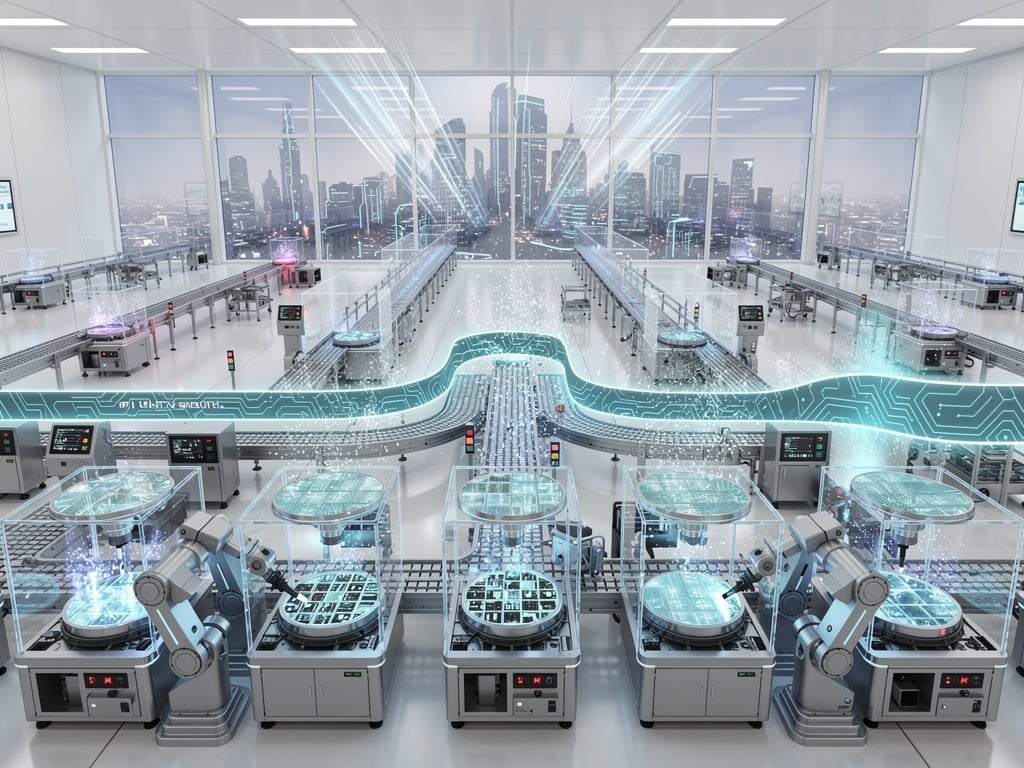
CHANDLER, Ariz. — The air inside Intel’s Fab 52 feels still. Too still. White-suited technicians move with practiced care across vast floors where silicon wafers transform into the processors powering tomorrow’s artificial intelligence systems. One errant particle, one misplaced step, and weeks of work vanish.
Paper. It sounds absurd. Yet a single sheet of paper can derail production here. So can certain wavelengths of light. Footsteps stir dust. And humans, for all their training, introduce variables machines cannot yet eliminate. A recent tour of one of Intel’s most advanced facilities reveals a truth the chip industry whispers but rarely states outright. People pose the greatest threat to perfect yields.
The factory represents Intel’s high-stakes bet on reclaiming leadership in semiconductor manufacturing. Billions in federal funding and private capital have poured into these Arizona sites. The goal? Produce AI accelerators competitive with those from TSMC and capable of challenging Nvidia’s dominance. Success hinges on processes measured in angstroms. Failure often traces back to human hands.
Technicians wear head-to-toe cleanroom suits known as bunny suits. They follow protocols that border on ritual. No cosmetics. No jewelry. Strict entry procedures. Even so, contamination events occur. A 2026 Business Insider report from inside the facility detailed how seemingly minor actions create major problems. (Business Insider)
One manager told the publication that humans remain the biggest variable. “The process is so sensitive now that even the smallest human error can cost millions.” The quote lands with force. It captures the tension at the heart of modern chipmaking. Automation handles much of the heavy lifting. Yet oversight, maintenance and decision-making still require people.
But Intel faces deeper troubles. Manufacturing snags have hammered its recovery efforts. Yields on its 18A process technology have fallen short of internal ambitions, though executives insist progress continues monthly. In January 2026, the company warned of these issues. Shares plunged. Reuters reported the yield challenges directly affect margins and customer confidence. (Reuters)
CEO Lip-Bu Tan has expressed disappointment. “I’m disappointed that we are not able to fully meet the demand in our markets,” he said according to Manufacturing Dive. The company redirected production lines toward server chips to address surging AI-related needs. Yet buffer inventory ran dry entering 2026. Fixes will take years. (Manufacturing Dive)
And. The pressure only grows. Global AI compute demand has shifted the primary bottleneck from power to actual chip production. A June 2026 report from the Center for a New American Security outlined how supply chain constraints now limit AI progress more than energy availability. (CNAS)
Intel’s Arizona operations sit at the center of this storm. Fab 52 and related facilities use extreme ultraviolet lithography and other advanced tools. The 18A node promises smaller, more efficient transistors. Yet achieving consistent high yields demands near-perfect conditions. Human operators monitor tools that cost hundreds of millions each. A single mistake in calibration or handling can scrap entire batches.
Footsteps matter. Airflow patterns shift with movement. Particles dislodge. Cleanroom protocols exist to minimize such risks, but they cannot remove the human element entirely. The Business Insider piece described sterile environments where even breathing requires filters. White light from certain sources damages photoresists. Paper introduces fibers.
These details paint a picture of fragility. The same factories that produce chips enabling large language models and autonomous systems operate on the edge of chaos. One insider noted the constant battle against contamination sources both obvious and invisible.
Recent data underscores the stakes. Stanford’s 2026 AI Index Report highlighted that the United States hosts the majority of AI data centers, yet fabrication still depends heavily on overseas foundries like TSMC. Intel’s push for domestic capacity carries national security implications alongside commercial ones. (Stanford HAI)
Executives at Intel have set 2026 as a pivotal year for validating its manufacturing roadmap, including decisions on the 14A process. CFO Dave Zinsner indicated the company holds off on heavy investment until a major customer commits. The caution reflects painful lessons from previous nodes.
So yields improve. Slowly. Intel claims its 18A yields meet internal plans even if they lag executive desires. Analysts remain skeptical. Manufacturing capacity problems could persist for years, according to industry observers. This delays Intel’s ability to serve exploding demand for AI training and inference chips.
The human factor extends beyond the cleanroom floor. Training thousands of technicians to exacting standards takes time. Turnover creates knowledge gaps. And as tools grow more complex, the expertise required rises. Intel invests heavily in simulation and AI-assisted process control to reduce reliance on human judgment. Yet full autonomy remains distant.
Broader industry trends compound these challenges. A memory chip shortage linked to AI data center buildouts is expected to last through 2027, Synopsys CEO Sassine Ghazi told CNBC in January 2026. (CNBC) Helium rationing at fabs in Taiwan and South Korea adds another layer of constraint.
Intel’s foundry ambitions face an uphill battle too. Despite technical competence in chips like Gaudi 3, the CUDA software ecosystem locks many developers into Nvidia platforms. No major external customers have fully committed to Intel’s advanced nodes yet. Trust, once lost, proves hard to regain.
Still, the company persists. Federal grants totaling nearly $8 billion support its expansion. New packaging technologies such as EMIB aim to connect chiplets efficiently for AI workloads. Progress in defect detection using AI itself shows promise. One EE Times article from April 2026 described Intel scaling AI for defect image analysis and die prediction. (EE Times)
That represents an ironic twist. AI helps manage the very manufacturing processes that enable more AI. Yet the loop depends on humans designing, programming and interpreting those systems.
Outside the fab walls, debates rage about AI’s future. Some voices call for slowing chip production to mitigate risks of advanced systems. Others push for accelerated buildout to maintain competitive edges against China. The physical realities inside facilities like Fab 52 ground those arguments in concrete challenges.
Contamination. Yield variability. Human error. These terms define daily life for semiconductor engineers. They rarely make headlines. But they determine which companies lead the next decade of computing.
Intel’s Arizona story offers no easy resolution. The factories stand as monuments to engineering ambition. They also highlight persistent vulnerabilities. Until robots replace people entirely — an unlikely prospect anytime soon — the greatest threat will continue walking the production floor in bunny suits.
Executives, engineers and policymakers watch closely. Each wafer that emerges successfully strengthens the case for American manufacturing resurgence. Each lost batch reminds them why the human element demands constant vigilance. The chips of the future depend on getting this balance right. Today.


 WebProNews is an iEntry Publication