
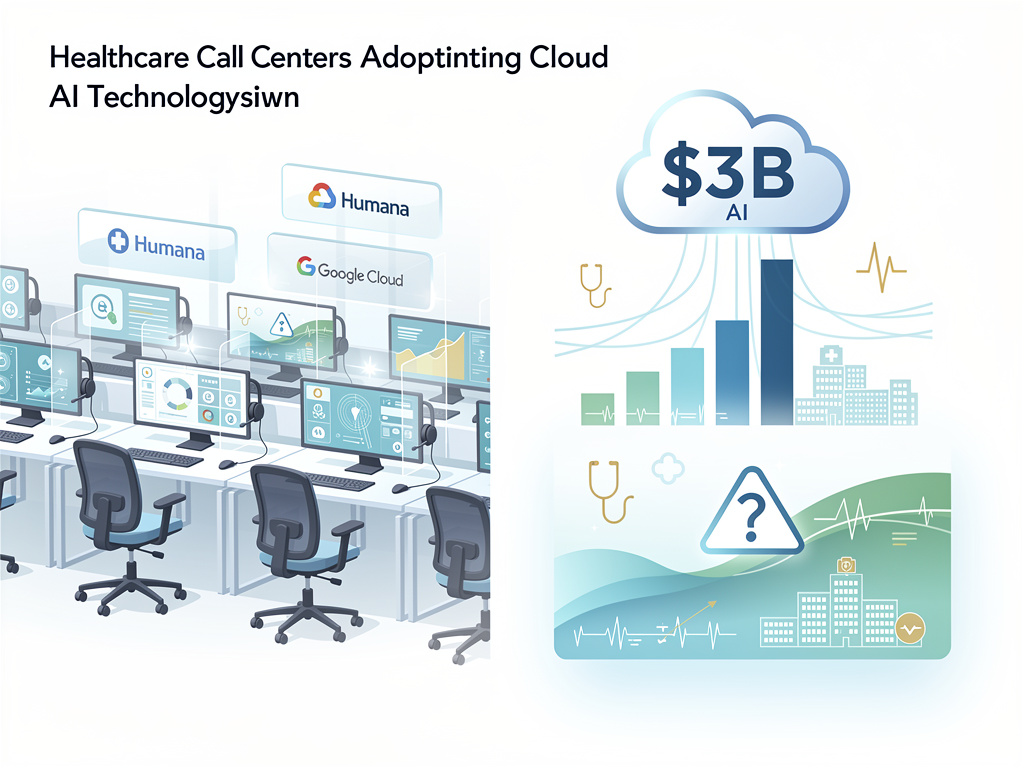
Humana Inc., one of the nation’s largest health insurers with 17 million members, has deployed an artificial intelligence-powered support system across its call center operations in a strategic move that signals a fundamental shift in how healthcare companies interact with patients and providers. The Louisville-based insurer’s partnership with Google Cloud represents one of the most ambitious applications of generative AI technology in the health insurance sector to date, with implications that extend far beyond simple cost reduction.
According to Healthcare Dive, the AI-powered agent assist tool leverages Google Cloud’s Contact Center AI Platform to provide real-time support to customer service representatives fielding inquiries about benefits, claims, and care coordination. The system analyzes conversations as they occur, surfacing relevant information from Humana’s vast databases and suggesting responses that representatives can use or modify based on the specific context of each interaction. This represents a departure from traditional call center technology, which typically relies on scripted responses and manual database searches that can extend call times and frustrate customers seeking immediate answers.
The deployment comes at a critical juncture for the healthcare industry, where customer service operations have become increasingly complex due to the proliferation of plan options, regulatory changes, and the growing prevalence of high-deductible health plans that require members to navigate intricate cost-sharing arrangements. Industry analysts estimate that health insurers collectively spend approximately $3 billion annually on call center operations, with average handle times ranging from 8 to 12 minutes per call and customer satisfaction scores that frequently lag behind other service industries.
The Technology Behind the Transformation: How Google’s AI Interprets Healthcare Conversations
The technical architecture underlying Humana’s AI implementation relies on Google Cloud’s Vertex AI platform, which combines large language models with healthcare-specific training data to understand the nuanced terminology and regulatory requirements inherent in health insurance conversations. Unlike consumer-facing chatbots that directly interact with customers, this agent assist technology operates as an invisible partner to human representatives, analyzing speech patterns, identifying member intent, and retrieving relevant policy information in real-time without requiring the representative to navigate multiple systems manually.
The system has been trained on millions of historical call transcripts, claims data, and policy documents, enabling it to recognize patterns and anticipate member needs based on the context of the conversation. When a member calls with a question about prescription drug coverage, for instance, the AI can instantly surface the member’s specific formulary, prior authorization requirements, and available pharmacy options while simultaneously checking for any pending claims or recent changes to the member’s plan that might affect the answer. This level of integration represents a significant advancement over previous generations of call center technology, which typically required representatives to toggle between six or seven different systems to gather complete information.
Measuring Success: Early Performance Indicators and Industry Benchmarks
While Humana has not disclosed specific performance metrics for the AI deployment, industry sources familiar with similar implementations report average handle time reductions of 15-25% and first-call resolution improvements of 10-15 percentage points. These gains translate directly to bottom-line savings: for a large insurer processing 50 million calls annually, a 20% reduction in handle time could eliminate the need for approximately 1,000 full-time equivalent positions, generating annual savings exceeding $50 million when accounting for wages, benefits, and infrastructure costs.
However, the financial calculus extends beyond simple headcount reduction. Customer satisfaction scores, which directly correlate with member retention rates, represent an equally important metric. In the Medicare Advantage market, where Humana derives a substantial portion of its revenue, member retention rates above 90% are considered essential for maintaining profitability given the significant acquisition costs associated with enrolling new members. Each percentage point improvement in retention can translate to tens of millions of dollars in preserved revenue, making customer service quality a strategic imperative rather than merely an operational concern.
The Human Element: Workforce Implications and Training Challenges
The introduction of AI-powered tools inevitably raises questions about workforce displacement, a concern that resonates particularly strongly in the call center industry, which employs approximately 3 million workers in the United States. Humana has emphasized that the technology is designed to augment rather than replace human representatives, enabling them to handle more complex inquiries while the AI manages routine information retrieval and documentation tasks. This narrative aligns with broader industry trends toward “hybrid” customer service models that combine AI efficiency with human empathy and judgment.
Nevertheless, the skills required of call center representatives are evolving rapidly. Rather than memorizing policy details or navigating complex software interfaces, representatives must now develop expertise in interpreting AI-generated suggestions, recognizing when the technology’s recommendations require modification based on individual circumstances, and managing the emotional dimensions of healthcare conversations that AI systems cannot adequately address. Training programs have been redesigned to emphasize critical thinking, emotional intelligence, and the ability to override AI suggestions when clinical or situational factors warrant deviation from standard protocols.
Regulatory Considerations and Data Privacy Safeguards
The deployment of AI systems in healthcare contexts triggers a complex web of regulatory requirements, including HIPAA privacy protections, state insurance regulations, and emerging AI governance frameworks. Humana’s implementation includes multiple safeguards designed to ensure that AI-generated responses comply with regulatory requirements and do not inadvertently disclose protected health information or provide inaccurate guidance that could affect member care decisions.
The system operates within strict parameters that prevent it from making coverage determinations or clinical recommendations without human review. When conversations venture into areas requiring medical judgment or involve potential coverage denials, the AI flags these interactions for escalation to specialized teams with appropriate clinical credentials. This tiered approach reflects industry best practices for AI deployment in regulated environments, where the technology’s speed and efficiency must be balanced against the need for human oversight in consequential decisions.
Competitive Dynamics: The Race for AI Supremacy in Health Insurance
Humana’s move follows similar AI initiatives by competitors including UnitedHealth Group, which has invested heavily in natural language processing capabilities through its Optum technology division, and Anthem, which has partnered with IBM Watson to develop AI-powered care management tools. The competitive pressure to adopt these technologies stems from the recognition that operational efficiency will increasingly determine which insurers can offer competitive premiums while maintaining acceptable profit margins in an industry where medical loss ratios are tightly regulated.
The strategic implications extend beyond call center operations. Insurers that successfully implement AI-powered customer service capabilities gain valuable data insights that can inform product design, identify emerging health trends, and detect potential fraud or abuse patterns. The same natural language processing capabilities that enable real-time call center support can be applied to claims processing, prior authorization reviews, and care coordination activities, creating a compounding efficiency advantage that could reshape competitive dynamics in the industry.
Looking Ahead: The Evolution of Healthcare Customer Experience
The trajectory of AI deployment in healthcare customer service points toward increasingly sophisticated applications that blur the boundaries between transactional support and proactive care management. Future iterations of these systems may incorporate predictive analytics that identify members likely to experience coverage gaps or medication adherence issues, triggering outreach before problems escalate. Integration with wearable devices and remote monitoring technologies could enable AI systems to contextualize customer service interactions within a broader understanding of each member’s health status and care needs.
The ultimate measure of success for initiatives like Humana’s AI deployment will be whether they genuinely improve the member experience or merely optimize operational metrics at the expense of service quality. Early indications suggest that well-designed AI systems can achieve both objectives simultaneously, but sustained success will require ongoing investment in technology refinement, workforce development, and quality monitoring to ensure that efficiency gains do not come at the cost of the human connection that remains essential in healthcare interactions.
As the healthcare industry continues its digital transformation, Humana’s bet on AI-powered customer service represents a test case that competitors and regulators will watch closely. The results will help determine whether artificial intelligence can successfully navigate the unique challenges of healthcare communication, where technical accuracy must be balanced with empathy, regulatory compliance, and the recognition that behind every call is a person navigating one of life’s most complex and consequential systems.


 WebProNews is an iEntry Publication