
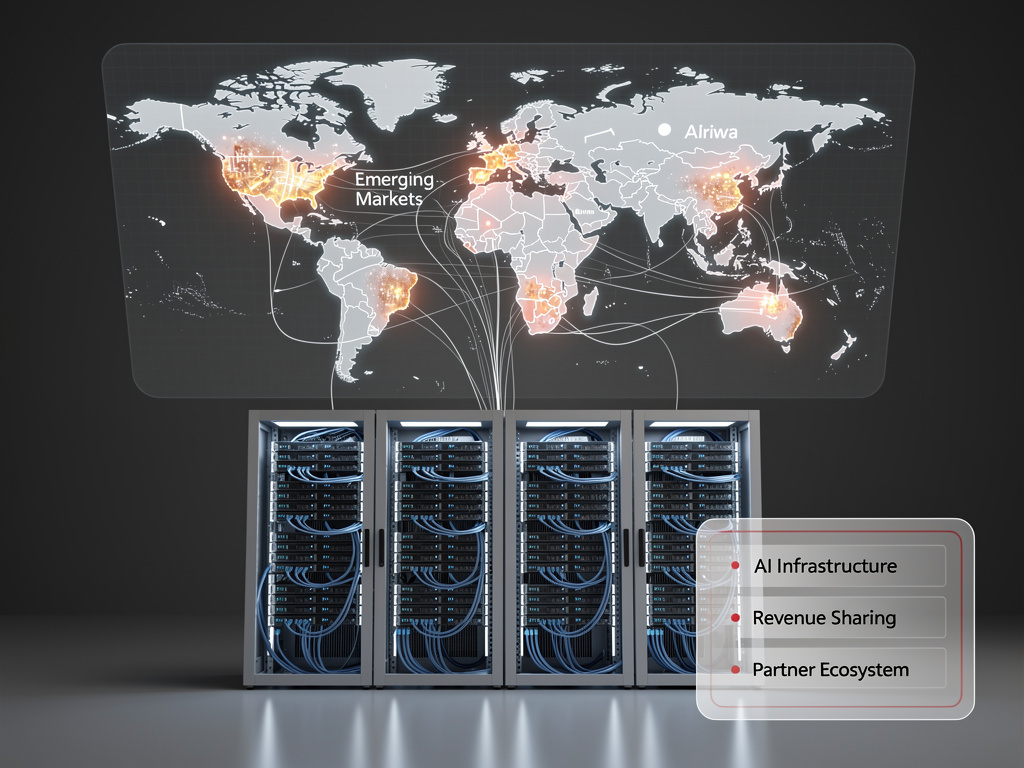
Huawei Cloud is recalibrating its global partner ecosystem with a comprehensive policy framework designed to position data centers at the heart of its artificial intelligence infrastructure ambitions. As the Chinese technology giant races to compete with Western cloud providers, its 2026 partner strategy reveals a sophisticated approach that treats data center operators not merely as real estate providers, but as strategic allies in building AI-ready computing capacity across emerging markets.
The new partnership model, unveiled at Huawei’s recent partner summit, represents a fundamental shift in how the company views colocation facilities, hyperscale operators, and edge computing providers. According to Data Centre Magazine, Huawei Cloud is prioritizing partners who can deliver specialized cooling systems, high-density power infrastructure, and low-latency connectivity—all critical requirements for training and deploying large language models and other AI workloads that demand unprecedented computational resources.
This strategic pivot comes as global demand for AI-optimized data center space has created severe capacity constraints in traditional cloud markets. Huawei’s approach differs markedly from competitors by focusing heavily on regions where Western cloud providers have limited presence, particularly across Southeast Asia, the Middle East, Africa, and Latin America. The company’s partner policy explicitly incentivizes data center operators who can provide facilities in these growth markets, offering preferential technical support, co-marketing funds, and revenue-sharing arrangements that industry analysts suggest are more generous than those typically offered by Amazon Web Services or Microsoft Azure.
The technical specifications embedded within Huawei’s partner requirements illuminate the company’s AI infrastructure priorities. Data center partners must demonstrate capability to support power densities exceeding 30 kilowatts per rack—double the industry standard for traditional enterprise workloads—and implement liquid cooling technologies that can handle the thermal output of GPU clusters running continuous training operations. These requirements reflect the physical realities of modern AI development, where a single training run for a frontier model can consume megawatts of power and generate heat loads that overwhelm conventional air-cooling systems.
Strategic Geographic Positioning and Market Penetration
Huawei’s partner policy documents reveal a tiered geographic strategy that aligns data center partnerships with broader geopolitical and market access considerations. The company has designated certain markets as “strategic priority regions” where it will provide enhanced financial incentives and technical resources to data center partners. These regions notably include countries participating in China’s Belt and Road Initiative, suggesting that Huawei Cloud’s expansion strategy is coordinated with broader Chinese foreign policy objectives.
In Southeast Asia, Huawei has already signed preliminary agreements with multiple data center operators in Indonesia, Thailand, and Malaysia, according to regional telecommunications industry sources. These partnerships will enable Huawei Cloud to offer AI-as-a-service capabilities to local enterprises and government agencies without requiring data to transit international boundaries—a critical consideration in markets with increasingly stringent data sovereignty requirements. The partner policy provides financial subsidies for data center operators who build facilities meeting Huawei’s AI-ready specifications in these designated markets, effectively de-risking capital investments in regions where demand for advanced cloud services is still developing.
Technical Integration and Infrastructure Requirements
The partnership framework mandates deep technical integration between Huawei’s cloud management software and partner data center infrastructure. Participating facilities must implement Huawei’s proprietary data center infrastructure management (DCIM) platform, which provides real-time monitoring of power consumption, cooling efficiency, and computational resource utilization. This level of integration gives Huawei unprecedented visibility into partner operations while enabling automated workload placement and resource optimization across a distributed network of facilities.
Data center partners are also required to deploy Huawei’s networking equipment, including its CloudEngine switches and routers, to ensure consistent performance characteristics across the partner ecosystem. This requirement has raised concerns among some potential partners who have existing relationships with competing networking vendors, but Huawei argues that standardization is essential for delivering the low-latency, high-bandwidth connectivity that AI workloads demand. The company has structured its partner incentives to offset the capital costs of this equipment deployment, offering extended payment terms and revenue guarantees that make the transition financially viable for most operators.
Financial Models and Revenue Sharing Mechanisms
Huawei’s partner policy introduces novel revenue-sharing arrangements that differ substantially from traditional colocation or wholesale data center contracts. Rather than simple space and power leasing, the framework establishes joint-venture-like structures where data center operators receive ongoing percentages of cloud services revenue generated from their facilities. This model aligns partner incentives with Huawei’s growth objectives while providing data center operators with exposure to the high-margin cloud services market without requiring them to develop software platforms or customer acquisition capabilities.
The financial terms vary based on partner tier and geographic market, but industry sources familiar with the agreements indicate that revenue shares typically range from 15% to 30% of cloud services revenue attributable to workloads running in partner facilities. These arrangements are structured as long-term commitments, typically spanning ten to fifteen years, providing data center operators with predictable revenue streams that support project financing for new construction or facility upgrades. For partners willing to invest in the most advanced AI infrastructure—including liquid cooling systems and high-density power distribution—Huawei offers enhanced revenue shares and minimum revenue guarantees that substantially reduce investment risk.
Competitive Implications and Market Response
Huawei’s aggressive partner strategy has not gone unnoticed by established cloud providers, who are responding with their own data center partnership initiatives. The company’s willingness to share cloud services revenue with infrastructure partners represents a potential disruption to traditional models where hyperscale cloud providers typically lease space and power at arms-length commercial terms without providing partners with upside participation in service revenue growth.
Industry analysts suggest that Huawei’s approach may prove particularly effective in emerging markets where data center operators face difficulty securing financing for speculative construction of AI-ready facilities. By providing revenue guarantees and technical support, Huawei effectively becomes a development partner rather than simply a tenant, accelerating the pace at which advanced computing infrastructure can be deployed in regions that have historically lagged behind developed markets. This could enable Huawei to establish dominant market positions in multiple geographies before Western competitors mobilize equivalent partnership programs.
Regulatory Considerations and Geopolitical Constraints
The expansion of Huawei’s data center partner network faces significant regulatory headwinds in certain markets, particularly those with close security relationships with the United States. American export controls on advanced semiconductors and computing equipment limit Huawei’s ability to deploy cutting-edge GPU clusters in its data centers, potentially constraining the competitiveness of its AI services compared to offerings from NVIDIA-powered competitors. The partner policy acknowledges these constraints by focusing primarily on markets where U.S. technology restrictions are less stringently enforced or where alternative chip suppliers can provide adequate computational capacity.
European markets present a more complex regulatory environment, where data protection requirements under GDPR and emerging AI regulations create both opportunities and challenges for Huawei’s partnership strategy. The company has structured its partner program to enable data residency and sovereignty commitments that may appeal to European enterprises and government agencies concerned about data transfers to the United States. However, several European Union member states have implemented or are considering restrictions on Chinese technology in critical infrastructure, which could limit Huawei’s ability to execute its partner strategy in these economically significant markets.
Technical Differentiation and Innovation Initiatives
Beyond financial incentives, Huawei’s partner policy emphasizes joint innovation programs designed to advance data center efficiency and AI infrastructure capabilities. The company has established technical collaboration frameworks where partner engineers work alongside Huawei researchers to develop next-generation cooling technologies, power management systems, and rack architectures optimized for AI workloads. These initiatives provide data center operators with access to Huawei’s substantial research and development resources while generating intellectual property that can differentiate partner facilities in increasingly competitive markets.
Huawei has committed to sharing certain patents and technical designs with qualified partners, enabling them to implement proprietary cooling and power distribution technologies that can reduce operational costs and increase facility capacity. This knowledge transfer represents significant value for data center operators, particularly those in emerging markets who may lack access to cutting-edge infrastructure engineering expertise. The partner policy structures these arrangements as licensing agreements with preferential terms, creating additional revenue opportunities for Huawei while strengthening partner capabilities and competitiveness.
Future Trajectory and Industry Impact
As Huawei Cloud scales its partner ecosystem through 2026 and beyond, the program’s success will likely depend on the company’s ability to navigate geopolitical constraints while delivering competitive AI services that justify the substantial infrastructure investments required from partners. The revenue-sharing model represents a bold experiment in cloud industry business models, one that could reshape relationships between infrastructure providers and platform operators if it proves financially sustainable at scale.
For data center operators, particularly those in emerging markets, Huawei’s partner policy offers unprecedented opportunities to participate in the AI infrastructure boom with reduced capital risk and access to advanced technologies. However, partnering with Huawei also carries potential reputational and regulatory risks in markets where Chinese technology faces scrutiny. The decisions that data center operators make in response to Huawei’s partnership overtures will significantly influence the global distribution of AI computing capacity and could determine which regions emerge as AI development hubs in the coming decade. As the artificial intelligence revolution demands ever-greater computational resources, the strategic positioning of data center infrastructure—and the partnerships that enable its deployment—will prove as consequential as the algorithms and models that run within these facilities.


 WebProNews is an iEntry Publication