
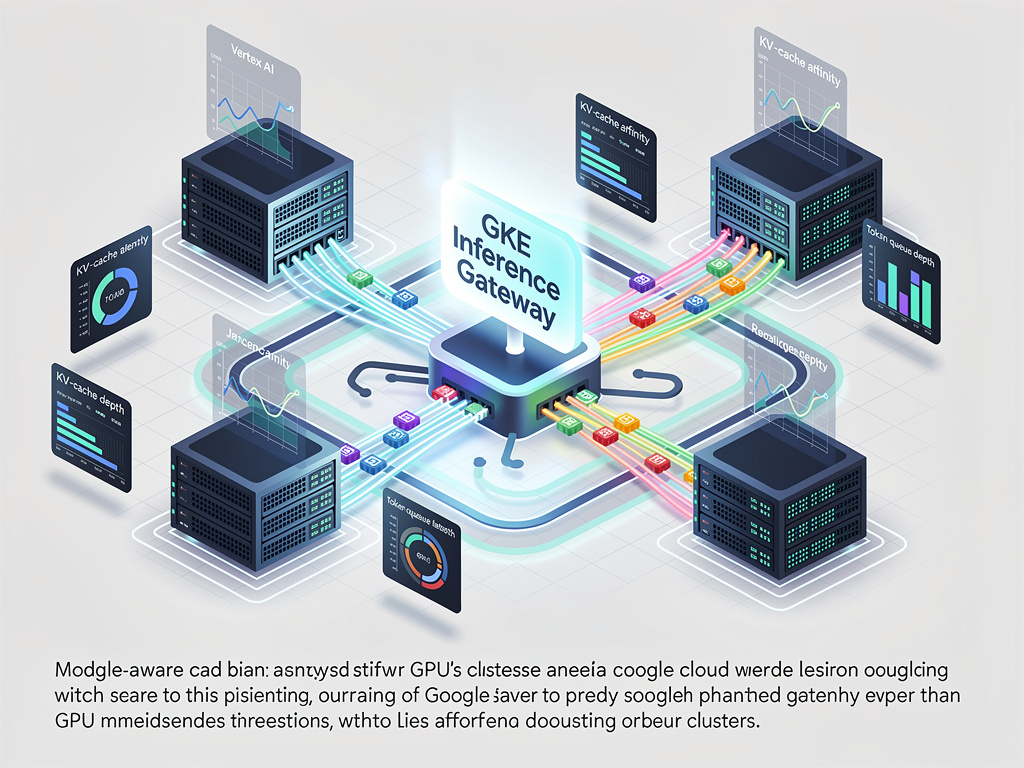
When Google Cloud’s engineering teams set out to optimize the infrastructure powering Vertex AI — the company’s flagship managed machine learning platform — they didn’t simply throw more hardware at the problem. Instead, they turned inward, rearchitecting the very networking layer that routes inference requests to large language models. The result was a dramatic reduction in latency, a more efficient use of expensive GPU resources, and a blueprint that could reshape how the entire industry thinks about serving AI workloads at scale.
The project centered on the GKE Inference Gateway, an advanced traffic management layer built on top of Google Kubernetes Engine that is purpose-designed for the unique demands of AI inference. According to a detailed technical account published on the Google Cloud Blog, the integration of this gateway into Vertex AI’s serving stack delivered measurable improvements in tail latency, throughput, and resource utilization — metrics that matter enormously when every millisecond of delay translates into degraded user experience and wasted compute dollars.
The Problem With Traditional Load Balancing in AI Inference
To understand why the GKE Inference Gateway matters, it helps to appreciate why conventional load balancing falls short for large language model (LLM) inference. Traditional HTTP load balancers distribute traffic based on relatively simple signals: round-robin scheduling, least-connections algorithms, or basic health checks. These approaches work well for stateless web applications where each request imposes roughly the same computational cost. But LLM inference is fundamentally different. A single request to a model like Gemini can vary wildly in cost depending on the length of the input prompt, the number of output tokens requested, and whether the request can benefit from KV-cache reuse.
This variability creates a problem that Google’s engineers describe as “head-of-line blocking” at the model server level. When a traditional load balancer sends a computationally expensive request to a server that is already processing several heavy queries, that server becomes a bottleneck. Meanwhile, other servers in the pool may be sitting partially idle. The result is elevated tail latency — the P95 and P99 response times that disproportionately affect user satisfaction. As the Google Cloud Blog post explains, this inefficiency is compounded at scale: Vertex AI serves inference requests across thousands of accelerators, and even small imbalances in load distribution can cascade into significant performance degradation.
Model-Aware Routing: A New Paradigm for AI Traffic Management
The GKE Inference Gateway addresses these challenges through what Google calls “inference-aware” or “model-aware” load balancing. Rather than treating every HTTP request identically, the gateway understands the semantics of inference workloads. It inspects incoming requests to determine their expected computational cost and queries backend model servers for real-time utilization metrics — including the number of active requests, pending tokens in the decode queue, and available KV-cache capacity. Armed with this information, the gateway makes routing decisions that are far more intelligent than anything a generic load balancer could achieve.
According to the technical details shared on the Google Cloud Blog, the system uses a custom endpoint picker that evaluates multiple signals simultaneously. This picker can, for example, route a short prompt to a server with a nearly full KV-cache — enabling cache hits that dramatically reduce time-to-first-token — while directing a long, complex prompt to a server with more available compute headroom. The net effect is a flattening of load across the serving fleet, which reduces both the mean and the tail of the latency distribution.
Quantifying the Impact: Vertex AI’s Performance Gains
The numbers Google has shared are striking. After integrating the GKE Inference Gateway into Vertex AI’s production serving infrastructure, the team observed significant reductions in P95 and P99 latency for inference requests. While Google has been careful about disclosing exact figures for all metrics, the blog post indicates that the improvements were substantial enough to justify a broader rollout across Vertex AI’s model serving fleet. For enterprise customers running latency-sensitive applications — real-time chatbots, code completion tools, document summarization pipelines — these gains translate directly into better end-user experiences and, critically, lower infrastructure costs per query.
The cost dimension deserves particular attention. GPUs and TPUs remain among the most expensive resources in any cloud provider’s portfolio. When inference requests are poorly distributed, some accelerators are overloaded while others are underutilized, meaning the customer (or, in the case of Vertex AI, Google itself) is paying for capacity that isn’t being effectively used. By improving load distribution, the GKE Inference Gateway allows the same fleet of accelerators to handle more requests at lower latency — effectively increasing the return on investment for every dollar spent on AI hardware. This is a point of intense competitive interest across the cloud industry, where margins on AI inference services are under constant scrutiny.
Architectural Decisions: Why Kubernetes Became the Foundation
Google’s decision to build the Inference Gateway on top of GKE — rather than as a standalone networking appliance or a modification to its existing Cloud Load Balancer — reflects a broader strategic bet on Kubernetes as the control plane for AI workloads. GKE already provides the orchestration layer for scheduling containers onto GPU and TPU nodes, managing autoscaling, and handling rolling updates. By embedding inference-aware routing directly into this Kubernetes-native stack, Google ensures that the gateway has deep visibility into the state of the serving infrastructure, including pod-level metrics that would be opaque to an external load balancer.
The architecture leverages the Gateway API, an evolving Kubernetes standard that provides a more expressive and extensible model for traffic management than the older Ingress API. Google has been a leading contributor to the Gateway API specification, and the GKE Inference Gateway represents one of the most sophisticated real-world implementations of this standard. The gateway extends the base API with custom resource definitions (CRDs) specific to inference workloads, enabling platform teams to define routing policies that reference model-specific parameters such as target queue depth, token throughput limits, and cache affinity rules.
Broader Industry Implications and Competitive Dynamics
Google is not operating in a vacuum. The challenge of efficiently serving LLM inference at scale is one that every major cloud provider and AI infrastructure company is grappling with. Amazon Web Services has invested heavily in its own inference optimization stack, including custom Inferentia and Trainium chips and the Neuron SDK. Microsoft Azure, powered by its deep partnership with OpenAI, has built specialized inference infrastructure for GPT-4 and related models. Startups like Anyscale, Modal, and Baseten are also competing fiercely in the inference serving space, each offering their own approaches to model routing and GPU orchestration.
What distinguishes Google’s approach with the GKE Inference Gateway is the degree to which it integrates inference-aware intelligence directly into the networking layer of a general-purpose container orchestration platform. This is not a bespoke solution that only works for one model or one serving framework; it is designed to work with any model server that exposes the appropriate metrics, including open-source frameworks like vLLM and NVIDIA’s Triton Inference Server. This flexibility is strategically important because it positions GKE as the platform of choice not just for Google’s own models but for the rapidly growing ecosystem of open-weight models from Meta, Mistral, and others that enterprises are increasingly deploying.
The KV-Cache Optimization: A Technical Deep Dive
One of the most technically interesting aspects of the GKE Inference Gateway is its handling of KV-cache affinity. In transformer-based LLMs, the key-value cache stores intermediate attention computations from previous tokens, allowing the model to avoid redundant work during autoregressive generation. When a request can be routed to a server that already has relevant KV-cache entries — for example, because a previous request from the same conversation session was processed there — the time-to-first-token can be reduced dramatically. The GKE Inference Gateway supports session affinity policies that attempt to route related requests to the same backend, maximizing cache hit rates without sacrificing load balance.
This is a delicate optimization. Overly aggressive session affinity can recreate the very load imbalance problems that the gateway is designed to solve, as popular sessions accumulate on specific servers. The gateway therefore implements a weighted decision framework that balances cache affinity against current server load, dynamically adjusting its routing behavior based on real-time conditions. As detailed in the Google Cloud Blog, this adaptive approach proved essential during the Vertex AI integration, where traffic patterns are highly variable and bursty.
What This Means for Enterprise AI Deployments
For enterprise technology leaders evaluating their AI inference strategies, the GKE Inference Gateway represents a maturation of the tooling available for production AI serving. The days when deploying a model meant simply wrapping it in a Flask API behind an NGINX reverse proxy are fading rapidly. Modern inference workloads demand infrastructure that understands the computational characteristics of the models being served and can make intelligent, real-time decisions about how to allocate scarce accelerator resources.
Google’s willingness to share the technical details of how this gateway improved Vertex AI’s own performance is also notable from a transparency perspective. By publishing concrete architectural patterns and performance insights, Google is signaling confidence that the underlying technology is a competitive advantage that cannot be easily replicated — and that the greater strategic value lies in attracting workloads to GKE rather than in keeping the approach secret. For the broader AI infrastructure community, this level of openness provides valuable reference architecture that can inform design decisions regardless of which cloud provider an organization ultimately chooses. The GKE Inference Gateway may have been built to solve Google’s own problems, but its implications extend far beyond a single platform.


 WebProNews is an iEntry Publication