
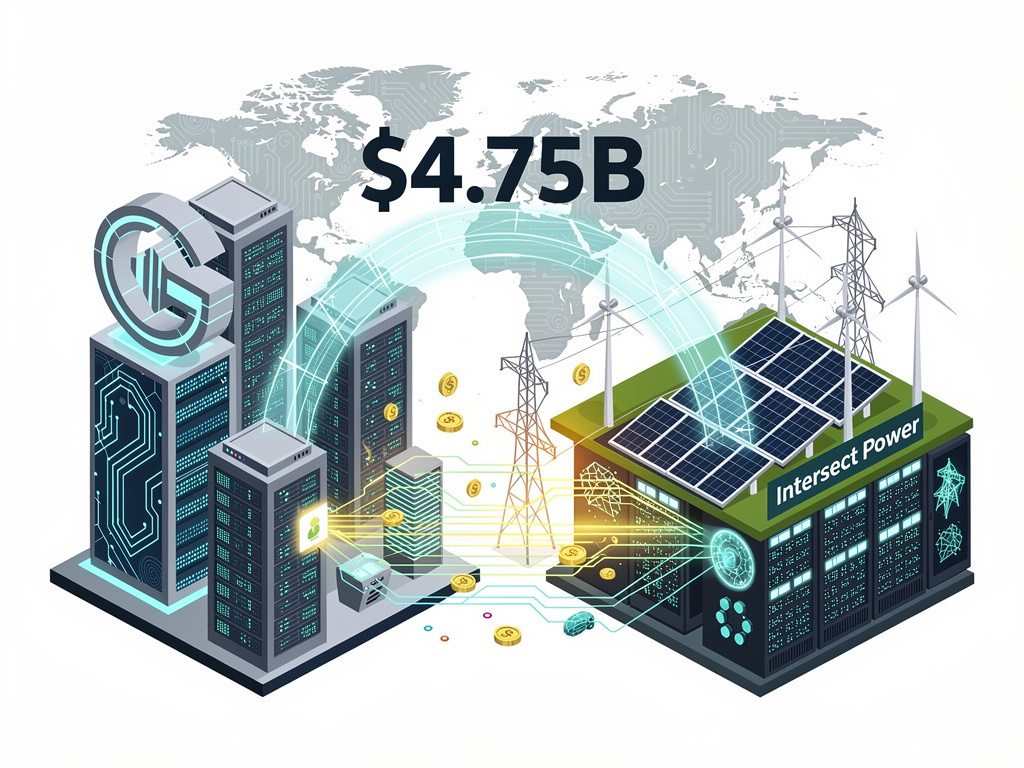
In a move that signals a fundamental shift in how technology companies approach infrastructure development, Google has committed $4.75 billion to acquire Intersect Power, a wind and solar developer with $15 billion in assets either operational or under construction. The acquisition, reported by The Wall Street Journal, represents the first time a major technology company will directly own a power generation business, fundamentally altering the competitive dynamics of the artificial intelligence race where electricity access has emerged as a critical bottleneck.
The deal comes as data center power consumption has become one of the most pressing infrastructure challenges facing the technology sector. Each new generation of AI models requires exponentially more computational power, and the data centers housing these systems now consume electricity at rates comparable to medium-sized American cities. According to industry analysts, this surge in demand has collided with a power grid system that, until recently, had experienced relatively flat electricity consumption for decades, creating a supply-demand imbalance that threatens to constrain AI development.
“The energy system, I would say, globally, is no longer fit for purpose, for serving the demands of AI,” said Amanda Peterson Corio, Google’s global head of data-center energy, in comments to The Wall Street Journal. “What we’re trying to do is really think proactively.” This proactive approach has positioned Google ahead of competitors including Microsoft, Amazon, and Meta, each of which has pursued power solutions but none with the vertical integration that direct ownership of generation assets provides.
The Strategic Imperative Behind Vertical Integration
Google’s acquisition of Intersect represents more than a simple procurement strategy; it reflects a fundamental recognition that energy infrastructure has become as strategically important as semiconductor design or software development. Oliver Kerr, managing director for North America at consulting firm Aurora Energy Research, drew a direct parallel to Google’s earlier moves to reduce dependence on external chip suppliers. “Just as Google brought in house some of the elements around chip design to reduce reliance on Nvidia, I think it makes sense that they’re also bringing the power-generation piece in house,” Kerr told The Wall Street Journal.
The timing of this acquisition proves particularly significant given the regulatory environment surrounding data center development. Within PJM Interconnection, a 13-state power market spanning from New Jersey to Kentucky, the rapid proliferation of data center connection requests has already resulted in measurably higher electricity prices and growing concerns about grid reliability during periods of peak demand. The Trump administration has responded by proposing that PJM conduct an emergency power auction this year, with technology companies expected to bear the costs of building new generation capacity rather than passing those expenses to residential and commercial consumers.
Intersect’s business model evolution mirrors the broader transformation occurring at the intersection of technology and energy sectors. The company pivoted in recent years from developing traditional stand-alone wind and solar installations to focusing specifically on renewable projects designed to support data center operations. Currently, Intersect is completing construction of a solar farm with battery storage capabilities in West Texas, purpose-built to supply a Google data center. This project exemplifies the co-location strategy that regulators increasingly favor, as it reduces strain on centralized grid infrastructure and transmission systems.
Nuclear Ambitions and the Quest for Baseload Power
While the Intersect acquisition provides Google with renewable generation capacity, the company has simultaneously pursued what many in the energy sector consider the ultimate prize: carbon-free, constant baseload power from nuclear sources. In 2024, Google became the first major technology company to sign an agreement supporting the commercial construction of small modular reactors (SMRs), partnering with nuclear-energy startup Kairos Power to develop seven such units. The deal, as reported by The Wall Street Journal, preceded similar announcements from Amazon and Meta, each of which subsequently struck their own SMR agreements with different vendors.
The appeal of nuclear power for data center operations stems from its ability to provide continuous output regardless of weather conditions or time of day, addressing one of the fundamental limitations of wind and solar generation. However, the nuclear industry’s track record in the United States has been marked by significant cost overruns and construction delays, with several recent projects running billions of dollars over budget and taking years longer than initially projected. Many existing nuclear facilities have closed in recent years due to economic pressures, unable to compete with cheaper natural gas and renewable alternatives.
Small modular reactor technology represents the nuclear industry’s response to these historical challenges, with proponents arguing that standardized, factory-built designs can be deployed more quickly and cost-effectively than traditional large-scale plants. Yet these technologies remain largely unproven at commercial scale, and even optimistic timelines suggest that Google’s Kairos Power reactors are years away from generating electricity. This reality has driven Google to pursue parallel strategies, ensuring that the company maintains multiple pathways to securing the massive amounts of power its AI ambitions require.
Geothermal Innovation and Early-Stage Technology Bets
Recognizing that nuclear solutions remain on a distant horizon, Google moved early to support geothermal energy development, a technology that could provide clean, constant power on a faster timeline than advanced nuclear systems. In 2021, the company signed the first corporate agreement to develop a pilot geothermal project with Fervo Energy, a startup that applies hydraulic fracturing techniques originally developed for oil and gas extraction to access the earth’s heat for power generation. That pilot project came online in 2023, demonstrating the viability of next-generation geothermal technology.
Fervo Energy reached a significant milestone last year with a $462 million funding round that included investment from Google, as reported by The Wall Street Journal. The company now has larger-scale projects in development, including a facility in Utah scheduled to begin power production this year. These projects could provide Google with access to geothermal capacity significantly sooner than nuclear options, filling a critical gap in the company’s power portfolio while longer-term technologies mature.
“There’s no free lunch, there’s no magic wand that makes all the problems go away,” said Tim Latimer, CEO of Fervo Energy, in comments to The Wall Street Journal. “That’s something I think Google internalized a lot sooner than the rest of their peers, because they’ve just been at this for longer and have hired folks that really understand how the power sector works.” This institutional knowledge has allowed Google to navigate the complex regulatory and technical challenges of power development more effectively than competitors who entered the space more recently.
Grid Interconnection Challenges and Regulatory Headwinds
The sheer volume of data centers seeking grid connections has created unprecedented strain on interconnection processes nationwide. Wait times for connection studies have lengthened dramatically as grid operators work to determine whether sufficient generation capacity and transmission infrastructure exist to support new loads while maintaining reliability for existing customers. During extreme weather events—heat waves in summer and cold snaps in winter—when electricity demand surges across entire regions, the addition of massive data center loads raises legitimate concerns about grid stability.
Regulators have begun exploring frameworks that would prioritize certain types of data center projects for faster grid connection. Data centers that bring their own generation capacity or demonstrate the ability to disconnect from the grid during supply emergencies are increasingly viewed favorably in these discussions. This regulatory evolution creates a structural advantage for companies like Google that have invested in owned generation assets, as these facilities can potentially secure grid access more rapidly than competitors relying entirely on utility-provided power.
The concept of data centers operating with some degree of independence from the grid remains controversial within an industry that has traditionally expected and demanded continuous, reliable power supply. Yet the mathematics of grid planning increasingly suggest that without such flexibility, the pace of data center development will need to slow dramatically to match the rate at which new generation and transmission can be built. For technology companies engaged in an AI arms race where computational capacity translates directly to competitive advantage, such delays could prove strategically catastrophic.
Demand Response and Grid Flexibility Innovations
While competitors have focused primarily on securing additional power supply, Google has distinguished itself by pioneering demand-side solutions that allow its data centers to reduce consumption during periods of grid stress. The company became the first major technology firm to systematically study how data center operations might be curtailed temporarily without compromising critical functions, and it now operates pilot programs with several utilities in which it reduces power consumption in exchange for financial compensation—a practice known as demand response.
“The demand side is an area that’s been not fully tapped at all,” said Michael Terrell, Google’s head of advanced energy, according to The Wall Street Journal. This focus on flexibility represents a significant departure from the traditional data center operating model, which prioritizes maximum uptime above all other considerations. By demonstrating that certain workloads can be shifted in time or temporarily paused without material business impact, Google has opened a pathway for data center development that doesn’t require proportional increases in grid capacity.
Google’s commitment to this approach is evidenced by its recent hiring of Tyler Norris, a former renewable-energy developer who, as a Ph.D. student at Duke University, published widely discussed research last year showing that if data centers reduced power consumption for brief periods as needed, grid operators could accommodate them far more easily. The company also brought on Doug Lewin, a former energy consultant in Texas, to lead energy market development in that state, where massive numbers of data centers are seeking grid connections and lawmakers have passed legislation establishing protocols for disconnecting data centers during supply emergencies.
The Texas Energy Market and Regional Strategies
Texas represents a particularly important testing ground for data center energy strategies due to the state’s unique electricity market structure and its aggressive pursuit of data center development. The Electric Reliability Council of Texas (ERCOT), which operates the grid for most of the state, functions as an isolated system with limited connections to neighboring regions, making it particularly vulnerable to supply-demand imbalances. Recent years have seen ERCOT struggle with reliability during extreme weather events, most notably the February 2021 winter storm that resulted in widespread blackouts.
Against this backdrop, Texas lawmakers passed legislation in the most recent session establishing conditions under which data centers can be curtailed or disconnected from the grid when power demand threatens to exceed available supply. This regulatory framework acknowledges the reality that the state’s aggressive economic development policies, which have attracted numerous data center projects, must be balanced against the need to maintain grid reliability for residential and commercial customers. For technology companies, this creates both challenges and opportunities: those that can demonstrate flexibility and self-sufficiency may gain preferential treatment, while those dependent entirely on grid power may face constraints.
Google’s decision to hire a dedicated leader for Texas energy market development signals the company’s recognition that regional strategies will prove essential as power markets evolve differently across the country. What works in the PJM territory may not apply in ERCOT, and California’s approach differs from both. By building expertise in navigating these varied regulatory environments, Google positions itself to optimize data center deployment across multiple regions rather than concentrating facilities in any single market.
Competitive Implications and Industry Response
The comprehensive nature of Google’s energy strategy—spanning owned generation assets, advanced nuclear and geothermal development, and demand flexibility programs—creates significant competitive pressure on rivals. Microsoft, Amazon, and Meta have each announced substantial investments in power infrastructure, but none has yet matched the vertical integration that Google’s Intersect acquisition provides. This gap could translate into meaningful differences in the speed at which these companies can deploy new data center capacity, with direct implications for their respective positions in the AI race.
Sheldon Kimber, CEO of Intersect Power, emphasized the strategic importance of energy infrastructure in comments to The Wall Street Journal: “You don’t even get a seat at the table here without being a big, big player in physical infrastructure.” This observation reflects a fundamental shift in the technology sector, where success increasingly depends not just on software innovation or chip design but on the ability to secure and manage massive amounts of electrical power.
The AI race that accelerated following OpenAI’s November 2022 launch of ChatGPT has placed fast-moving technology companies somewhat at odds with utility and power companies unaccustomed to rapid demand growth. For decades, U.S. electricity consumption remained largely flat, and in some regions, older power plants retired faster than new ones came online, creating a supply situation ill-suited to sudden, massive increases in demand. The cultural and operational differences between Silicon Valley’s move-fast ethos and the utility sector’s deliberate, safety-focused approach have created friction that companies like Google are attempting to navigate through direct ownership and control of generation assets.
Financial Implications and Long-Term Value Creation
The $4.75 billion price tag for Intersect Power represents a substantial investment, but one that must be evaluated in the context of Google’s broader capital expenditure plans and the strategic value of energy security. Alphabet’s total infrastructure spending has increased dramatically in recent years as the company builds out AI capabilities, and energy costs represent a significant and growing portion of data center operating expenses. By owning generation assets, Google gains not only supply security but also potential cost advantages over time, particularly if electricity prices continue to rise due to increased demand from data centers across the industry.
The acquisition also provides Google with development expertise and project pipelines that would take years to build organically. Intersect’s $15 billion in assets either online or under construction represents substantial value beyond the physical infrastructure itself—the company has navigated complex permitting processes, secured land rights, established utility relationships, and developed the specialized knowledge required to bring renewable projects to completion. This institutional capability becomes part of Google’s organization, enabling the company to continue developing new projects to support future data center expansion.
From a risk management perspective, vertical integration into power generation provides Google with greater control over a critical input to its business operations. Just as companies in other industries have periodically moved to secure supply chains for essential materials or components, Google’s move into power generation reflects a calculation that the strategic benefits of ownership outweigh the complexities of operating in a heavily regulated industry. This decision may prove prescient if electricity supply constraints tighten further or if regulatory frameworks increasingly favor companies that bring their own power solutions.
Environmental Considerations and Sustainability Commitments
Google has long maintained public commitments to environmental sustainability, including goals to operate on carbon-free energy around the clock by 2030. The Intersect acquisition aligns with these objectives, as the company’s portfolio consists entirely of wind and solar projects, with battery storage components that help address the intermittency challenges inherent in renewable generation. By owning these assets directly, Google gains greater visibility into and control over the carbon intensity of its operations, supporting its sustainability reporting and stakeholder commitments.
However, the reality of operating large-scale data centers creates tensions with pure renewable energy strategies. AI workloads require consistent power availability, and while battery storage technology has improved significantly, it cannot yet provide the multi-day backup capacity needed to weather extended periods of low wind and solar output. This reality drives Google’s parallel investments in nuclear and geothermal technologies, which can provide carbon-free baseload power. The company’s portfolio approach—combining intermittent renewables with emerging constant-output technologies—represents a pragmatic path toward decarbonization that acknowledges current technical limitations.
The environmental implications of AI’s explosive growth extend beyond direct energy consumption to include questions about resource allocation and climate impact. As data centers consume increasing amounts of electricity, they compete with other decarbonization efforts, such as electrification of transportation and heating. Some environmental advocates have questioned whether the societal benefits of advanced AI justify the associated energy consumption and emissions, particularly for applications that may be more commercial than transformative. Google’s investments in new clean energy technologies rather than simply purchasing existing renewable power represent a response to these concerns, expanding overall clean energy capacity rather than merely redirecting it.
Workforce and Operational Integration Challenges
The acquisition of Intersect Power will require Google to integrate a business with fundamentally different operational characteristics than its core technology operations. Power generation involves 24/7 physical asset management, regulatory compliance across multiple jurisdictions, environmental permitting, community relations, and safety protocols that differ substantially from software development or data center operation. Successfully managing this integration while preserving Intersect’s development capabilities and institutional knowledge will prove critical to realizing the acquisition’s strategic value.
Google’s recent hiring of energy sector specialists, including Tyler Norris and Doug Lewin, suggests the company recognizes the importance of building internal expertise in power markets and regulation. These hires complement the capabilities that will come with Intersect’s existing workforce, creating a combined team with both development experience and strategic vision. The challenge will be maintaining the entrepreneurial culture and decision-making speed that allowed Intersect to pivot successfully toward data center-focused development while integrating into a much larger corporate structure.
The cultural integration extends beyond Google’s corporate boundaries to relationships with utilities, regulators, and communities where power projects are developed. Intersect has built trust and working relationships over years of operation; maintaining and leveraging these relationships under Google ownership will require sensitivity to concerns about corporate consolidation and the role of technology companies in critical infrastructure. How Google manages these stakeholder relationships may influence not only the success of this particular acquisition but also the broader receptivity of energy sector participants to similar arrangements with other technology companies.
Implications for Energy Markets and Grid Evolution
Google’s move into direct power generation ownership has implications that extend well beyond the company’s own operations, potentially catalyzing broader changes in how energy markets function and how grid infrastructure evolves. If the model proves successful, other major energy consumers—whether technology companies or industrial manufacturers—may pursue similar vertical integration strategies, fundamentally altering the utility-customer relationship that has characterized electricity markets for more than a century.
Grid operators and regulators are already grappling with how to accommodate this evolution while maintaining reliability and equity. The preferential treatment being considered for data centers with on-site generation or demand flexibility capabilities raises questions about cost allocation and grid access. If large, sophisticated customers increasingly supply their own power and use the grid primarily for backup, the fixed costs of maintaining transmission and distribution infrastructure must be spread across a smaller base of traditional customers, potentially raising rates for residential and small commercial users.
These dynamics may accelerate the transition toward more decentralized, distributed energy systems, with generation located closer to consumption and greater emphasis on flexibility and local balancing. Such a transition aligns with broader trends in renewable energy deployment and battery storage adoption, but the pace and equity of this evolution remain contested. Google’s Intersect acquisition and similar moves by other major companies will serve as test cases for whether large-scale vertical integration can coexist with traditional utility models or whether more fundamental restructuring of energy markets becomes necessary.
Looking Ahead: The Future of Tech-Energy Convergence
The intersection of technology and energy sectors, dramatically accelerated by AI’s computational demands, appears likely to deepen rather than diminish in coming years. As AI models continue to grow in size and capability, their energy requirements will increase correspondingly, while the timeline for developing new generation capacity remains measured in years or decades. This mismatch creates ongoing pressure for innovation in both supply-side solutions—new generation technologies, faster development processes—and demand-side approaches that allow computational workloads to flex with available power.
Google’s comprehensive strategy, combining owned generation, advanced technology investments, and demand flexibility, provides a template that other companies will likely study and potentially emulate. However, the capital requirements and operational complexity of this approach may limit its adoption to the largest, most well-resourced organizations. Smaller technology companies and startups, lacking the financial capacity to make billion-dollar infrastructure investments, may find themselves at a structural disadvantage in accessing the power needed to compete in AI development, potentially contributing to further industry consolidation.
The regulatory environment will prove crucial in determining how this sector evolves. Policymakers must balance multiple objectives: encouraging innovation and economic development, maintaining grid reliability, ensuring equitable cost allocation, and advancing environmental goals. The frameworks they establish for data center interconnection, cost responsibility, and demand flexibility will shape not only where and how quickly data centers can be built but also the broader structure of energy markets. Google’s proactive engagement with these regulatory processes, evidenced by its strategic hiring and pilot programs, positions the company to influence these outcomes in ways that align with its strategic interests.
As the AI revolution continues to unfold, the companies that succeed may be determined as much by their ability to secure and manage electrical power as by their algorithmic innovations or chip designs. Google’s $4.75 billion bet on Intersect Power represents a recognition of this reality and a substantial investment in building competitive advantage through energy infrastructure. Whether this strategy delivers the anticipated benefits will become clear in coming years, but the move has already established a new benchmark for vertical integration in the technology sector and raised the stakes for competitors who must now decide whether to follow Google’s path or chart alternative routes to energy security in the age of artificial intelligence.


 WebProNews is an iEntry Publication