
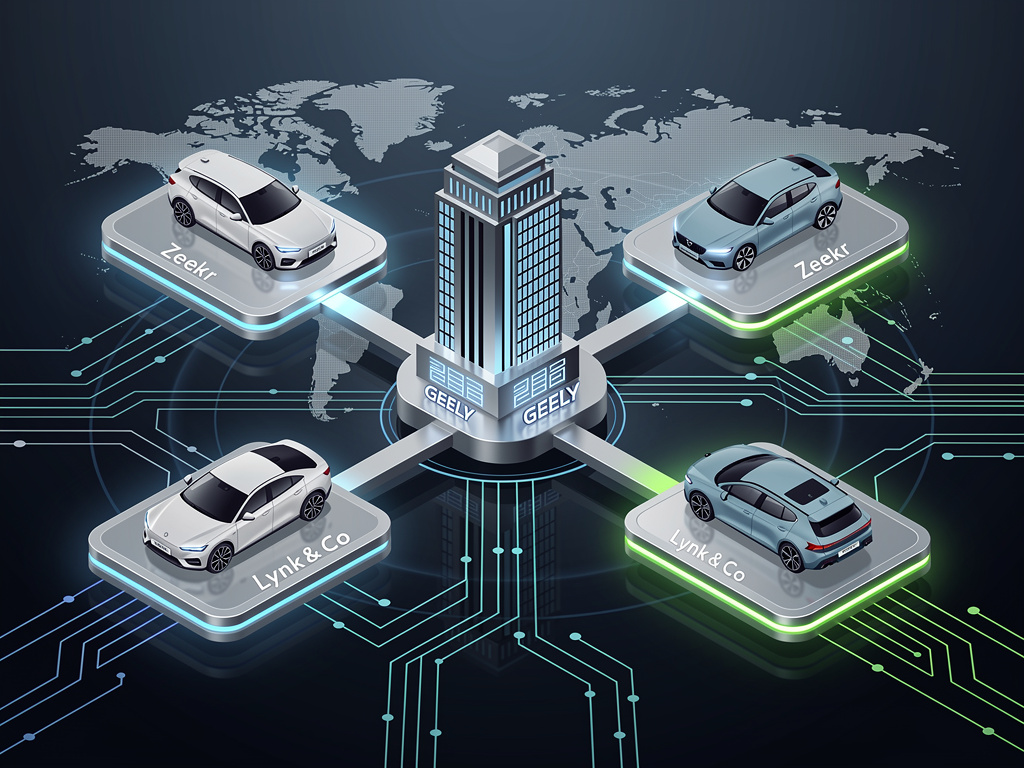
While Western automakers struggle to pivot toward electrification, Chinese automotive conglomerate Geely has quietly assembled one of the industry’s most sophisticated multi-brand portfolios, positioning itself as a formidable competitor in both domestic and international markets. Through strategic acquisitions and homegrown innovation, the company has created a diverse ecosystem of brands—including Zeekr, Lynk & Co, Polestar, and Volvo—each targeting distinct market segments with varying degrees of autonomy and technological sophistication.
The company’s approach represents a fundamental departure from traditional automotive business models, where parent companies typically maintain tight control over subsidiary brands. Instead, Geely has embraced a more decentralized structure, allowing each brand to develop its own identity, design language, and market positioning while leveraging shared technological platforms and manufacturing capabilities. This strategy has enabled rapid innovation and market penetration at a scale that would be difficult for a single brand to achieve independently.
According to The Verge, recent test drives of Geely’s Zeekr and Lynk & Co vehicles in China reveal the tangible results of this strategy. The vehicles demonstrate sophisticated engineering, competitive pricing, and feature sets that often surpass their Western counterparts. Zeekr, in particular, has emerged as Geely’s premium electric vehicle brand, targeting tech-savvy consumers with vehicles that blend performance, luxury, and cutting-edge technology.
The Zeekr Phenomenon: Premium Electric Mobility Redefined
Launched in 2021, Zeekr has rapidly established itself as a serious contender in the premium electric vehicle segment, competing directly with Tesla, BMW, and Mercedes-Benz. The brand’s flagship models, including the Zeekr 001 shooting brake and the Zeekr 009 luxury MPV, showcase the company’s commitment to design innovation and technological excellence. Built on Geely’s proprietary SEA (Sustainable Experience Architecture) platform, these vehicles offer impressive performance specifications, with some models achieving 0-60 mph times under four seconds and ranges exceeding 400 miles on a single charge.
The SEA platform represents a significant technological achievement, providing the flexibility to accommodate vehicles of varying sizes and configurations while maintaining high levels of efficiency and performance. This modular approach allows Geely to rapidly develop and deploy new models across its brand portfolio, significantly reducing time-to-market and development costs. The platform’s 800-volt architecture enables ultra-fast charging capabilities, with some Zeekr models capable of adding 300 miles of range in just 15 minutes.
Beyond raw specifications, Zeekr vehicles distinguish themselves through attention to detail and user experience. Interiors feature premium materials, intuitive infotainment systems, and advanced driver assistance features that rival or exceed those found in vehicles costing significantly more. The brand has also invested heavily in charging infrastructure, deploying thousands of high-power charging stations across China to address range anxiety and improve the ownership experience.
Lynk & Co: Bridging Premium and Mainstream Markets
While Zeekr targets the premium segment, Lynk & Co occupies a strategic middle ground, offering near-premium vehicles at competitive prices. Established in 2016 as a joint venture between Geely and Volvo, the brand has developed a distinctive identity characterized by bold design, connectivity features, and innovative ownership models. The company’s subscription-based approach in European markets represents a departure from traditional automotive retail, allowing customers to access vehicles without the long-term commitment of ownership.
Lynk & Co vehicles share technical DNA with Volvo, utilizing the CMA (Compact Modular Architecture) platform developed jointly by both brands. This relationship provides Lynk & Co with access to Volvo’s safety technology and engineering expertise while maintaining cost competitiveness through shared development and manufacturing resources. Models like the Lynk & Co 01 and 03 offer Volvo-derived safety features and build quality at prices significantly below comparable Volvo models, creating compelling value propositions for consumers.
The brand has also embraced electrification, with plug-in hybrid variants available across its lineup and fully electric models in development. This dual approach allows Lynk & Co to serve markets at different stages of electric vehicle adoption while building the infrastructure and expertise necessary for a full transition to battery-electric vehicles. The strategy reflects Geely’s pragmatic approach to electrification, recognizing that the transition will occur at different rates in different markets.
Global Ambitions and Western Market Challenges
Geely’s multi-brand strategy extends beyond China’s borders, with varying degrees of international presence across its portfolio. Volvo, acquired by Geely in 2010, maintains its Swedish identity and global distribution network, while Polestar positions itself as a global electric performance brand. Lynk & Co has established a presence in several European markets, and Zeekr recently announced plans for international expansion, including entry into European markets.
However, international expansion faces significant challenges, particularly in Western markets where Chinese automotive brands face skepticism regarding quality, brand perception, and geopolitical concerns. Trade tensions, tariffs, and regulatory barriers complicate market entry strategies, while established competitors benefit from decades of brand building and customer loyalty. Geely’s approach of maintaining distinct brand identities and leveraging established names like Volvo helps mitigate some of these challenges, but significant obstacles remain.
The company’s investment in local manufacturing and partnerships represents an attempt to address these concerns. Volvo’s continued operation of Swedish factories and Polestar’s manufacturing presence in both China and the United States demonstrate Geely’s willingness to invest in local production to build trust and navigate trade barriers. This localization strategy, while capital-intensive, may prove essential for long-term success in Western markets where “Made in China” labels can still carry negative connotations in the automotive sector.
Technological Innovation and Platform Sharing
At the core of Geely’s multi-brand success lies its commitment to platform development and technological innovation. The company has invested billions in developing flexible, scalable platforms that can accommodate diverse vehicle types and powertrains. Beyond the SEA and CMA platforms, Geely has developed the SPA2 platform for larger Volvo vehicles and continues to refine its architectures to incorporate advancing battery technology, autonomous driving capabilities, and connectivity features.
This platform approach delivers significant economies of scale, allowing Geely to amortize development costs across multiple brands and models while maintaining brand differentiation through unique styling, features, and market positioning. Components such as battery packs, electric motors, and electronic control units can be shared across brands, reducing costs and improving reliability through higher production volumes. The strategy mirrors approaches used by Volkswagen Group and other large automotive conglomerates but has been executed with remarkable speed and efficiency.
Geely has also invested heavily in battery technology and autonomous driving capabilities, recognizing these as critical differentiators in future automotive competition. The company’s investments in battery manufacturers and technology startups aim to secure supply chains and ensure access to cutting-edge technology. Partnerships with companies like Mobileye and internal development of autonomous driving systems position Geely’s brands to compete as vehicles become increasingly automated and connected.
Market Performance and Financial Implications
The financial performance of Geely’s multi-brand strategy has been mixed, with established brands like Volvo delivering consistent profitability while newer ventures like Zeekr and Polestar continue to require significant investment. Zeekr’s initial public offering in New York in 2024 provided capital for expansion but also exposed the brand to scrutiny from international investors and analysts. The company’s ability to scale production while maintaining quality and managing costs will be critical to achieving profitability.
Sales volumes across Geely’s brands have shown strong growth, particularly in China where the company benefits from home-market advantages and government support for electric vehicle adoption. Zeekr delivered over 118,000 vehicles in 2023, while Lynk & Co’s combined sales across all markets exceeded 220,000 units. These figures, while impressive, remain small compared to established global automakers, highlighting the scale of the challenge Geely faces in building truly global brands.
The company’s willingness to sustain losses in pursuit of market share and technological leadership reflects confidence in long-term prospects for electric vehicles and Chinese automotive brands. This approach mirrors strategies employed by Tesla in its early years and by Chinese technology companies in other sectors. Whether this patience will be rewarded depends on Geely’s ability to convert market share into profitability as the industry matures and competition intensifies.
The Road Ahead: Sustainability and Competition
As global automotive markets undergo their most significant transformation in a century, Geely’s multi-brand strategy positions the company to compete across multiple segments and geographies. The approach provides flexibility to respond to changing market conditions, regulatory requirements, and consumer preferences while spreading risk across diverse brands and markets. However, managing this complexity while maintaining focus and efficiency presents ongoing challenges.
The success of brands like Zeekr and Lynk & Co in China demonstrates the viability of Geely’s approach in supportive markets with receptive consumers. Replicating this success internationally will require overcoming significant barriers related to brand perception, regulatory compliance, and competition from established players who are rapidly developing their own electric vehicle offerings. The next several years will prove critical as Geely’s brands attempt to establish footholds in Western markets while defending their positions in China against intensifying domestic competition.
Ultimately, Geely’s multi-brand strategy represents a bold bet on the future of automotive mobility, one that leverages China’s manufacturing capabilities, technological prowess, and market scale to challenge traditional automotive hierarchies. Whether this approach can overcome geopolitical tensions, trade barriers, and entrenched competition remains to be seen, but the sophistication and ambition of Geely’s efforts ensure the company will remain a significant force in shaping the industry’s evolution. For Western automakers, Geely’s rise serves as both warning and inspiration, demonstrating the speed at which new competitors can emerge when backed by technological innovation, strategic vision, and patient capital.


 WebProNews is an iEntry Publication