
When most automakers talk about the future of electric vehicles, the conversation typically centers on battery chemistry, charging infrastructure, or autonomous driving software. GAC Group, the Guangzhou-based Chinese automaker, has taken a decidedly different path — one that runs through the physics of superconductivity and temperatures cold enough to liquefy nitrogen.
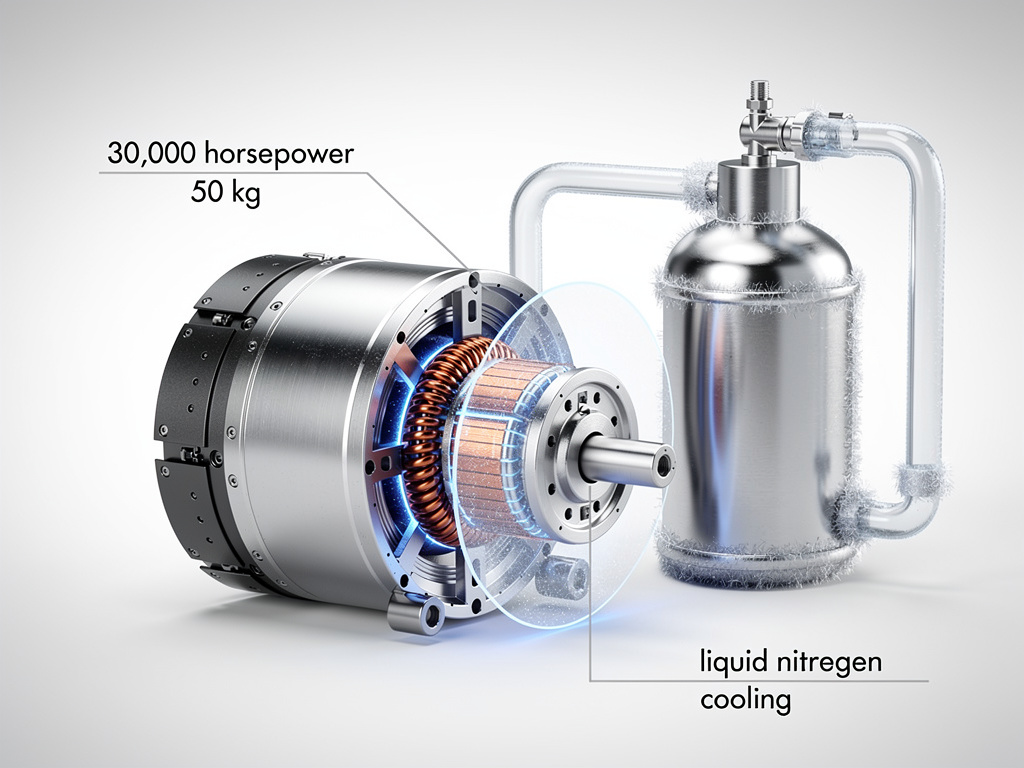
At a recent technology demonstration, GAC unveiled what it calls a high-temperature superconducting electric motor, a piece of hardware that the company claims could fundamentally alter the performance ceiling of electric vehicles. The motor, cooled by liquid nitrogen to approximately minus 196 degrees Celsius (minus 321 degrees Fahrenheit), is designed to eliminate electrical resistance in its wiring, allowing for extraordinary power density in a compact package. According to reporting by MSN, GAC says the motor can produce a staggering 30,000 horsepower equivalent while weighing just 50 kilograms — roughly 110 pounds.
A Motor That Defies Conventional Engineering Limits
To put those numbers in context, a Formula 1 car’s power unit produces roughly 1,000 horsepower. A modern electric hypercar like the Rimac Nevera tops out around 1,914 horsepower. GAC is claiming its superconducting motor could deliver more than 15 times the output of the most powerful production EV drivetrain on the market, at a fraction of the weight. If those figures hold up under real-world conditions — a significant “if” that engineers and analysts are quick to flag — the implications for vehicle design, performance, and efficiency would be profound.
The underlying science is well established. Superconductivity, first discovered in 1911 by Dutch physicist Heike Kamerlingh Onnes, describes a state in which certain materials conduct electricity with zero resistance when cooled below a critical temperature. High-temperature superconductors, discovered in the 1980s, raised the threshold somewhat — though “high temperature” in this context still means well below minus 100 degrees Celsius. The challenge has always been practical application: maintaining those extreme cold temperatures in a reliable, cost-effective, and compact system suitable for everyday use.
GAC’s Cryogenic Architecture and the Engineering Behind It
GAC’s approach involves integrating a liquid nitrogen cooling system directly into the motor assembly. The company displayed the technology at its annual tech day event, showing a motor unit that pairs superconducting coils with a cryogenic management system. As reported by MSN, the automaker emphasized that this is not merely a laboratory concept — GAC intends to move toward vehicle integration, though it has not provided a specific production timeline.
The engineering hurdles are formidable. Liquid nitrogen must be stored, managed, and replenished. The cryogenic system adds complexity, weight (beyond the motor itself), and potential failure points. Thermal management in a vehicle that must operate in ambient temperatures ranging from desert heat to arctic cold presents a design challenge of enormous proportions. And then there is the question of infrastructure: where and how would drivers refill their liquid nitrogen supply? These are not trivial problems, and GAC has not yet provided detailed answers to many of them.
Why Superconductivity Matters Beyond Raw Horsepower
The appeal of superconducting motors extends well beyond headline-grabbing power figures. Because superconducting wires carry current without resistance, they generate virtually no waste heat during operation — a persistent problem in conventional electric motors that requires heavy cooling systems and reduces overall efficiency. A superconducting motor could, in theory, convert a far higher percentage of electrical energy into mechanical output, extending range and reducing battery demands.
Weight savings compound the advantage. Electric vehicles are notoriously heavy, largely because of their battery packs. If a motor can deliver equivalent or superior performance at a fraction of the mass, engineers gain flexibility to either reduce total vehicle weight — improving handling, braking, and tire wear — or reallocate that weight budget to larger batteries or additional features. GAC’s claim of 50 kilograms for a 30,000-horsepower motor, if verified, would represent a power-to-weight ratio that dwarfs anything currently available in the automotive sector.
The Broader Race for Motor Technology Among Chinese EV Makers
GAC’s superconducting motor announcement arrives amid an intensifying technology competition among Chinese automakers, who have been aggressively investing in proprietary drivetrain and battery technologies. BYD, NIO, Xpeng, and others have each staked claims on various aspects of EV innovation, from solid-state batteries to battery-swapping networks. GAC, which sells vehicles under the Aion and Trumpchi brands and also operates joint ventures with Toyota and Honda in China, has positioned its superconducting motor work as a differentiator that could set it apart from domestic and international rivals alike.
The timing is strategic. Chinese EV manufacturers are pushing hard into export markets across Southeast Asia, Europe, the Middle East, and Latin America, even as tariff barriers rise in the United States and European Union. Demonstrating technological leadership — particularly in areas where Western automakers have not yet made comparable announcements — serves both a commercial and a geopolitical purpose. It signals to global consumers, investors, and regulators that Chinese firms are not merely competing on cost, but on fundamental engineering capability.
Skepticism From the Engineering Community Is Warranted
Independent engineers and automotive analysts have urged caution regarding GAC’s claims. Superconducting technology has been explored for decades in applications ranging from MRI machines to particle accelerators and magnetic levitation trains, but its adoption in consumer products has been limited precisely because of the practical difficulties of maintaining cryogenic conditions in uncontrolled environments. A hospital MRI suite is a very different operating context from a passenger car driving through stop-and-go traffic in Phoenix or Beijing in August.
There is also the question of durability and maintenance. Automotive components must endure tens of thousands of hours of operation, vibration, temperature cycling, and exposure to road debris and moisture. How superconducting coils and their associated cryogenic plumbing would hold up under those conditions over a vehicle’s 10- to 15-year lifespan remains an open question. GAC has not published peer-reviewed data or third-party validation of its performance claims, which makes independent assessment difficult at this stage.
What GAC’s Bet Tells Us About the Direction of EV Development
Regardless of whether GAC’s specific motor reaches production vehicles in the near term, the announcement reflects a broader trend in the electric vehicle industry: the recognition that battery technology alone will not determine the winners of the EV transition. Motor design, power electronics, thermal management, and materials science are all areas where significant gains remain possible, and where competitive advantages can be built.
Traditional automakers in Europe, Japan, and the United States have largely focused their R&D spending on battery partnerships, software platforms, and manufacturing scale. Few have publicly pursued superconducting motor technology for automotive applications. If GAC or another Chinese manufacturer can solve the practical challenges and bring even a limited version of this technology to market, it could force a reassessment of R&D priorities across the global industry.
The Road From Laboratory Demonstration to Production Reality
History offers both encouragement and caution. Many technologies that seemed impractical at first demonstration — lithium-ion batteries, regenerative braking, over-the-air software updates — eventually became standard features in production vehicles. Others, like hydrogen fuel cells for passenger cars, have struggled to move beyond niche applications despite decades of investment. Superconducting motors could follow either trajectory.
What is clear is that GAC is willing to invest significant resources in a technology bet that most competitors have not yet made. Whether that bet pays off will depend on engineering execution, cost reduction, infrastructure development, and the willingness of consumers to adopt a vehicle with a liquid nitrogen system under the hood. For now, the automotive world is watching — with a mixture of fascination and healthy skepticism — as a Chinese automaker attempts to bring one of physics’ most elegant phenomena to the highway.


 WebProNews is an iEntry Publication