
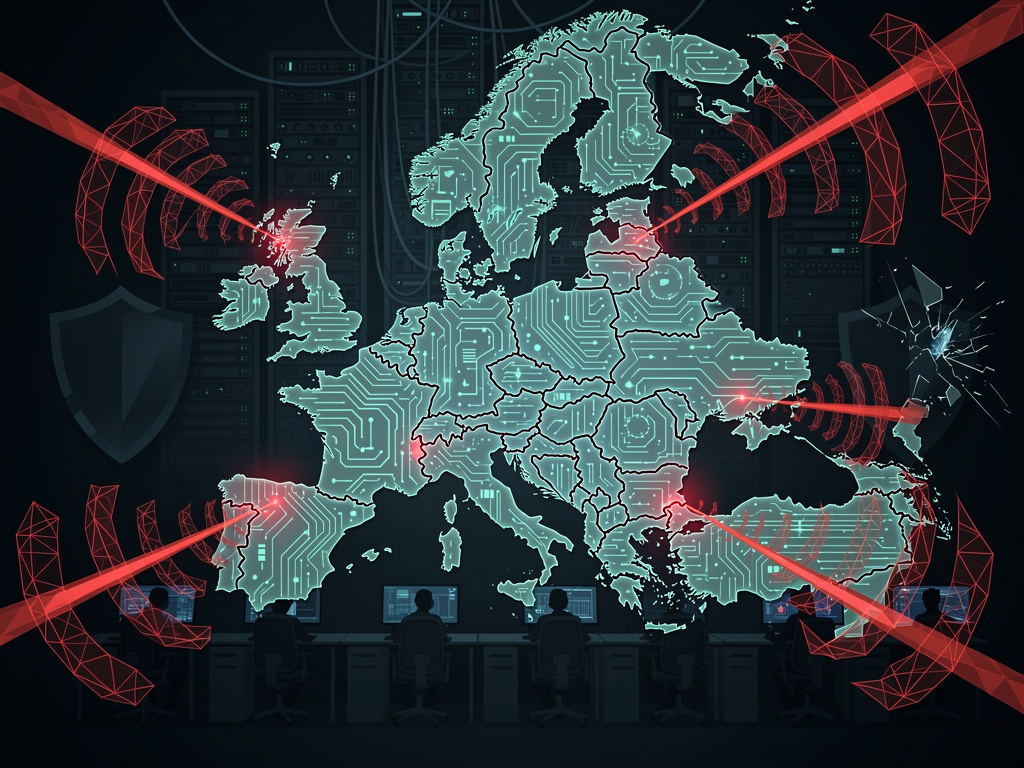
Europe has a hacking problem it can’t seem to fix. Despite years of regulatory buildup, billions in cybersecurity spending, and the creation of dedicated agencies tasked with defending the continent’s digital infrastructure, organized hacking gangs continue to breach government systems, steal citizen data, and leak sensitive records with near impunity. The pattern has become grimly familiar: breach, disclosure, finger-pointing, promises of reform. Then it happens again.
The European Union Agency for Cybersecurity, known as ENISA, has spent the better part of the last two years issuing increasingly urgent warnings about the sophistication and frequency of attacks targeting European institutions and critical infrastructure. Its 2024 Threat Landscape report identified ransomware and data theft as the top threats facing the bloc, with state-affiliated and financially motivated hacking groups blurring the lines between espionage and extortion. The agency noted a sharp increase in attacks against public administration targets — a 68% year-over-year rise that placed government entities among the most frequently hit sectors across the EU.
That trajectory hasn’t reversed. It’s accelerated.
Recent months have brought a cascade of high-profile breaches across European government agencies and private companies alike. Hacking collectives — some operating out of Russia, others with suspected ties to Chinese intelligence services, and still others that appear to be purely criminal enterprises — have demonstrated a persistent ability to penetrate systems that were supposed to be hardened against exactly these kinds of attacks. The scale of data exposed in several incidents has been staggering, with personal records of millions of European citizens surfacing on dark web forums and Telegram channels within days of the intrusions.
ENISA has attributed many of these attacks to organized hacking gangs rather than lone actors. That distinction matters. These aren’t teenagers in basements. They’re structured operations with division of labor, dedicated infrastructure, and in some cases, what cybersecurity researchers describe as corporate-style management hierarchies. Groups like LockBit, BlackCat (also known as ALPHV), and Cl0p have become household names in security circles, each responsible for hundreds of attacks across multiple continents.
The damage extends well beyond the immediate theft of data. When a hacking gang breaches a European health ministry and leaks patient records, the consequences ripple outward for years. Identity theft. Insurance fraud. Erosion of public trust in digital government services that the EU has spent a decade trying to promote. And there’s a geopolitical dimension too — breaches of defense-related agencies or diplomatic communications carry national security implications that are difficult to quantify but impossible to ignore.
According to Reuters, European law enforcement agencies have stepped up their efforts to disrupt these groups, with Europol coordinating several major takedown operations in 2024 and early 2025. Operation Cronos, which targeted LockBit’s infrastructure in February 2024, was hailed as a landmark achievement. Authorities seized servers, froze cryptocurrency accounts, and even identified several alleged operators. But LockBit reconstituted itself within weeks. The group’s administrator, known by the handle “LockBitSupp,” taunted investigators publicly on dark web forums, posting new victim data as proof of the gang’s resilience.
So the takedowns help. But they don’t solve the problem.
Part of the challenge is structural. Europe’s cybersecurity apparatus is fragmented across 27 member states, each with its own national cyber agency, its own legal frameworks, and its own political priorities. ENISA serves a coordinating role but lacks the operational authority to directly defend networks or compel member states to adopt specific security measures. The agency can issue guidance, publish threat assessments, and facilitate information sharing. It cannot force a government ministry in, say, Bulgaria or Greece to patch a known vulnerability in its email servers.
This fragmentation has real consequences. When the NIS2 Directive — the EU’s updated cybersecurity law — took effect in October 2024, it imposed new security requirements on thousands of organizations across the bloc. But implementation has been uneven. Euractiv reported that several member states missed the transposition deadline entirely, leaving gaps in the regulatory framework that attackers can and do exploit. The directive requires organizations in critical sectors to report significant cyber incidents within 24 hours. A worthy goal. But reporting an incident and preventing one are very different things.
The financial toll is enormous. IBM’s Cost of a Data Breach Report pegged the average cost of a data breach in the EU at over €4 million in 2024, with breaches in the healthcare and financial sectors running significantly higher. And those figures capture only direct costs — forensic investigation, notification, legal fees, regulatory fines. The indirect costs, including lost business, reputational damage, and the long-term expense of credit monitoring for affected individuals, can dwarf the initial estimates.
Fines under the General Data Protection Regulation have added another layer of financial pain for breached organizations. The GDPR was designed in part to incentivize better security practices by making data breaches expensive for the organizations that suffer them. And it has, to a degree. But critics argue that the regulation’s enforcement has been inconsistent, with some national data protection authorities far more aggressive than others. Ireland’s Data Protection Commission, which oversees many of the world’s largest tech companies due to their European headquarters being based in Dublin, has faced persistent criticism for slow investigations and what some view as lenient penalties.
Meanwhile, the attackers face almost no consequences.
Most of the hacking gangs responsible for major European breaches operate from jurisdictions that have little interest in cooperating with Western law enforcement. Russia remains the primary safe harbor. The Kremlin has long maintained a tacit arrangement with cybercriminal groups: don’t target Russian organizations or citizens, and you’ll be left alone. Some groups go further, providing intelligence or conducting operations that align with Russian state interests, blurring the line between crime and statecraft in ways that complicate any law enforcement response.
China-linked groups present a different challenge. According to Mandiant, several advanced persistent threat groups associated with Chinese intelligence services have targeted European government agencies, telecommunications providers, and research institutions in recent years. Their objectives tend to be espionage rather than financial gain — stealing diplomatic communications, intellectual property, and strategic intelligence. But the techniques they use often mirror those employed by criminal gangs, including exploitation of zero-day vulnerabilities, supply chain compromises, and sophisticated phishing campaigns.
The supply chain angle deserves particular attention. Some of the most damaging breaches in recent memory haven’t involved direct attacks on the ultimate target at all. Instead, hackers compromised a software vendor or managed service provider, then used that access to reach dozens or even thousands of downstream organizations. The MOVEit Transfer vulnerability exploited by the Cl0p ransomware gang in 2023 affected hundreds of European organizations, including government agencies, universities, and major corporations. The attackers didn’t need to breach each victim individually. They found one weak link and pulled the entire chain.
ENISA has pushed hard for better supply chain security practices, publishing detailed guidance and calling for mandatory security assessments of critical vendors. The Cyber Resilience Act, which the European Parliament approved in 2024, will eventually impose security requirements on manufacturers of products with digital elements — everything from smart home devices to industrial control systems. But the act won’t be fully enforceable until 2027. That’s a long time in cybersecurity.
And the threat is evolving faster than the regulatory response. Artificial intelligence is already changing the game for both attackers and defenders. Hacking gangs have begun using large language models to craft more convincing phishing emails, generate malicious code, and automate reconnaissance of target networks. Europol warned in its 2024 Internet Organised Crime Threat Assessment that AI-enabled attacks would become significantly more common in the coming years, potentially lowering the barrier to entry for less sophisticated criminal groups.
On the defensive side, AI-powered security tools are improving detection capabilities and reducing response times. But the asymmetry remains. Attackers need to find one vulnerability. Defenders need to protect everything.
There’s also the human element. Social engineering — manipulating people into revealing credentials or granting access — remains one of the most effective attack vectors, and no amount of technical hardening can fully eliminate it. A well-crafted phishing email that appears to come from a trusted colleague can bypass even the most sophisticated security controls if the recipient clicks the link and enters their password. Training helps. But people are people. They get tired, distracted, rushed. And attackers know it.
European officials are increasingly candid about the scale of the challenge. Juhan Lepassaar, ENISA’s executive director, has spoken publicly about the need for a “paradigm change” in how Europe approaches cybersecurity, emphasizing that the continent must move from a reactive posture to a proactive one. That means not just responding to breaches after they occur but actively hunting for threats, sharing intelligence across borders in real time, and investing in the workforce needed to defend increasingly complex systems.
The workforce issue is acute. Europe faces a cybersecurity skills shortage estimated at several hundred thousand unfilled positions, according to (ISC)². Universities and training programs are ramping up, but producing qualified cybersecurity professionals takes time. And the private sector, which can offer significantly higher salaries than government agencies, tends to snap up the best talent, leaving public institutions — often the most attractive targets for nation-state hackers — understaffed and outmatched.
Some bright spots exist. The EU’s Joint Cyber Unit concept, designed to coordinate crisis response across member states and EU institutions, has made progress. Cross-border cyber exercises have become more frequent and more realistic. And several member states, notably France, Germany, and the Netherlands, have invested heavily in national cybersecurity capabilities, building offensive and defensive capacities that rank among the best in the world.
But the gap between the best-prepared and least-prepared member states is wide. A hacking gang looking for European government data doesn’t need to breach the French ANSSI or Germany’s BSI. It can target a smaller member state with fewer resources and less mature defenses, then use any interconnected systems or shared databases to reach higher-value targets. The chain is only as strong as its weakest link. And in a union of 27 members with vastly different levels of cyber maturity, weak links aren’t hard to find.
The data leak dimension adds urgency. When stolen data surfaces publicly — on dark web marketplaces, paste sites, or Telegram channels — the damage becomes irreversible. You can patch a vulnerability. You can’t un-leak a database. And the trend toward immediate publication of stolen data, rather than quiet negotiations for ransom, suggests that some groups are more interested in causing maximum disruption than in making money. That’s a troubling shift, because it removes the one point of leverage that victims sometimes had: the hope that paying a ransom would prevent public exposure.
For European citizens whose data has been compromised, the practical implications are deeply personal. Leaked health records, financial information, government identification numbers, and communications can be weaponized for years. And the notification process, while mandated by GDPR, often comes weeks or months after the breach, by which time the data has already been widely circulated.
The question facing Europe isn’t whether more breaches will occur. They will. The question is whether the continent can narrow the gap between the sophistication of its attackers and the effectiveness of its defenses quickly enough to prevent the kind of catastrophic incident — a breach of critical infrastructure that causes physical harm or a massive leak of classified intelligence — that many security professionals consider not just possible but probable.
Right now, the attackers are winning. And they know it.


 WebProNews is an iEntry Publication